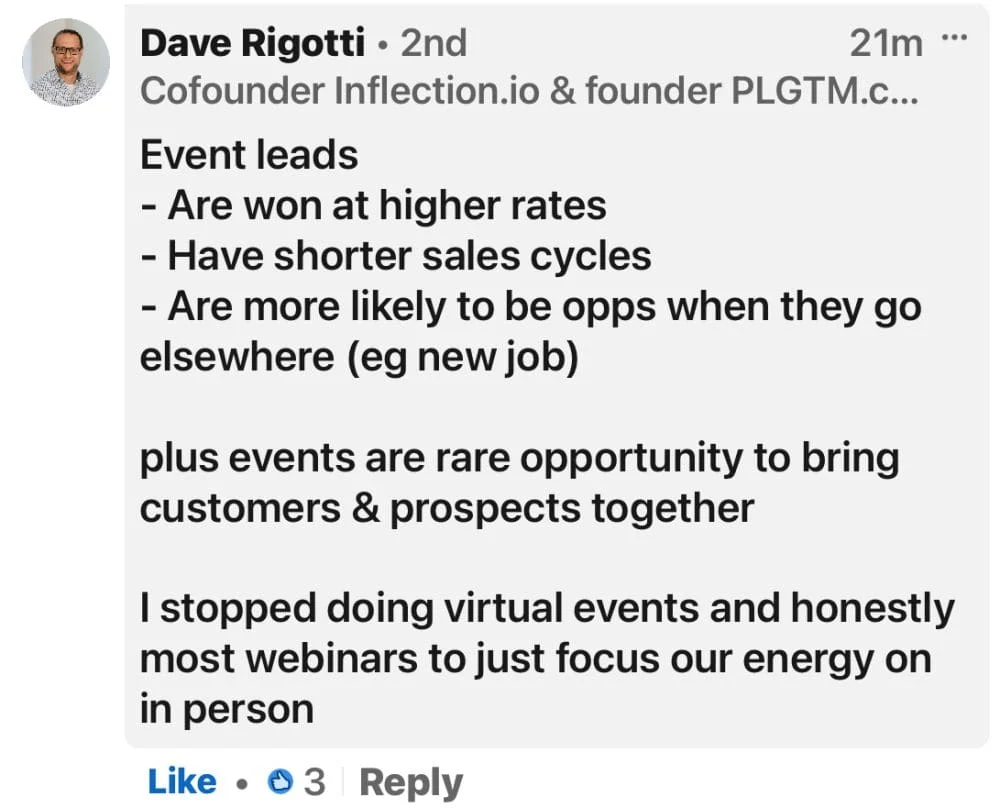
In the hyper-digitized landscape of 2024, where artificial intelligence promises to automate everything from cold-email outreach to complex customer support, one might assume the era of the physical conference is dead. Yet, the data tells a different story. As digital fatigue sets in and traditional channels like SEO and automated cold outreach face diminishing returns, the industry is witnessing a robust pivot back to the "real world."
The proof is in the results. Recently, a CEO shared a striking success story: a $450,000 Total Contract Value (TCV) deal closed, directly sourced from a conversation initiated at the SaaStr Annual conference in September. As Jason Lemkin, founder of SaaStr, aptly noted on social media: "Be where your customers are. Even in the age of AI."
The State of Play: Why Events Are Booming
From the buzzing tech hubs of San Francisco to international centers like London, the appetite for in-person connection is insatiable. Companies like Replit and ElevenLabs are not merely attending events; they are curating them. The logic is simple: in a world where content is commoditized by LLMs, authentic human interaction has become the ultimate premium.
For sales leaders and marketers, the challenge is clear. Traditional Go-To-Market (GTM) playbooks are fracturing. SEO strategies are being disrupted by AI-generated search summaries, and automated email cadences are increasingly viewed as spam. In this environment, the "IRL" (in-real-life) event offers a rare, high-trust environment. Buyers are showing up to the best events not just for the content, but for the clarity that only face-to-face interaction can provide.
A Chronology of the Event Pivot
The journey toward prioritizing events has not been linear. It is a lesson learned through trial and error across different stages of company growth.
The Early Days: The Whale Hunt
In the earliest stages of a startup, the strategy is often one of surgical precision. For many founders, the goal is to land a few "whales"—contracts worth $1 million or more. In this context, the annual industry trade show serves as a high-stakes hunting ground.
One founder recalls attending a single, massive industry conference. The immediate result was modest: only one qualified lead. However, that lead represented a seven-figure annual commitment. The event provided the crucial social capital required to move from a cold prospect to a face-to-face meeting at the client’s headquarters just six weeks later. At this stage, the ROI isn’t measured in volume; it is measured in the acceleration of a single, life-changing contract.
The Scaling Phase: The Feedback Loop
As a company moves into the mid-market, the strategy shifts. It is no longer just about acquisition; it is about retention and product-market fit. Large-scale events like Dreamforce or SHRM become central to the GTM strategy.
A pivotal realization often occurs around the third or fourth year of attending these mega-events. It is not always the net-new leads that provide the most value; it is the existing customers who visit the booth. While some visitors are simply looking for company-branded swag, others arrive with grievances. Treating these moments as a high-touch customer success intervention allows companies to solve issues that, if left unaddressed, would have resulted in churn. By turning detractors into advocates, the event pays for itself in Customer Lifetime Value (CLV).
The Three Pillars of Event Success
To effectively measure the success of an event, leaders must look beyond the vanity metric of "scanned badges." The impact of an event generally falls into three distinct categories:

- Lead Generation (The SDR Goal): This is the classic function. The goal is volume and qualification. When your primary objective is filling the top of the funnel, the booth should be staffed by Sales Development Representatives (SDRs) who are trained to qualify prospects rapidly and transition them into the pipeline.
- Pipeline Acceleration (The AE Goal): Here, the event serves as a "closing room." When prospects are stuck in the pipeline, an in-person meeting can provide the final nudge needed to sign the contract. This requires the presence of experienced Account Executives (AEs) who can navigate complex deal structures and address final objections on the spot.
- Customer Success and Loyalty (The CSM Goal): As noted, the most valuable interactions are often with those who already pay you. Providing a forum for these customers to share feedback with leadership ensures that the product roadmap remains aligned with actual user needs. This requires the presence of Customer Success Managers (CSMs).
Supporting Data: The Case for Field Marketing
Despite the skepticism surrounding the "hard costs" of travel, booth space, and logistics, the industry data is definitive: Field Marketing is the single largest category of marketing spend in the enterprise SaaS sector.
Data suggests that many successful mid-market and enterprise SaaS companies allocate upwards of 40% of their total marketing budget to events and field marketing. This is not a legacy habit; it is a calculated investment.
The Economics of ACV (Annual Contract Value)
The effectiveness of field marketing is heavily correlated with the price point of the product.
- High-ACV ($10k–$1M+): Field marketing is exceptionally potent. When you are selling six-figure deals, the cost of a dinner, a private event, or a booth is negligible compared to the potential revenue. Capturing even one or two high-value clients can justify the entire quarterly event budget.
- Low-ACV ($1k–$5k): The math is much harder. If you are selling high-volume, low-cost SaaS, the "cost per lead" at an event often exceeds the total value of the customer. For these businesses, digital channels remain the more logical path.
Alternatives: What Are You Missing?
When leaders question the necessity of events, they often point to two primary alternatives:
- Direct Response/Paid Ads (AdWords/LinkedIn): These are scalable and measurable, but they suffer from high competition and rising Cost-Per-Click (CPC) rates. They rarely build the deep emotional connection of a face-to-face meeting.
- Content/Inbound Marketing: While vital for long-term brand authority, it is a slow-burn strategy. In the age of AI-curated search, organic traffic is becoming increasingly volatile.
Field marketing occupies the middle ground. It is more expensive and time-consuming than a blog post, but it provides a "moat" that is difficult for competitors to replicate.
Implications for the Future of GTM
The "Age of AI" has not rendered human connection obsolete; it has made it more valuable. When every competitor can use an AI agent to send 10,000 personalized emails, the "personalization" becomes noise.
The companies that will win in the next five years are those that master the hybrid approach. They will use AI to handle the tedious data-crunching and lead scoring, but they will use the budget saved by that efficiency to double down on the high-touch, high-impact world of events.
The "SaaStr Annual" Philosophy
The success of events like the SaaStr Annual—which continues to grow in size and influence—serves as a bellwether for the industry. It proves that despite the ubiquity of video conferencing, there is a fundamental human need to gather, debate, and shake hands.
If you are a sales leader or founder, the takeaway is clear: stop treating events as a line item to be cut. Start treating them as a strategic channel for relationship management. If you can identify the primary goal of your event participation—whether it is generating new leads, closing stalled deals, or solidifying customer relationships—and staff your team accordingly, the ROI will follow.
In a world of synthetic content and algorithmic sales, the most effective tool in your arsenal remains the one that has existed for centuries: the ability to stand in front of your customer, listen to their problems, and provide a solution in person. It is tiring, it is expensive, and it is entirely worth it.