In the rapidly evolving landscape of search engine optimization (SEO), the traditional playbooks that once guaranteed online visibility are undergoing a profound transformation. For nearly two decades, digital marketing treated link building largely as a numbers game—a popularity contest where the sheer volume of backlinks often dictated search engine results page (SERP) rankings.
Today, that paradigm is obsolete. The rise of Large Language Models (LLMs), Google’s AI Overviews, and increasingly sophisticated search algorithms have shifted the benchmark of SEO success. Chasing superficial metrics like raw search traffic, Domain Authority (DA) spikes, and keyword rankings no longer guarantees business growth. Brands can occupy the top of the SERP and still fail to convert visitors.
To survive this transition, search marketers are embracing a new philosophy: link building for legitimacy. This approach prioritizes earning authoritative backlinks, editorial citations, and high-quality brand mentions that signal trust, expertise, and credibility to both human searchers and AI systems.
Chronology: The Evolution of Search and Link Building
To understand why trust has become the ultimate currency of search, it is necessary to examine how search engines and user behaviors have evolved over the past decade.
+--------------------------+     +--------------------------+     +--------------------------+
|      The Volume Era      |     |    The Quality & E-A-T    |     |      The Generative AI    |
|       (Pre-2018)         | --> |     Era (2018-2023)      | --> |     Era (2024-Present)   |
| Quantity-driven links,   |     | Google cracks down on    |     | LLMs, RAG, and AI        |
| keyword stuffing, and    |     | link spam; introduces    |     | Overviews prioritize     |
| PBNs dominate SERPs.     |     | E-E-A-T frameworks.      |     | original proprietary data.|
+--------------------------+     +--------------------------+     +--------------------------+
1. The Volume Era (Pre-2018)
In the early days of SEO, search engines relied heavily on basic link-counting algorithms. Websites frequently "hacked" the system using high-volume, low-quality backlink strategies, including private blog networks (PBNs), directory submissions, and paid link schemes. While these tactics succeeded in temporarily inflating rankings, they compromised user experience by promoting low-quality content.
2. The Quality and E-A-T Era (2018–2023)
Recognizing the degradation of search quality, Google initiated a series of algorithmic adjustments. In 2018, the search giant updated its Search Quality Rater Guidelines to emphasize E-A-T (Expertise, Authoritativeness, and Trustworthiness).
To further refine this system, Google introduced the December 2022 Link Spam Update, leveraging its AI-based prevention system, SpamBrain, to neutralize manipulative outbound links. In the same month, Google added a second "E" to its quality framework: Experience. This established the current E-E-A-T framework, forcing marketers to prove firsthand experience and authentic sourcing.
3. The Generative AI Era (2024–Present)
The integration of generative AI into search engines—exemplified by Google’s AI Overviews and standalone conversational engines like OpenAI’s SearchGPT—has permanently altered user behavior. Rather than browsing a list of ten blue links, users increasingly receive synthesized answers directly on the search page.
These AI systems utilize Retrieval-Augmented Generation (RAG) to pull real-time data from the web. To avoid generating "hallucinations" or spreading misinformation, RAG systems are programmed to prioritize highly credible, primary sources of information. This has widened the gap between high-authority, legitimate brands and sites relying on synthesized or aggregated content.
Supporting Data: The Changing Dynamics of Search and Media
Recent empirical research highlights how both search behaviors and media relations are adapting to this AI-driven environment.
The Generative AI Shift Among Younger Audiences
A 2025 consumer study conducted by digital agency Resolve revealed that 61% of Gen Z users now utilize generative AI search tools in lieu of traditional Google search. This demographic shift means that visibility is no longer just about ranking #1 on a traditional SERP; it is about being cited as a trusted source in the conversational outputs of LLMs.
The Journalist-PR Disconnect
Because editorial backlinks from major publications are highly valued by search algorithms, digital PR has become a core SEO tactic. However, earning these links requires navigating a highly competitive media environment.

According to the 2026 MuckRack State of Journalism study:
- 90% of journalists report that at least some of their stories originate from PR pitches.
- Despite this reliance, 54% of journalists seldom or never respond to the pitches they receive.
- The primary reason cited for this low response rate is a lack of relevance. Journalists are inundated with mass-emailed, off-topic pitches that do not align with their specific beats or audience interests.
Case Study: EZ Contacts
The real-world efficacy of transition-to-legitimacy strategies is demonstrated by a recent data-driven campaign for eyewear retailer EZ Contacts. By pivoting away from standard link acquisition toward a credibility-focused digital PR campaign, the brand secured more than 1,000 high-tier editorial placements in major publications, including the New York Post and Yahoo.
As a direct consequence of these highly authoritative editorial citations, the brand’s visibility and citation frequency within ChatGPT and Google’s AI Overviews doubled, demonstrating that modern AI search engines actively reward real-world brand legitimacy.
Technical Mechanics: How Search Engines and LLMs Process Trust
To build an effective off-page SEO strategy, it is crucial to understand how modern search engines and LLMs evaluate trust mathematically and algorithmically.
                         [ External Web Sources ]
                                    |
                                    v
                       [ RAG Retrieval Engine ]
                                    |
          +-------------------------+-------------------------+
          |                                                   |
          v                                                   v
[ Entity Association ]                                [ Source Authority Filtering ]
Matches unlinked brand mentions                       Filters out low-tier sites to prevent
with core industry concepts.                          AI hallucinations and spam.
          |                                                   |
          +-------------------------+-------------------------+
                                    |
                                    v
                        [ AI Search Synthesizer ]
                     Generates cited response for user.
Retrieval-Augmented Generation (RAG) and Citation Filtering
LLMs do not merely generate text from static training data; they actively query the live web using RAG. When a user inputs a query, the RAG system retrieves a pool of relevant documents. To ensure accuracy, the system filters these documents based on trust metrics.
If a website publishes original, proprietary data, it is far more likely to be selected as a citation. Conversely, if a site merely aggregates or rephrases information found elsewhere, the RAG engine will default to the original, higher-authority source to mitigate the risk of error.

Entity Association and Unlinked Mentions
Google’s knowledge graph has evolved to understand the relationship between "entities" (brands, people, places, and concepts) without relying solely on hyperlinks.
When a highly credible publication mentions a brand name in connection with a specific topic, search engines register this as an unlinked brand mention. While a hyperlink is still the gold standard for page rank transmission, these unlinked mentions heavily influence Google’s E-E-A-T evaluation by building contextual topical authority.
Tactical Execution: Implementing a Legitimacy-Focused Strategy
Transitioning to a legitimacy-focused SEO model requires a multi-faceted approach combining high-value content creation, targeted digital PR, and relationship-driven media outreach.
1. Developing "Linkable Assets"
Modern linkable assets must offer unique, non-replicable value. Standard "how-to" articles and generic lists are no longer sufficient to earn editorial links. High-performing formats include:
- Proprietary Data and Industry Surveys: Conducting original research or analyzing internal datasets to uncover trends that have not been documented elsewhere.
- Interactive Tools and Calculators: Creating free, functional digital tools that solve specific user problems (e.g., financial calculators, industry-specific diagnostic tools).
- Expert Interviews and Original Insights: Publishing deep-dive conversations with recognized industry authorities to provide unique qualitative perspectives.
- Custom Graphics and Data Visualizations: Packaging complex data into easily digestible, embeddable infographics that external writers can use in their own articles.
2. Executing Modern Digital PR
Digital PR serves as the bridge between traditional brand building and off-page SEO. Unlike old-school link building, which often relied on directory submissions or paid guest posting, digital PR focuses on earning coverage from legitimate journalists. Key tactics include:
+------------------+------------------------------------------------------------------+
| Tactic           | Operational Execution                                            |
+------------------+------------------------------------------------------------------+
| Data Studies     | Commissioning demographic surveys to uncover surprising trends.  |
+------------------+------------------------------------------------------------------+
| Newsjacking      | Monitoring breaking news and offering expert commentary within   |
|                  | tight editorial windows.                                         |
+------------------+------------------------------------------------------------------+
| Creative Content | Designing highly visual, narrative-driven digital campaigns      |
|                  | that align with cultural conversations.                          |
+------------------+------------------------------------------------------------------+
3. Cultivating Relationship-Driven Journalist Outreach
To overcome the high rejection rates highlighted in the MuckRack study, outreach must shift from mass-scale automation to highly personalized, mutually beneficial exchanges.
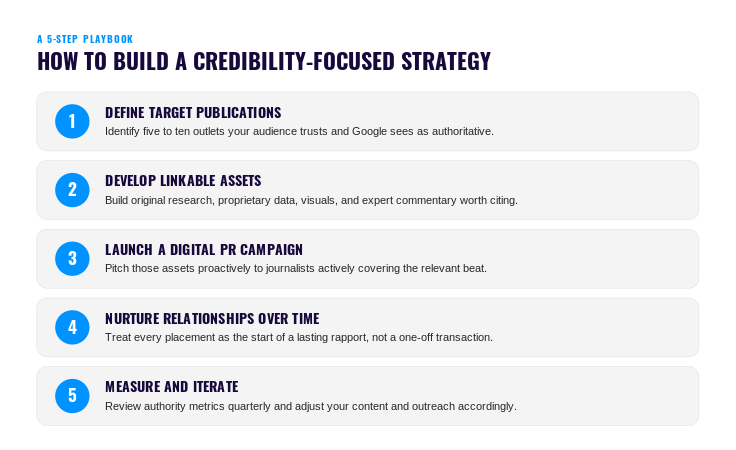
- Relevance Filtering: Researching a journalist’s historical coverage before pitching to ensure the content directly aligns with their active beat.
- Value-First Pitching: Framing the pitch around how the data or asset benefits the journalist’s readers, rather than focusing on the brand’s desire for a backlink.
- Long-Term Nurturing: Providing high-quality information consistently, even when a pitch does not result in an immediate article, to establish the brand as a reliable source for future stories.
Implications: The Future of Search and the Cost of Inaction
The shift toward legitimacy-focused search optimization carries significant implications for brands, agencies, and the broader digital marketing industry.
The High Risk of Outdated Tactics
Continuing to utilize outdated link-building methods—such as buying cheap backlinks, participating in reciprocal link schemes, or leveraging low-quality PBNs—poses severe risks.
Google’s spam detection algorithms are increasingly adept at identifying unnatural link patterns. At best, manipulative links are simply ignored, wasting marketing capital. At worst, they trigger manual penalties or core algorithm adjustments that can severely diminish a website’s organic visibility overnight.
Measuring What Matters
Because trust and authority are abstract concepts, measuring the success of a legitimacy-focused campaign requires looking beyond traditional metrics like keyword rankings and raw traffic volume. Marketers must track:
- Brand Search Volume: Increases in users searching specifically for the brand name, indicating growing real-world awareness.
- Referral Traffic Quality: High-value traffic arriving from trusted editorial placements, which typically yields superior conversion rates.
- Share of Voice (SoV): The brand’s visibility in industry-specific conversations relative to its competitors.
- AI Engine Citation Share: The frequency with which the brand is cited as a source in LLM-generated answers and Google AI Overviews.
       [ Traditional Metrics ]                     [ Legitimacy Metrics ]
    - Domain Authority (DA)                     - Brand Search Volume
    - Raw Backlink Count                        - Referral Traffic Quality
    - Keyword Rankings                          - Share of Voice (SoV)
    - Total Traffic Volume                      - AI Engine Citation Share
Conclusion: Building Durable Authority
In an era dominated by generative AI and continuous search algorithm updates, short-term traffic spikes are increasingly volatile. Algorithms can change overnight, but deep-seated brand authority and editorial trust cannot be easily erased.
By shifting focus away from manipulative, volume-based link acquisition and investing in original research, digital PR, and authentic media relationships, brands can build a durable search presence. This approach not only survives algorithmic volatility but actively capitalizes on the generative future of search.