By WP Tavern News Desk
Special Report / Podcast Analysis
Main Facts
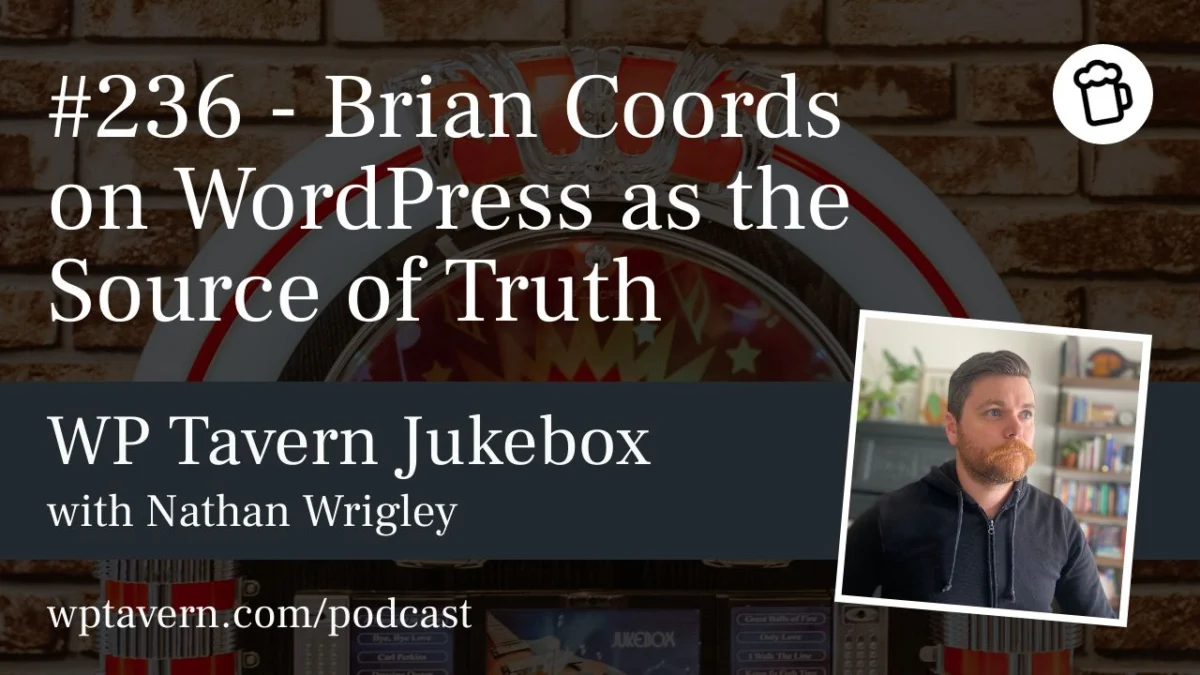
In a recent episode of the Jukebox Podcast from WP Tavern, host Nathan Wrigley sat down with Brian Coords, Developer Advocate at WooCommerce and former agency veteran. The central focus of their conversation was Coords’ well-received WordCamp US presentation, titled "The Site is the Source of Truth: Block Themes, AI and Agency Workflows."
The discussion navigated a volatile intersection of modern web development: the rise of generative AI, the maturation of WordPress block themes, and the ongoing viability of agency business models.
Key takeaways from the discussion include:
- The "Source of Truth" Concept: Coords argues that WordPress sites—particularly when reinforced with structured block themes, approved patterns, and design guidelines—should serve as the central repository for brand and design logic, guiding both human developers and generative AI agents.
- AI Constraints: While AI excels at moving from "zero to one," it struggles with long-lived websites containing legacy content, deep integrations, and complex user permissions unless strictly tethered to a structured framework.
- WooCommerce Evolution: WooCommerce is actively working to incorporate core features—such as enhanced variation image galleries and expanded block style controls—directly into its forthcoming block themes, reducing plugin sprawl and dependency vulnerabilities.
- The Pendulum Swing on AI: Both Wrigley and Coords observed a collective industry shift away from blind automation toward a revaluation of human craftsmanship, particularly in writing, design, and strategic content creation.
Chronology
From the Classroom to Code
Brian Coords’ professional trajectory is unconventional. Before spending a decade working within the freelance and agency WordPress ecosystem, Coords worked as a high school teacher. This foundational pedagogical background heavily informed his transition into Developer Relations (DevRel) at WooCommerce.
Recognizing that DevRel is fundamentally about teaching, writing, and explaining complex technical concepts to a broader community, Coords spent nearly two years effectively performing the role pro bono before formally landing his position at Automattic/WooCommerce.
WordCamp US and the Genesis of the Talk
Months before WordCamp US, Coords submitted multiple talk proposals. The one selected by organizers—focused on block themes, AI, and agency workflows—forced him to synthesize his decade of agency experience with his current role at WooCommerce.
"You can only talk about WooCommerce so much at a WordCamp," Coords explained. Drawing on his background of building custom solutions for clients, he sought to address a growing existential panic in the agency space: the temptation to throw WordPress out entirely in favor of static site generators and chaotic generative AI workflows.
Supporting Data & Ecosystem Analysis
The web development ecosystem is undergoing a philosophical schism. Agencies are racing to adopt "vibe coding" and AI agents to spin up web pages in seconds. However, this speed often comes at the cost of brand consistency, structural integrity, and long-term maintainability.
The Problem with Unchecked AI
When generative AI builds landing pages or blog posts entirely from scratch without constraints, the output varies wildly. Tone shifts, color palettes drift, and structural designs fracture. Coords highlighted that AI becomes vastly more useful when it works from constrained environments—such as a WordPress pattern library carefully constructed by a human designer.
Rather than letting AI invent new code on every run, centralizing approved patterns, design tokens, and layout structures directly within the WordPress site provides the necessary guardrails.
Plugin Bloat vs. Core Integration
The proliferation of WooCommerce extensions has long been a double-edged sword. While the marketplace empowers developers, store owners frequently juggle 30 to 50 plugins just to run a functional storefront. This introduces severe maintenance and compatibility overhead during updates.
According to Coords, the development team at WooCommerce is actively targeting this issue. By migrating heavily utilized utility features (such as variation image galleries) and expanding block-based styling controls directly into Core, WooCommerce aims to reduce plugin dependency. Coords notes that approximately 90% of basic styling and layout requirements can now be achieved natively within the block editor, making sites leaner and more resilient.
Official Responses and Perspectives
The "Content Guidelines" Feature and GitHub Workflows
During the podcast, the conversation touched upon experimental Core features, such as the proposed "Content Guidelines" project. Designed to establish rules, constraints, and style frameworks within WordPress, the feature was temporarily pulled before shipping to allow for real-world testing.
While enterprise publishers (such as news publications with dozens of authors) stand to benefit immensely from centralized editorial guidelines, Coords noted that many modern agencies prefer managing their constraints and instructions within GitHub repositories (utilizing agent files and customized developer skills).
Regardless of whether the rules live inside the WordPress database or a Git repository, the underlying principle remains identical: centralization prevents chaos.
The Threat to Small Plugin Developers
As AI makes it trivial to generate basic utility plugins with minimal lines of code, the market for "set-it-and-forget-it" micro-plugins faces an existential squeeze. Coords acknowledged this reality, noting that the floor for plugin development is rising.
However, he emphasized that complex integrations, specialized payment gateways, and intricate e-commerce logic remain firmly outside the scope of casual AI generation. Furthermore, WooCommerce’s decision to absorb certain features into Core primarily impacts Automattic’s own proprietary add-ons rather than targeting independent community developers who actively maintain robust extension businesses.
Implications
E-Commerce as a Structural Moat
While static brochure sites face intense disruption from alternative site builders and AI-driven static generation, the e-commerce sector occupies a much safer strategic position.
Store owners managing live revenues, complex inventories, multiple shipping zones, and secure payment processing require a robust database, reliable security, and continuous updates. Coords and Wrigley agreed that the operational realities of running an active online store create a formidable moat for WordPress and WooCommerce.
The Psychological Appeal of the Dashboard
An unexpected insight from the discussion centered on the human psychology of web management. Despite the prevalence of conversational AI interfaces, business owners still desire a dedicated, familiar environment to log into.
Viewing a centralized dashboard to track daily analytics, revenue metrics, and order histories provides a sense of operational ownership and security that ephemeral AI prompt outputs simply cannot replicate. As Coords noted, merchants do not want to "vibe code" their financial data on the fly.
The Artisan Renaissance in Writing and Design
As the internet becomes increasingly saturated with AI-generated text and media, both speakers predicted a strong market correction over the coming decade. Just as physical craftsmanship gained a premium in the wake of mass industrialization, human-authored content, transparent creative processes, and provably authentic design are projected to become distinct marketing advantages.
WordPress agencies and content creators who anchor their workflows in human strategy while deploying AI strictly as an efficiency tool will likely thrive in the post-hype era.
To listen to the full conversation or access related links, visit the WP Tavern Jukebox Podcast.