As the dust settles on SaaStr AI 2026, the data from the event floor provides more than just a summary of attendee foot traffic—it offers a definitive pulse check on the current state of the B2B software industry. With over 10,000 founders, operators, and enterprise buyers navigating the exhibition floor, the sponsor engagement leaderboard serves as a high-fidelity signal of where capital, interest, and operational focus are migrating in an AI-first economy.
The results are categorical. When analyzed by product function, the top 15 sponsors coalesce around three distinct pillars: Building, Selling, and Running. While the headlines are dominated by the AI gold rush, the data suggests a nuanced reality: the modern B2B buyer is no longer just looking for "AI" as a feature—they are looking for AI that enables them to own their infrastructure, accelerate their revenue, and maintain operational stability.
Chronology of Engagement: The Race for the Modern Stack
The event was defined by a clear shift in buyer behavior. In previous years, booths focused on broad-spectrum solutions; in 2026, the engagement was surgical. Early in the conference, the "Building" narrative took center stage, with Replit commanding an early, insurmountable lead in lead generation. By mid-conference, the "Selling" category began to dominate the total volume of interactions, as revenue teams sought to replace legacy CRM workflows with AI-native agents.
By the final afternoon, the "Running" category—the bedrock of the SaaS stack—asserted its relevance. Companies providing foundational infrastructure like payroll and banking demonstrated that even in an era of autonomous agents, the administrative reality of running a corporation remains a top-tier priority.
The Data: Where the Attention Went
The top 15 list reveals a stark reality: nearly half of the high-engagement winners are dedicated to the "Selling" function.
The Dominance of Sales Tech
The most significant trend of SaaStr AI 2026 was the prioritization of distribution over production. Seven of the top 15 companies—Lightfield, Auraseli, Salesforce, Vivun, Artisan, Reevo, and Glyphic—are focused on the revenue cycle.
For years, the industry’s greatest challenge was the "build" hurdle. With the advent of "vibe coding" and advanced LLM-based development environments, building products has become exponentially easier. Consequently, the bottleneck has shifted entirely to distribution. Founders are no longer asking "Can we build this?" but rather "How do we get this into the hands of the market?"
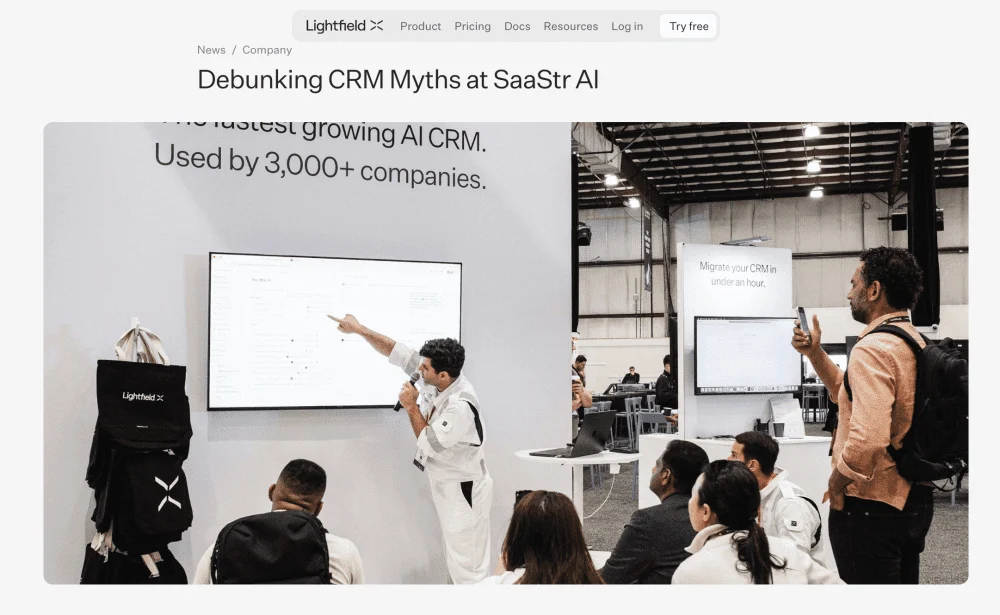
This is why companies like Vivun, which specializes in AI-powered sales agents, saw massive engagement. It is a category that barely existed in a meaningful, scaled sense two years ago. The fact that Lightfield, an AI-native CRM, outpaced industry titan Salesforce by 35 leads is a watershed moment. It signifies that buyers are no longer content with legacy systems that merely record data; they are migrating toward platforms that act on data.
The Rise of the "Builder" Class
Replit’s performance as the #1 sponsor—pulling 1,423 leads and beating the runner-up by a margin of 361—cannot be overstated. This lead count is a direct reflection of the democratization of software development.
In 2026, "vibe coding" is no longer a hobbyist’s curiosity; it is a core business strategy. Teams that once lacked an engineering department are now building their own internal tools, custom-facing applications, and automated agent workflows. Replit is the primary beneficiary of this shift. Buyers are increasingly choosing to "build it themselves" using these low-code/no-code environments rather than purchasing off-the-shelf software that may not fit their specific agent-driven needs.
Furthermore, OpenRouter’s placement at #6 with 915 leads provides a vital insight into the "Building" category. It suggests that infrastructure management—specifically model routing, latency, and token cost management—has moved from the desk of the lead engineer to the desk of the CEO. As AI features move into production, these metrics now dictate the P&L, making them high-priority boardroom conversations.
Supporting Insights: The Stability of Operations
While AI dominated the conversation, the "Running" category proved that the "back office" is not being replaced by agents—it is being integrated. Companies such as Rippling, which commanded 921 leads, prove that the fundamental needs of a company (payroll, compliance, banking) remain constant.
The presence of these firms in the top 15 serves as a crucial reminder: even if a company is entirely "AI-native" in its product offering, it still operates as a traditional entity on the backend. Founders are interested in the new AI stack, but they remain deeply invested in the reliability of the operational tools that keep their companies legally and financially sound.
Official Observations and Ecosystem Plays
A notable standout was Google for Startups, which secured the #7 spot. This performance highlights the importance of the "ecosystem play." In a fragmented market saturated with new tools, founders are looking for shortcuts. Whether it is cloud credits, mentorship programs, or a gateway into a larger distribution channel, ecosystem access is being treated as a high-value asset.
When asked about the engagement levels, industry analysts noted that the "buyer’s intent" has shifted significantly. In 2024, the questions were about "What does this AI do?" By 2026, the questions are "How does this integrate into my existing stack to lower my cost-to-acquire and increase my speed-to-market?"
Implications for the Future of B2B
The implications of the 2026 leaderboard are clear for any company selling into the B2B space:
- The "AI-Native" Requirement: The budget is no longer moving toward "AI-enhanced" legacy products. It is moving toward AI-native solutions. If your product is a legacy tool with an "AI wrapper," the data suggests you will struggle to compete with players who built their architecture from the ground up to handle agents, latency, and autonomous workflows.
- Infrastructure as a Priority: If you are not in the business of "Selling" or "Running," you must be in the business of "Building." Companies that empower their customers to create their own solutions—like Replit and OpenRouter—are winning because they are enabling the customer to become a creator.
- The Distribution Bottleneck: With product development costs dropping due to AI, the market is becoming flooded with new SaaS offerings. This makes sales-tech and revenue-enabling software more critical than ever. The companies that solve the problem of "distribution" will command the highest premiums in the coming years.
Conclusion: Preparing for 2027
As we look toward SaaStr AI 2027, scheduled for May 11-12 in the SF Bay, the trajectory is set. The "vibe coding" era has transformed the buyer from a passive consumer of software into an active builder of their own technological ecosystem.
The successful companies of the next 12 months will be those that lean into this shift—arming the founder with the tools to build, the agility to sell, and the operational stability to scale. The leaderboard does not lie: the budget is moving, and the winners are those who have stopped trying to sell the "future of AI" and started selling the "reality of the modern stack."
For those in the B2B sector, the message from the 2026 floor is simple: stop chasing the hype and start solving the operational, distribution, and build-centric bottlenecks that define the modern founder’s day-to-day life. The companies that do this will not just survive; they will lead the next cycle.