Microsoft Expands Bing Webmaster Tools with Advanced AI Performance Reports: A New Era for Semantic SEO Tracking
In an era where generative artificial intelligence is rapidly reshaping how users discover information online, search engines are under immense pressure to provide publishers with clearer insights into how their content is being utilized by AI systems. Responding to this demand, Microsoft has officially launched a preview of its highly anticipated, upgraded AI performance report within Bing Webmaster Tools.
First teased in late April, this comprehensive update introduces four sophisticated analytical dimensions: Intents, Topics, Citation Share, and Compare. The rollout marks a significant milestone in search analytics, offering webmasters, SEO professionals, and content publishers unprecedented visibility into the black box of Retrieval-Augmented Generation (RAG) and AI-driven search experiences.
Main Facts of the Rollout
The upgraded Bing Webmaster Tools AI performance report is designed to help publishers move beyond surface-level metrics. Rather than simply showing which keywords triggered a citation in Bing’s AI-powered search experiences (such as Bing Copilot), the new suite of features attempts to explain the underlying context, thematic relevance, and competitive standing of a website’s content within generative answers.
Breaking Down the Four New Analytics Pillars
The update is built around four primary features, each targeting a specific gap in traditional search analytics:
Intents: This feature classifies the underlying "grounding queries" (the search queries Bing’s AI executes behind the scenes to gather facts) into distinct behavioral categories. These include Informational, Commercial, Navigational, Learn and Solve, Research, Creation, and Local. By categorizing queries this way, publishers can understand the user’s psychological state and objective when the AI decided to reference their site.
Topics: Modern AI models do not process search queries as isolated strings of keywords; instead, they analyze concepts, entities, and semantic relationships. The Topics feature groups related grounding queries into broader thematic clusters. For example, queries like "solar panels," "residential solar installation," and "solar energy efficiency" are automatically consolidated under the macro-topic "Solar Energy."
Citation Share: This metric introduces a competitive benchmark to AI search. It calculates the percentage of citations a specific website receives out of the total citations displayed for a given grounding query. If an AI response cites three sources and a publisher’s site is one of them, Citation Share helps quantify that footprint relative to competitors.
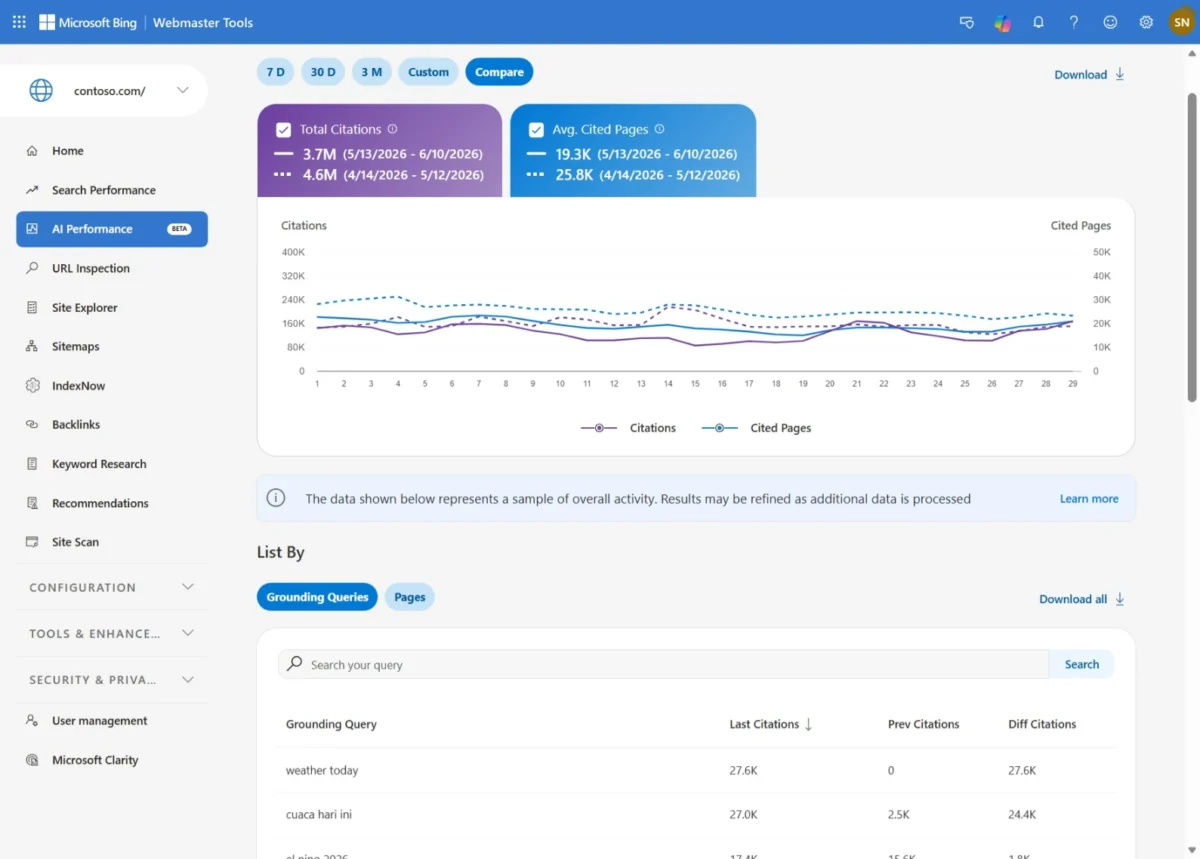
Compare: Given the dynamic nature of generative AI models, which are constantly updated and retrained, search visibility can fluctuate wildly. The Compare tool allows webmasters to overlay historical data directly onto current reports, facilitating a side-by-side analysis of how AI visibility, citation patterns, and thematic authority evolve over time.
Chronology of the AI Search Analytics Race
The release of these tools represents the latest volley in an ongoing competitive battle between Microsoft and Google to define the standards of "Generative Engine Optimization" (GEO) analytics.
[Feb 2026] Bing launches initial AI Performance Report
       │
[Apr 2026] Microsoft demos advanced metrics (Intents, Topics, Citations, Compare)
       │
[Jun 2026] Google releases Search Console AI reports (reactive/forced)
       │
[Jun 2026] Microsoft officially rolls out the advanced preview to users
February 2026: Microsoft takes the first mover advantage by officially rolling out its baseline AI performance report in Bing Webmaster Tools. This initial version provided basic data on how often a site was cited in AI-generated answers, giving publishers their first native look at AI referral traffic.
Late April 2026: Microsoft hosts a live demonstration showcasing advanced reporting capabilities. The preview teases a future where publishers can analyze semantic intent, thematic groupings, and competitive share of voice.
June 2026 (Early): Under pressure from the publishing and SEO communities, Google rolls out its own AI reporting features within Google Search Console. Industry analysts note that Google’s release feels somewhat reactive and "forced," lacking the depth of Microsoft’s planned updates and focusing heavily on options for publishers to block their content from being used in AI training rather than providing deep performance insights.
June 2026 (Late): Microsoft officially begins rolling out the preview of its advanced AI performance report to Bing Webmaster Tools users globally, delivering on the promises made during their April demonstration.
Supporting Data and Technical Architecture
To understand the value of these new metrics, it is necessary to examine the technical architecture of modern search engines. Traditional search relies on index matching—matching the keywords in a user’s query to the keywords on a webpage. Generative search, however, relies on Retrieval-Augmented Generation (RAG).
The Concept of Grounding Queries
When a user inputs a complex prompt into Bing Copilot, the AI does not simply search its static training data. Doing so would lead to hallucinations and outdated information. Instead, the system translates the user’s prompt into one or more "grounding queries." These are targeted search queries executed programmatically to retrieve the most accurate, up-to-date documents from the web index.
The AI then synthesizes these retrieved documents to draft a cohesive response, embedding citations to credit the sources. Bing’s new Intents and Topics features analyze these underlying grounding queries rather than the raw user prompts.
For publishers, this distinction is critical. A user might write a 100-word conversational prompt, but Bing’s AI might boil that down to a grounding query of "best CRM software for small business." By reporting on the grounding query, Bing provides publishers with actionable SEO data rather than chaotic, conversational conversational prompts.
Calculating Citation Share
The introduction of Citation Share represents a major shift toward share-of-voice (SOV) metrics in AI-driven search. The mathematical calculation behind this metric is straightforward but powerful:
$$textCitation Share = left( fractextCitations Attributed to Your SitetextTotal Citations Across All Sites for the Grounding Query right) times 100$$
For example, if a grounding query regarding "organic gardening tips" triggers an AI response that cites four distinct URLs, and two of those URLs belong to your domain, your Citation Share for that query is $50%$.
This metric is vital because generative search interfaces often compress the real estate available to publishers. In traditional organic search, a site could rank in position three and still capture a predictable percentage of clicks. In an AI response, if a site is not cited—or if its citation is buried deep within an expandable footnote—its visibility drops to zero. Citation Share gives SEOs a concrete KPI to measure their dominance within these synthesized summaries.
Official Responses and Industry Reactions
In a blog post announcing the release, Krishna Madhavan, a key member of the Bing Webmaster Tools team at Microsoft, highlighted the strategic intent behind the update.
"These new capabilities build on that foundation by helping publishers better understand why their content is being surfaced, which broader subject areas they are gaining visibility in, how their presence evolves relative to other cited sources, and how citation patterns change over time," Madhavan wrote.
Addressing the transition from keyword-focused tracking to thematic tracking, Madhavan explained the rationale behind the Topics feature:
"AI systems reason across concepts and themes rather than isolated keywords. Content teams and publishers often think in terms of themes, editorial areas, and audience interests rather than isolated keywords. Topics help bridge that gap by turning grounding query data into a more thematic view of AI engagement."
Madhavan did offer a note of caution regarding the preview nature of the release, stating that "during the preview phase, some labels may still be broad—especially for highly specialized or niche domains—but the system is already beginning to reveal meaningful thematic patterns."
The Search Community’s Perspective
While the search marketing community has welcomed Microsoft’s transparency, prominent industry analysts have pointed out a glaring omission that continues to plague both Bing and Google’s AI reporting: the lack of click-through rate (CTR) and raw click data.
Barry Schwartz, a widely respected search technologist and Contributing Editor to Search Engine Land, offered a pragmatic critique of the update:
"While we still do not have click and click-through rate data, Microsoft keeps adding more and more to its AI performance reports. I am hopeful that one day we will get click data, but I am still not expecting to see that from Google or Microsoft any time soon."
This sentiment is shared across the digital marketing landscape. Without direct click data, publishers find it difficult to calculate the exact return on investment (ROI) of their optimization efforts for AI search. The current reporting tells publishers where and why they are being cited, but it does not tell them how many users are actually clicking through those citations to visit their websites.
Strategic Implications for SEOs and Publishers
The rollout of these advanced metrics signals a permanent shift in how digital content must be planned, structured, and optimized. As search engines transition from search portals to answer engines, traditional SEO strategies must evolve.
Metric Type
Traditional SEO Approach
Generative Engine Optimization (GEO) Approach
Targeting
Isolated, high-volume keywords
Broad thematic concepts and entity clusters (Topics)
Intent Analysis
Mapping keywords to basic funnel stages
Aligning content structure with AI-specific behaviors (Intents)
Maximizing digital footprint in AI syntheses (Citation Share)
Performance Tracking
Monthly rank tracking and traffic monitoring
Multi-period volatility and algorithmic model analysis (Compare)
Transitioning from Keywords to Conceptual Topics
Because Bing’s AI groups search data into thematic clusters, publishers can no longer rely on creating individual, thin pages targeted at minor keyword variations. To build visibility in a topic cluster like "Solar Energy," a publisher must build comprehensive, authoritative topical maps.
Content creators must focus on "entity-based SEO." This means defining terms clearly, using structured schema markup, and ensuring that their site is recognized by search engine knowledge graphs as a primary authority on a given subject. If an AI model cannot associate a website with a broader entity or topic, it is highly unlikely to pull that site’s content for grounding queries.
Optimizing for "Intent" Categories
The classification of queries into intents like "Learn and Solve" or "Research" provides a blueprint for content formatting.
For "Learn and Solve" Intents: Content should be highly structured, utilizing clear step-by-step instructions, bullet points, and direct answers to common questions. This format makes it easy for an LLM (Large Language Model) to parse and extract facts for its generated responses.
For "Research" and "Commercial" Intents: Publishers should focus on comparison tables, objective pros-and-cons lists, and deep analytical context. An e-commerce site, for instance, must ensure its product specification sheets are easily readable by search crawlers to capture visibility in comparison-oriented AI experiences.
Adapting to the Reality of Zero-Click Journeys
Perhaps the most profound implication of these new reports is the tacit acknowledgement of the "zero-click" search environment. By focusing heavily on "Citation Share" rather than traditional clicks, Microsoft is preparing publishers for a future where brand impression and message attribution within an AI interface are almost as important as direct referral traffic.
If a user gets their answer directly from Bing Copilot without clicking through to the source, the publisher’s primary value lies in being cited as the trusted authority within that answer. This keeps the brand top-of-mind and builds long-term consumer trust, even if it forces a re-evaluation of traditional web traffic monetization models. Publishers must begin measuring the value of "assisted conversions" and brand lift generated by these prominent AI citations.