In the rapidly shifting landscape of web development, the year 2025 has become a crucible for change. As Artificial Intelligence (AI) matures from a novelty into a foundational pillar of modern software engineering, the professional paradigm for WordPress developers is undergoing a radical metamorphosis.
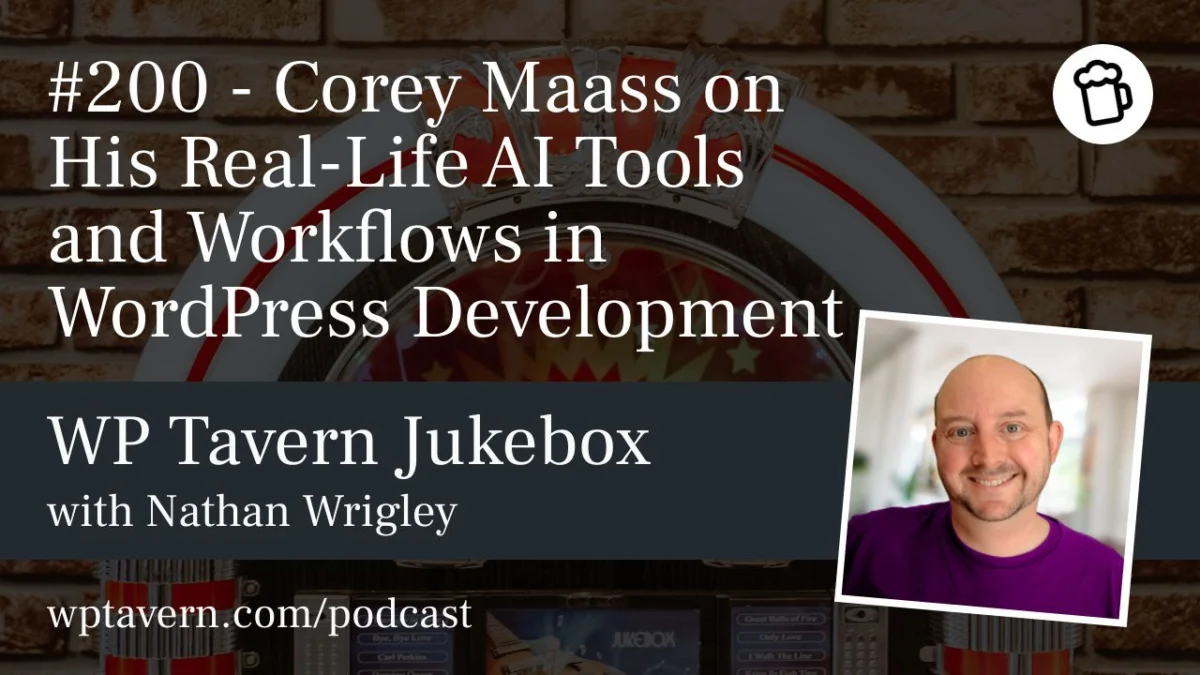
In a recent episode of the Jukebox Podcast, veteran developer Corey Maass—a builder who has navigated the industry since the "Photoshop and tables" era of 1997—offered a candid look at how AI is not just accelerating workflows, but fundamentally redefining the role of the developer. This shift marks the transition from being a "writer of code" to a "curator of intent," where human creativity is increasingly augmented by machine-driven efficiency.
The Chronology of an AI-Driven Workflow
For many in the developer community, the adoption of AI was an incremental, often skeptical process. Maass, who has been building for the web for nearly three decades, describes his journey as a pragmatic evolution.
- The Early Skepticism (2023–Early 2024): Initially, AI models were treated as "glorified typing assistants." Developers used them to draft emails or generate boilerplate code, but the tools were prone to hallucinations—often citing non-existent WordPress hooks or incorrect syntax.
- The Tipping Point (March 2025): A breakthrough occurred during a work-travel stint in Thailand, where Maass committed to a "total immersion" project. By rebuilding a legacy productivity app, Timerdoro, using the Cursor IDE, he discovered that the issue wasn’t the AI’s capability, but the developer’s method of interaction.
- The Modern Stack (Late 2025): Today, Maass employs a multi-layered, automated stack. He uses Cursor as an IDE, utilizes Claude Code for the heavy lifting of software construction, and runs GitHub Copilot as an automated peer-review mechanism. The process is now less about individual keystrokes and more about managing a sophisticated digital assembly line.
Redefining Creativity and "The Point" of Technology
Perhaps the most profound insight from the discussion is the shift in how developers perceive "authenticity." Maass suggests that the industry is moving toward a new metric for evaluating work: What is the point of this thing?
When it comes to art or music production, human labor and the "struggle" of creation remain central to the value proposition. However, when it comes to SaaS apps or client-side business software, the market is increasingly indifferent to the origin of the code. If a piece of software is performant, secure, and solves a business problem, the client rarely questions whether a human typed the logic or a large language model synthesized it.
Maass notes that AI is now functioning as a "sounding board for inspiration." By intentionally introducing elements of randomness—asking a model to rewrite a prompt as a five-year-old would, or to translate a concept into a foreign language and back—developers are using AI to break through creative stalemates. This mirrors Brian Eno’s famous "Oblique Strategies" deck, where randomness is used to force a pivot in creative direction.
Technical Implications: The "Clicky-Clicky" Bottleneck
Despite the rapid automation of coding, WordPress presents a unique challenge: the Graphical User Interface (GUI). WordPress is inherently "clicky-clicky"—a visual, admin-heavy environment where much of the work involves configuring plugins and settings via mouse-based interaction.
While AI can now write complex PHP, interact with ACF (Advanced Custom Fields) JSON files, and structure databases, it struggles with the physical "click" required to configure existing WordPress sites. Maass identifies this as the current frontier. He anticipates that as WordPress APIs mature—particularly with the development of the "Abilities API"—the gap between code generation and interface configuration will close.
"We are going to go through a phase where it’s going to absolutely break the website and my phone will ring," Maass joked, referencing the inevitable trial-and-error period of AI-managed site updates. However, he remains bullish: as plugin developers begin to expose their capabilities to AI in a structured way, the days of manually navigating the WordPress admin dashboard for routine tasks will likely become a relic of the past.
The Human Element: Responsibility and Oversight
A critical concern for any professional is the liability inherent in AI-generated work. When an AI writes the code, who is responsible when the site goes down?
Maass maintains that the developer’s role has evolved into that of a project manager and a rigorous reviewer. By integrating "harnesses"—the mechanisms that facilitate the interaction between human intent and machine execution—developers act as the final quality assurance gate. The "human-in-the-loop" model ensures that while the grunt work is offloaded to machines, the architectural integrity and long-term maintainability of the project remain under human supervision.
This has allowed Maass to offer services at a higher velocity. In one client project, he was able to propose a rebuild at 50% of the traditional hourly budget, relying on AI to bridge the cost gap. The result was a win-win: the client received a robust, modern application within a limited budget, and the developer remained profitable by reducing the time-to-market.
The Future: A Symbiotic Relationship
The conversation regarding AI in WordPress development is no longer about if it will happen, but how it will be integrated. The consensus among forward-thinking developers is that AI will not replace the human developer, but rather force them to ascend to a higher level of abstraction.
As the industry moves into 2026, we can expect the following trends:
- Standardization of Stacks: Developers will favor tools that are "AI-friendly," meaning plugins and themes that provide clean, structured data and APIs that AI can easily parse.
- Increased Focus on Architecture: With the AI handling the syntax, the human developer will spend more time on system design, security auditing, and client communication.
- The Rise of the "Super-Developer": The ability to manage multiple AI agents—Claude for code, Copilot for review, and Gemini for diagnostic analysis—will separate the high-output developers from those who cling to legacy, manual workflows.
Conclusion
The transformation of the WordPress ecosystem via AI is a testament to the industry’s resilience. From the early, error-prone days of 2023 to the sophisticated, multi-agent workflows of late 2025, the journey has been one of adaptation.
For developers like Corey Maass, the rise of AI is not an end to the "joyous rollercoaster" of web development; it is a new chapter that allows builders to focus on what matters most—solving problems, connecting with clients, and pushing the boundaries of what is possible on the web. As we look toward the future, the developers who thrive will be those who embrace the "randomness" of AI, treat their models with the curiosity of a peer, and never lose sight of the human intent behind the screen.