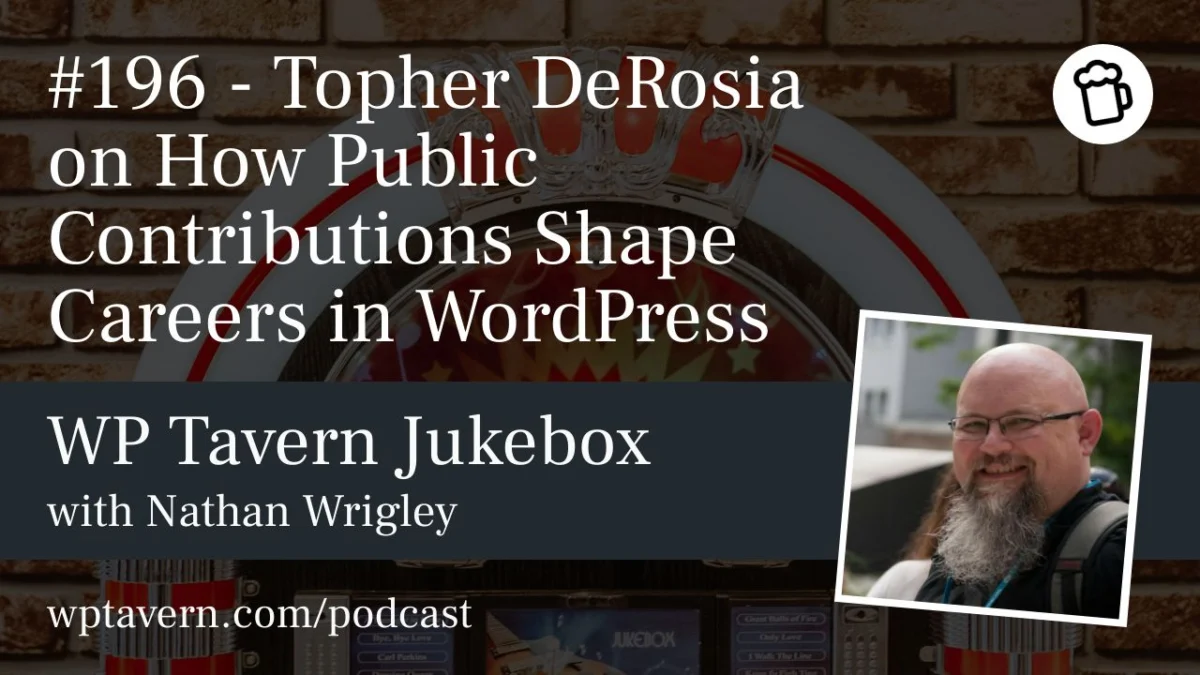
In an era where professional success is often measured by private metrics—salary brackets, proprietary codebases, and gated career growth—the WordPress ecosystem stands as a striking counter-narrative. At the heart of this movement is a simple, yet profound philosophy: working in public.
For industry veteran Topher DeRosia, a web developer with three decades of experience, the decision to share knowledge freely has been more than a philanthropic endeavor; it has been the defining catalyst of his professional trajectory. In a recent episode of the Jukebox podcast from WP Tavern, DeRosia joined host Nathan Wrigley to unpack the serendipitous nature of open-source participation and why the long-term, organic growth of a "public resume" remains the most potent tool for a sustainable career.
The Foundations of a Community-Driven Career
Topher DeRosia’s journey into the WordPress ecosystem began 15 years ago, sparked by a casual conversation with a colleague about a local meetup. "I did not know there was a community for several years," DeRosia admits. That initial encounter—a pivot from viewing WordPress merely as "downloadable software" to recognizing it as a global movement—transformed his life.
Since then, DeRosia has become a pillar of the WordPress world, attending nearly 80 WordCamps across the globe. For DeRosia, the community is not merely a networking hub; it is an infrastructure of support. "My wife got into the community, both my kids have spoken at WordCamp US, and my wife has spoken," he notes. This deep integration into the community has provided more than just professional contacts; it has fostered a sense of global family, where support networks transcend borders.
Chronology of Contribution: From Small Acts to Global Impact
The trajectory of DeRosia’s work illustrates the "long tail" effect of open-source contribution. His involvement was never driven by a master plan for fame or industry dominance. Instead, it was defined by a series of incremental, public-facing actions:
- The Early Years: Creating educational content for platforms like OS Training, initially as a contracted service, which inadvertently built a public body of work demonstrating his technical proficiency.
- The HeroPress Era: Launching HeroPress, a project dedicated to highlighting how people leverage WordPress to improve their lives, which cemented his reputation as a community leader.
- The Present: Transitioning into a consistent, three-times-a-week video series on YouTube, designed to demystify WordPress for beginners.
This chronological accumulation of work has led to "accidental" career advancements. DeRosia recounts instances where companies from halfway across the world—such as a firm in Bangladesh—sought him out specifically because they had consumed his content or interacted with his work in the public domain years prior.
The Mechanics of "Community Known" vs. Traditional Fame
A central theme in the discussion between DeRosia and Wrigley is the distinction between "fame" and being "community known." In a digital landscape dominated by influencer culture and the pursuit of rapid virality, DeRosia advocates for a more grounded approach.
"Within a community, you could say famous, but outside that community, people have no idea who you are," DeRosia observes. This "community-known" status is built on a corpus of work—plugins on the WordPress repository, blog posts, public speaking, and code contributions. It is a form of social capital that is remarkably resilient because it is tied to tangible utility.
Wrigley and DeRosia argue that this approach protects individuals from the volatility of seeking "influencer" status. By focusing on helping others—answering questions, building documentation, and sharing expertise—the professional gains a reputation that is not only earned but also verifiable.
Navigating the Tension Between Philanthropy and Commerce
A persistent challenge in the WordPress ecosystem is the friction between its open-source, philanthropic foundations and the increasing commercial pressure of a multi-billion-dollar industry. As WordPress matures, the presence of large, profit-driven entities at community events has become commonplace.
DeRosia acknowledges the cognitive dissonance this creates. "People look at this golden company, the pinnacle of WordPress, open source, love, family, and they’re letting people go. And you think, what? They’re just another business." He notes that while it is possible to build a successful business while remaining culturally aligned with the WordPress mission, the reality of managing a payroll and answering to stakeholders inevitably introduces hard choices.
However, both contributors argue that this tension is not a defect, but a feature of a maturing ecosystem. The goal is not to eliminate commerce, but to ensure that the foundational, volunteer-driven spirit of the project remains the primary North Star.
Implications for the Next Generation
For a 17-year-old developer picking up their first computer at a library, the barrier to entry in the tech world can seem insurmountable. Yet, as DeRosia emphasizes, the beauty of the WordPress model is that it allows someone in Malaysia to compete on a relatively equal footing with someone in New York.
The implications for new developers are clear:
- Work in Public: Do not hide your process. By documenting your learning—whether through blog posts, GitHub commits, or video tutorials—you are building a body of evidence that will serve you for decades.
- Prioritize Utility: As DeRosia says, "If I get asked a question more than three times, I’m making documentation." Solving common problems is the fastest way to become a valued member of a community.
- Trust the Organic Process: Avoid the temptation to gate your knowledge behind paywalls too early. While monetization is necessary for sustainability, the act of giving back creates a network effect that often leads to more lucrative opportunities than direct selling ever could.
Sustaining the Future: A Call to Action
The conversation concludes with a reflection on why, after 30 years in development, DeRosia continues to produce free content. His motivation remains rooted in a fundamental belief in the power of accessibility. "Anything I put behind a paywall is not going to be able to help a 17-year-old who’s making a dollar a week. And that’s where my heart is."
His current project—a YouTube channel focused on foundational WordPress tasks—is a testament to this commitment. Supported by a sponsor, but distributed freely, the project represents a hybrid model that respects the need for commercial support while upholding the mission of open-source education.
Conclusion
The "Jukebox" episode serves as a powerful reminder that in the noisy, often hyper-commercialized world of modern technology, the most sustainable career path is one paved with generosity. By contributing to the public record, sharing knowledge, and building deep, human-centric relationships, individuals like Topher DeRosia have proven that the "slow and steady" approach to career building is not just an ideal—it is a winning strategy.
For those wondering how to make their mark, the advice is simple: stop seeking influence and start seeking impact. Build a legacy of "community-known" expertise, and the opportunities will follow. As DeRosia’s experience demonstrates, you never know how a video made today or a blog post written five years ago will open a door to a new life tomorrow.