The landscape of web traffic is undergoing a tectonic shift. For years, digital marketers and SEO professionals have obsessed over the "Blue Links"—the traditional organic search results that dictated the hierarchy of the internet. However, with the meteoric rise of generative AI platforms like ChatGPT, Gemini, and Claude, the way users find and interact with content has fundamentally changed. Recognizing this, Google Analytics 4 (GA4) introduced a dedicated "AI Assistant" channel in May, providing a long-awaited window into how AI-driven discovery impacts website performance.
Main Facts: What is the AI Assistant Channel?
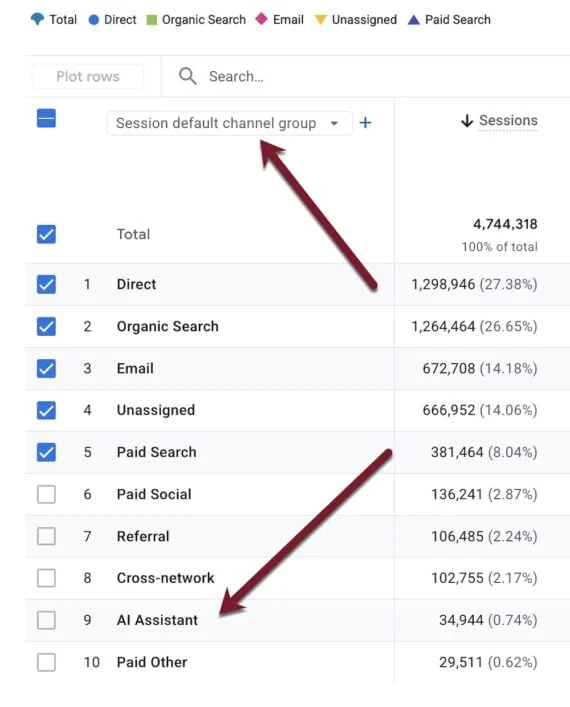
The AI Assistant channel is a new default channel group in GA4 designed to isolate and measure traffic originating from generative AI platforms. Unlike traditional referral traffic, which often masked the true nature of how a user landed on a site, this dedicated dimension captures visits driven by AI chat interfaces.
According to official Google Analytics documentation, the feature is specifically tailored to aggregate traffic from major chatbot platforms. By centralizing this data, Google is acknowledging that these AI-native tools have become a distinct "top-of-funnel" source for digital businesses.
It is important to note, however, that this category is not an "all-encompassing" bucket for every AI interaction. Google clarifies that traffic from "AI Overviews"—the generative summaries displayed directly within the Google Search results page—and "AI Mode" features remain categorized under "Organic Search." This distinction is critical: Google treats AI Assistant as a separate traffic stream for direct chatbot referrals, while maintaining its traditional categorization for AI-enhanced search engine experiences.
Chronology: From Ambiguity to Actionable Insight
For the past eighteen months, webmasters have been flying blind. While traffic from OpenAI’s ChatGPT or Anthropic’s Claude was reaching websites, it was often misattributed as "Direct" or "Referral" traffic, making it nearly impossible to calculate the true ROI of AI-based content discovery.
- Early 2023: The rapid adoption of ChatGPT led to a surge in unclassified traffic. Analysts began noticing spikes in traffic from referral domains like
chatgpt.com, but there was no native GA4 feature to handle this segment. - Late 2023 – Early 2024: The industry relied on custom configurations, complex filters, and Regex-heavy reports to manually isolate AI traffic. These workarounds were prone to error and required constant maintenance as new AI tools emerged.
- May 2026: Google officially rolled out the "AI Assistant" channel group. This update marked the first time Google formally recognized AI chat platforms as a distinct traffic source in its flagship analytics product.
- Post-Launch: Following the launch, analysts began the process of auditing historical data to see how much of their "Direct" traffic had actually been hidden AI-assisted visits all along.
Supporting Data: How to Access and Analyze the Metrics
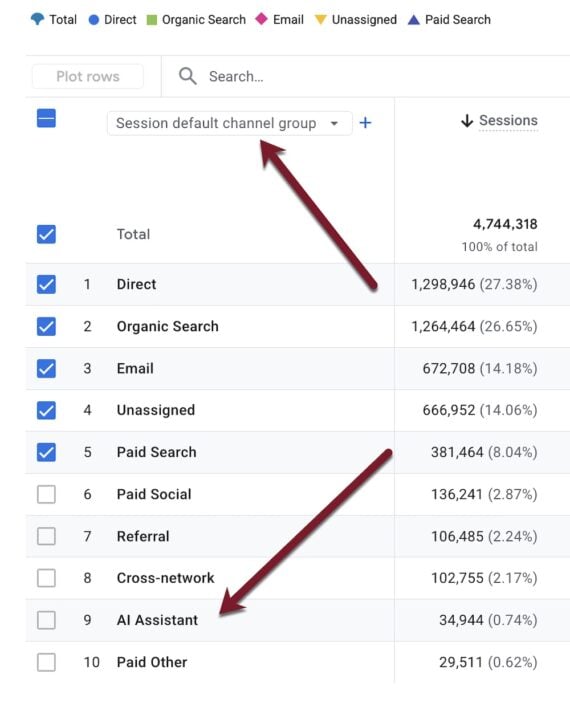
The power of the AI Assistant channel lies in its integration with existing GA4 reporting structures. To access this data, navigate to Reports > Acquisition > Traffic acquisition. Within the "Session default channel group" dimension, you will see "AI Assistant" listed alongside established categories like Organic Search, Paid Search, and Direct.
Analyzing Landing Pages
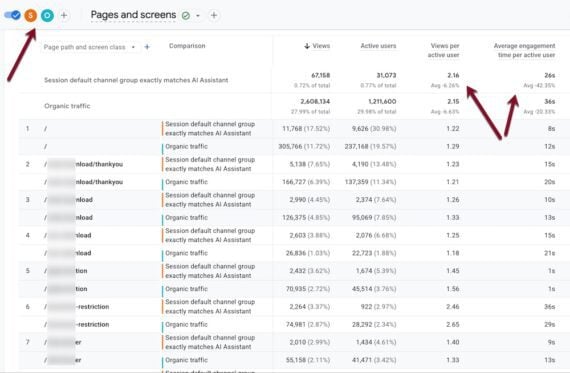
To understand which specific pages are being cited by AI models—a crucial metric for "AI SEO"—you can apply filters in the Engagement > Pages and screens report:
- Click "Add filter."
- Select "Session default channel group."
- Set the match type to "exactly matches" and select "AI Assistant."
This provides a clear view of which content pieces are currently winning in the AI-generated citation war. If a particular article appears consistently in this report, it is highly likely that the page is being utilized by AI models as a primary source of truth for their users.
The Power of Comparison
One of the most valuable features of this update is the ability to compare performance. By clicking "Add comparison" in the Pages and screens report, you can view your AI-assisted traffic metrics (such as engagement rate, events per session, and average engagement time) side-by-side with organic search traffic.
In initial testing, many industry experts have noted that AI-assisted traffic patterns often differ significantly from organic search. AI-driven visitors often spend more time on a page but may have lower conversion rates than users who clicked a traditional search link. Identifying these behavioral discrepancies is the first step toward optimizing your site for the "AI-first" era.
Advanced Tracking: The Regex Approach
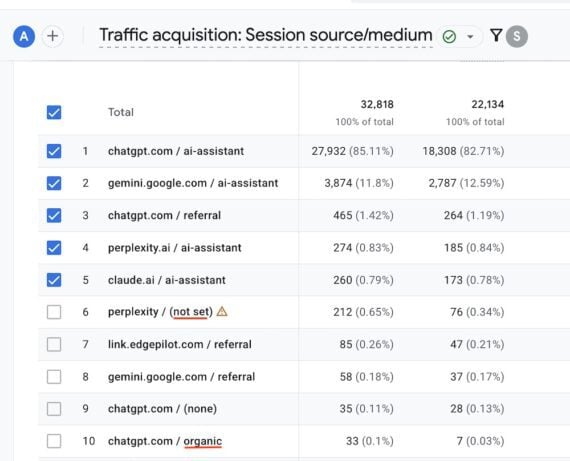
While the AI Assistant channel is convenient, it is a "black box" regarding which platforms are included. To gain granular control, many analysts prefer using Regular Expressions (Regex) to segment traffic by specific source. By creating a custom exploration or filtering by "Session source," you can use the following regex to capture a wide array of AI platforms:
.*chatgpt.com.*|.*perplexity.*|.*edgepilot.*|.*copilot.microsoft.com.*|.*openai.com.*|.*gemini.google.com.*|.*claude.ai.*|.*grok.x.ai.*
This method reveals exactly which platform is driving the most traffic. For example, if you see a spike from perplexity.ai, it indicates that your content is being successfully indexed and cited by Perplexity’s real-time search index, a key signal for modern content visibility.
Implications: The New Frontier of SEO
The emergence of the AI Assistant channel has profound implications for digital strategy. We are moving away from an era of "keyword-only" optimization toward an era of "citation-based" optimization.
1. The Death of the "One-Size-Fits-All" Strategy
My testing reveals that the overlap between top organic search pages and top AI-assisted pages is often minimal. This suggests that the ranking factors for an AI model (which prioritizes factual density, clear structure, and direct answers) differ from the traditional Google algorithm. Marketers must now optimize their content for two distinct audiences: the human user searching on Google and the Large Language Model (LLM) processing information for a chat query.
2. Identifying AI Prompts
By seeing which pages drive AI traffic, you can work backward. Tools like Semrush or Ahrefs can help you identify the queries associated with those pages. Once you know which pages are being cited, you can reverse-engineer the "prompts" that likely led the AI to choose your content. If you are a finance site and your "How to calculate interest" page is a top AI-traffic driver, it’s clear that AI models are using your page as a definitive source for financial calculations.
3. Data Integrity and "Not Set" Issues
It is worth noting that the GA4 AI Assistant channel is still in its infancy. In some instances, traffic sources like "Organic" or "(not set)" may still bleed into the reporting, indicating minor data inconsistencies. As Google refines the algorithm behind this channel, we can expect the accuracy of this reporting to improve. Until then, practitioners should use this data as a directional trend indicator rather than an exact accounting of every single visit.
4. A Shift in Engagement Metrics
Engagement time on AI-assisted sessions is often higher, which suggests that users who click through from an AI chat are highly qualified. They have already received a summarized answer from the chatbot and are clicking through to your site for deeper validation or specific data. This represents a higher "intent" phase of the user journey compared to a casual search click.
Conclusion: The Future is Conversational
The introduction of the AI Assistant channel in GA4 is more than just a new row in a report; it is a clear signal from Google that the internet’s traffic architecture has evolved. For site owners, ignoring this data is no longer an option.
As generative AI continues to integrate into the daily workflows of millions of users, the sites that understand how to feed these models with high-quality, authoritative, and structured information will be the ones that thrive. By leveraging the new AI Assistant channel, tracking specific sources via regex, and comparing AI-driven performance against traditional search, businesses can successfully navigate this transition.
The "Blue Link" is no longer the sole arbiter of success. We are now in the age of the "Answer Engine," and GA4 has finally given us the map to navigate it.