The marketing agency landscape is currently undergoing its most profound transformation since the dawn of the digital era. Driven by the rapid proliferation of artificial intelligence, machine learning, and agentic automation, the traditional "execution-heavy" agency model has not only become obsolete—it has become a financial and operational liability for brands.
For over a decade, marketing contracts have been built on a foundation of manual labor: trafficking, bidding, reporting, and micro-optimization. Today, the rise of platform-native AI tools—such as Google’s Performance Max and Meta’s Advantage+—has effectively automated these core functions. As these platforms take over the "heavy lifting," the value proposition of the agency must shift from an army of executors to a lean, high-level partner focused on strategy, governance, and creative ingenuity.
The Three Strategic Drivers of Change
The industry is no longer operating in the "Kansas" of traditional digital marketing. Three primary drivers are forcing this metamorphosis:
- Platform Intelligence: AI is now the primary engine of performance marketing. It processes data at a speed and scale that no human team can replicate, rendering manual bidding and campaign architecture tweaks redundant.
- The Death of Manual Labor: The "Assembly Line" model—building, tagging, and trafficking—is being absorbed by algorithms that require little more than a goal, a budget, and high-quality creative assets.
- The Inversion of Value: As execution costs plummet, the value of senior-level judgment, cross-platform strategy, and ethical AI governance skyrockets. Agencies that refuse to evolve will find themselves charging for services that no longer add value, effectively taxing their clients for the privilege of being inefficient.
Chronology: The Road to the July 2026 Shift
The trajectory of this change is accelerating. Industry experts suggest that the next 18 months represent a critical window for brands to renegotiate their agency relationships.
- Mid-2024 to Early 2025: The "Realization Phase." CMOs began to notice that their internal teams and agencies were spending increasing hours on tasks that AI platforms were already handling natively.
- Late 2025: The "Optimization Gap." Brands began identifying the performance dip caused by "over-touching"—agencies manually overriding AI models, which resulted in constant, unnecessary learning resets.
- July 2026 (The Threshold): This date marks the projected inflection point where standard agency contracts—if left unadjusted—will represent a 25% to 75% overpayment for redundant services.
- 2027 and Beyond: The "Agentic Future." Agencies that successfully pivot will be those that have fully integrated into an outcome-based fee structure, moving away from "hours spent" to "value generated."
Supporting Data: Where the Fees Disappear
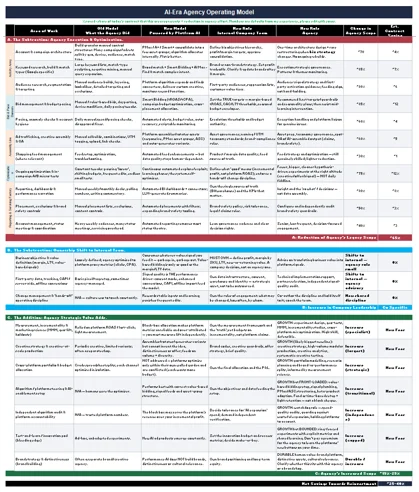
To understand the financial impact of this shift, one must audit the 12 dimensions of typical agency contracts. These can be distilled into five key clusters where work is either being automated or eliminated:
1. The Agency Activity Army
Traditionally, agencies charged for campaign architecture, keyword research, and audience segmentation. These tasks are now largely managed by algorithms. By shifting to a "deciding" rather than "building" model, brands can see an estimated 78% reduction in effort in this area, which accounts for roughly 22% of total contract costs.
2. The Bid & Pace Dancers
Manual bidding, day-parting, and budget adjustments were once the bread and butter of account management. Now, AI platforms perform these tasks continuously. Continued human intervention here is often detrimental to performance. This cluster, representing 14% of contract costs, is ripe for a 73% reduction.
3. The Assembly Line
Trafficking, tagging, and shopping-feed management are being swallowed by Generative AI. While data quality remains a human responsibility, the assembly of ad formats and creative variants is increasingly platform-led. This allows for a 45% reduction in the 12% of the budget historically allocated to these tasks.
4. The Optimization Theater
This is perhaps the most destructive area of the old model. Daily rituals of pausing "losers" and making granular, feel-based adjustments are being replaced by the platform’s own "explore-exploit" cycles. By cutting this "theater," brands can eliminate 16% of their contract weight with a 75% reduction in effort.
5. The Reporting & Servicing Factory
The reliance on manual decks and twice-weekly check-in meetings is an artifact of the past. With real-time dashboards and Claude-fronted data analysis, the "servicing" requirement has plummeted. This area, which often consumes 30% of an agency contract, can see a 60% reduction by shifting the focus from "care" to "impact."
Official Perspectives: The Case for a New Operating Model
Industry leaders argue that the "Percent of Media Spend" fee model is inherently toxic in an AI-first world. Because this model incentivizes agencies to spend more and touch the account more often, it actively fights against the efficiency of modern AI.
A proposed "New Operating Model" suggests a three-tier fee structure:
- 40-50% Lean Base Retainer: Focused solely on governance, steering, and data engineering.
- 30-40% Project Fees: Allocated to high-value work, including creative concepting, pre-testing, and complex, cross-platform strategic analytics.
- 15-25% Outcome Incentive: Tied strictly to incremental profit or revenue, moving away from flawed metrics like platform ROAS.
"The goal is not to save money on agencies," says one industry consultant. "The goal is to stop paying for the past so you can afford to invest in the future."
Implications for Brands and Agencies
The implications of this shift are binary: either a brand evolves its contract structure, or it continues to subsidize an antiquated, anti-AI workforce.
For Clients:
- Ownership is Non-Negotiable: Brands must take full, immediate control of their ad accounts, pixels, and data pipelines. If an agency owns your data, you are a hostage.
- Renegotiate or Rotate: The current SOW is likely misaligned with the reality of your business. If your agency is resistant to an outcome-based model, they are structurally incentivized to prioritize their own revenue over your performance.
- Audit the "Human Touch": If your agency is touching your account more than once every two weeks, they are likely causing algorithmic sabotage.
For Agencies:
- The End of the Hamster Wheel: Agencies should celebrate this transition. By shedding the low-value, $50/hr manual tasks, they can reallocate resources toward $500/hr and $1,000/hr strategic initiatives.
- Shift in Talent: The agency of 2027 will not be filled with junior traffickers. It will be a hub of data scientists, creative directors, and AI governance experts.
- Survival of the Fittest: We are entering a period where agency births and deaths will accelerate. The "Modern Agency" will be defined by its ability to persuade, its responsiveness to consumer behavior, and its structural alignment with business outcomes.
Conclusion: Carpe Diem
The "Agency Reckoning" is not a call for the end of agencies, but for their rebirth. The best agencies possess a depth of taste, courage, and cross-client pattern memory that no internal team can replicate. However, that value can only be unlocked if the contract aligns with the speed and logic of the AI era.
By stripping away the "motion" that masks a lack of impact, brands can finally transition their agencies from vendors to indispensable partners. The work is not disappearing—it is simply becoming more important, more strategic, and more lucrative for those brave enough to stop paying for the past.