In an era defined by rapid technological acceleration, the marketing industry finds itself at a crossroads. For decades, the professional identity of a Search Engine Marketing (SEM) specialist was built on a foundation of granular control: adjusting keyword bids, segmenting match types, and obsessing over hourly geo-targeting. However, as the Google Ads platform evolves into an AI-powered ecosystem, that traditional manual approach has become a relic—akin to insisting on horse-drawn carriages in an age of fuel-efficient motorcycles.
The transformation of platforms like Google Ads and Meta is not merely an incremental update; it is an "AIfying" of the entire advertising landscape. This shift demands a fundamental pivot from human-led micro-management to machine-led strategic orchestration. For agencies and in-house teams still clinging to the "AdWords-era" playbook, the message is clear: the choice to stay in the past is no longer a viable business strategy.
The Paradigm Shift: From Manual Tweak to Machine Learning
For years, the gold standard of search marketing was defined by complexity. Agencies proved their value by making dozens of manual changes daily—sculpting accounts, refining negative keyword lists, and testing ad copy variants. Today, this behavior is often described as "profit-pulverizing."
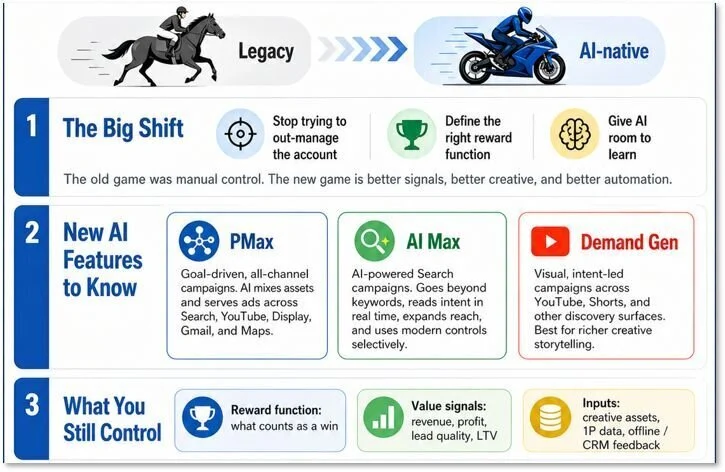
The modern reality is that AI-powered systems can process intent, context, and historical signals at a scale and speed that no human can replicate. Tools like Performance Max (PMax), AI Max, and Demand Gen are designed to take the heavy lifting out of the equation. By feeding these systems high-quality assets and clear business goals, marketers can offload the tactical execution to algorithms that learn and improve with every interaction.
Chronology of the Transformation
The trajectory toward AI-native advertising has been steady, marked by several key milestones:
- The Era of Control (2000–2015): The rise of Google AdWords, where success was determined by the human ability to manipulate match types, bid modifiers, and manual campaign structures.
- The Rise of Automation (2016–2020): Google began integrating machine learning into Smart Bidding, gradually reducing the efficacy of manual bid adjustments.
- The AI-First Pivot (2021–Present): The introduction of PMax and AI Max solidified the shift. The platform moved from "Search-first" to "Intent-first," leveraging signals across YouTube, Display, Gmail, and Maps.
- The Current Maturity Gap: Today, the industry is split between "Legacy Operators" (those who still view search as a series of manual levers) and "AI-Native Advertisers" (those who view AI as a partner in revenue generation).
Supporting Data: Measuring Your Maturity
To navigate this transition, it is essential to conduct an honest self-assessment. A "Maturity Model" helps marketers determine if they are truly embracing the modern paradigm or merely visiting it as tourists. This assessment rests on two critical dimensions: Capability Scoring (sophistication) and Depth Scoring (how widespread the application is across your total spend).
The Six Dimensions of Maturity
To reach the top-tier of maturity (a score of 85+), organizations must optimize their operations across six distinct dimensions:
- Measurement & Value Architecture: This is the bedrock. AI can only optimize for the "reward function" it is given. If you are optimizing for pageviews or basic leads, you are failing. True maturity involves passing revenue, profit, or lead-quality data back to Google via offline conversion imports or CRM feedback loops.
- Search Operating Model: Moving away from manual CPC and keyword-specific segmentation. Modern teams use Smart Bidding and broad matching, allowing AI to find intent that humans would miss.
- 1P Data & Audience Intelligence: Leveraging first-party data to feed the machine, ensuring the AI finds users who match your highest-value customers.
- Surface Breadth & Campaign Mix: Embracing the full suite of Google’s inventory, rather than limiting ads to traditional text search.
- Creative & Landing Page Adaptability: Providing the AI with diverse, high-performing assets that it can mix and match for maximum relevance.
- Operating Cadence & Governance: Moving from daily manual tweaks to high-level strategic oversight and governance.
Implications for the Modern Marketer
The shift toward AI-native advertising has profound implications for the professional services industry. Agencies that rely on "hours billed" for manual optimizations are facing an existential threat. The new value proposition for agencies is not "how many changes did we make today," but rather "how effectively did we architect the data and creative inputs to ensure the AI drives maximum profitability."
The "Reward Function" Control
One of the most important takeaways for modern marketers is the concept of the "Reward Function." While we give up control over how the ads are shown, we gain power in defining what winning looks like. By feeding the AI sophisticated, business-critical data—such as predicted Lifetime Value (LTV) or closed-won revenue—marketers can steer the machine toward business outcomes that truly matter, rather than superficial KPIs like "cost per click."
The "Horse Rider" vs. "Motorcycle Rider"
The distinction between the legacy operator and the modern advertiser can be summarized by their internal monologues:
- The Horse Rider (Legacy): "We trust automation, but we still optimize for traffic. We believe performance comes from sculpting the account harder and micromanaging every bid."
- The Motorcycle Rider (AI-Native): "We’ve simplified our account structure to give the system room to learn. We use controls sparingly to protect the brand, but we let the algorithm optimize toward our highest-value customers."
Avoiding Self-Deception
The greatest danger in this transition is the tendency to "fake" maturity. It is easy to point to a single pilot program and claim the company is "AI-native." To avoid this, organizations must:
- Score Depth First: Evaluate what percentage of your total spend is running on AI-first systems. If it’s under 10%, you are still a legacy operator, regardless of how "sophisticated" your pilot is.
- Audit the Top 80%: Focus your assessment on the bulk of your budget. Do not let edge cases distort the reality of your overall maturity.
Conclusion: Embracing the Future
The cultural shift required to embrace AI in advertising is significant, but the payoff is immense. We are moving from a world of "soul-sucking" manual labor to one of high-level strategic alignment. The objective is to feed the machine the best possible truth, provide it with the highest quality creative assets, and trust it to find the signals that translate into 3x, 5x, or even 20x revenue growth.
The era of the "Search Marketer" as a manual laborer is ending. The era of the "Performance Architect"—someone who understands data, creative, and business value—has begun. The choice is simple: continue to fight the tide and risk obsolescence, or step into the future and enjoy the efficiency, scale, and profitability that only AI-native advertising can provide. Carpe diem.