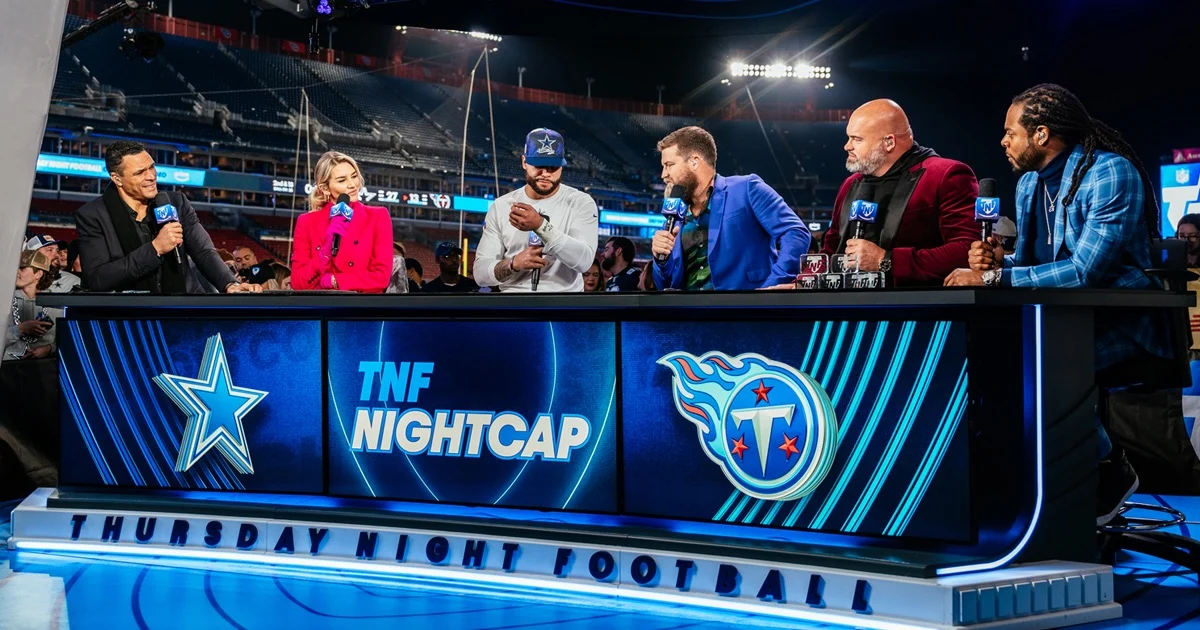
NEW YORK — As the autumn air grows crisp and millions of households tune in for the quintessential American ritual of professional football, Amazon’s Prime Video is quietly marking a monumental milestone. Entering the fifth season of its historic 11-year broadcasting agreement with the National Football League (NFL), the tech and streaming giant is proving that its multi-billion-dollar bet on live sports is not only viable but thriving.
In a recent showcase of this dominance, a thrilling matchup saw the Chicago Bears narrowly take down the New England Patriots with a score of 30-24—a game that captivated audiences nationwide. Yet, away from the gridiron and behind the scenes, the true victory for Amazon is unfolding on corporate balance sheets. Prime Video has posted exceptionally healthy advertiser growth numbers for the current Thursday Night Football (TNF) campaign, signaling a structural shift in how brands allocate their marketing budgets between traditional linear television and streaming ecosystems.
With a 6% year-over-year increase in overall TNF advertisers and a staggering 17% of this season’s brand partners being entirely new to both the franchise and Prime Video, Amazon is rewriting the rules of sports broadcasting monetization.
Main Facts
The ongoing fifth season of Thursday Night Football on Prime Video represents a maturing product that has successfully bridged the gap between Silicon Valley technological capability and traditional sports entertainment.
- The Broadcast Partnership: Amazon is currently in Year 5 of an unprecedented 11-year deal to exclusively broadcast Thursday Night Football. This partnership fundamentally altered the media landscape by making a major NFL package exclusively available on a subscription-based streaming platform for the first time.
- Advertiser Growth Metrics: Overall advertiser volume for TNF is up 6% year-over-year. More importantly, Amazon is experiencing double-digit percentage growth across several key economic sectors, including financial services, retail, hardlines, automotive, and travel.
- New-to-Platform Acquisition: A notable 17% of the brands advertising during this season’s TNF broadcasts have never previously purchased ad inventory on Prime Video or through the TNF package, illustrating Amazon’s ability to pull fresh corporate spend into the streaming sports market.
- Strategic Pivot: Rather than treating TNF as a standalone media buy, Amazon Ads is actively leveraging its broader retail, cloud, and entertainment ecosystem to encourage brands to deepen their commitments across the company’s vast portfolio.
Chronology: From Silicon Valley Upstart to Gridiron Heavyweight
To understand the weight of Amazon’s current advertising success, it is necessary to examine the trajectory that brought the tech titan to this juncture. The timeline of Amazon’s ascension in live sports broadcasting reveals a calculated, step-by-step corporate strategy.
Phase 1: Digital Experimentation (2017–2021)
Long before securing exclusive rights, Amazon dipped its toes into the live sports waters. In 2017, the company struck a modest deal to stream a select package of Thursday Night Football games, which were simultaneously broadcast on traditional networks like CBS and NBC, as well as the NFL Network. This initial phase served as a stress test for Amazon Web Services (AWS) infrastructure, testing global video delivery, latency minimization, and user interface design for live, high-concurrency events.
Phase 2: The Blockbuster 11-Year Deal (2021–2022)
In March 2021, the landscape of sports media shifted permanently. Amazon and the NFL agreed to an 11-year, multi-billion-dollar contract granting Prime Video exclusive worldwide rights to Thursday Night Football starting with the 2022 NFL season. This leap moved the package off free-to-air broadcast television entirely, tying a marquee NFL property directly behind a paid Prime subscription paywall. Skeptics questioned whether fans would follow the game to a streaming app, and whether advertisers would commit top-tier dollars to a platform without decades of linear TV history.
Phase 3: Early Growing Pains and Technological Refinement (2022–2023)
The inaugural exclusive season in the fall of 2022 brought mixed reviews. While the production quality, led by veteran play-by-play announcer Al Michaels and analyst Kirk Herbstreit, met broadcast standards, initial audience measurements were volatile. Amazon leaned heavily on technological innovations—such as Prime Vision (an alternative broadcast featuring advanced analytics and graphical overlays powered by AWS), Next Gen Stats, and interactive shopping features—to differentiate the streaming experience from traditional television.
Phase 4: Mainstream Integration and Ad Innovation (2024–Present)
By the current fifth season, the platform has found its stride. Viewership metrics have stabilized and grown, driven by more competitive matchups—such as the recent high-stakes thriller between the Chicago Bears and the New England Patriots. Crucially, this period has marked the maturation of Amazon Ads. The tech giant has transitioned from merely selling 30-second commercial spots to offering holistic, data-driven marketing campaigns that connect an in-game TV ad directly to an e-commerce purchase on Amazon.com.
Supporting Data and Market Analysis
The numbers coming out of Amazon’s current TNF campaign do not exist in a vacuum; they reflect broader macroeconomic trends in the media advertising industry. As cord-cutting accelerates and younger demographics abandon traditional cable packages, brands are forced to follow eyeballs to connected television (CTV) and streaming services.
Sector-Specific Gains
The double-digit growth observed across specific verticals highlights changing consumer habits and corporate marketing strategies:
- Financial Services: Banks, credit card issuers, and fintech firms are utilizing TNF to target affluent, tech-savvy demographics capable of opening accounts, applying for loans, or managing investments via mobile devices during commercial breaks.
- Automotive: Car manufacturers, traditionally heavy spenders on linear sports, have embraced Prime Video’s targeted ad capabilities, allowing them to serve different vehicle models to households based on regional preferences and verified purchasing intents.
- Retail and Hardlines: Given Amazon’s unmatched dominance in e-commerce, retail brands find a natural synergy in advertising on Prime Video, where a viewer can seamlessly transition from watching an ad to adding a product to their Amazon shopping cart.
- Travel: With pandemic-era restrictions long behind us, travel and hospitality brands are fiercely competing for consumer discretionary income, viewing the massive, highly engaged TNF audience as prime real estate for vacation marketing.
The Power of the "First-Timer"
Perhaps the most telling metric of Amazon’s current season is that 17% of all advertisers are new to TNF and Prime Video. This influx suggests that Amazon is not merely cannibalizing ad dollars that would have otherwise gone to traditional networks (like ESPN, FOX, NBC, or CBS). Instead, the company is successfully convincing brands that previously sat out of professional football advertising—due to prohibitive costs, lack of targeting, or a preference for digital-only campaigns—that Prime Video offers a unique, hybrid value proposition that justifies the investment.
Official Responses and Executive Insights
Behind these glowing metrics is an intentional, highly coordinated sales and marketing strategy executed by Amazon’s leadership team.
Amy McDevitt, Head of Live Sports Sales Partnerships at Amazon Ads, offered insight into the philosophy driving the platform’s current success. According to McDevitt, the primary objective of the latest season has been moving past the initial novelty phase of streaming sports and compelling major brands to deeply integrate themselves into the broader Amazon ecosystem.
"This latest season is about getting advertisers to lean in to Prime Video’s offerings and expand their relationship across the company," McDevitt explained.
By encouraging brands to think beyond the standard commercial break, Amazon is pitching an interconnected marketing funnel. An advertiser can sponsor an alternate broadcast stream, integrate products into on-screen graphics powered by AWS, utilize interactive display ads on the Prime Video UI, and retarget viewers with personalized promotional banners on the Amazon retail homepage days later. This closed-loop attribution model—the ability to trace a direct line from a television commercial to an online retail transaction—is something traditional linear television networks simply cannot replicate.
Implications for the Future of Sports Media and Advertising
The success of Amazon’s fifth season of Thursday Night Football carries profound implications for the future of the media, entertainment, and advertising industries.
1. The Normalization of Streaming as the Primary Home for Sports
For decades, the NFL was synonymous with broadcast and cable television. The smooth operational execution and commercial viability of Prime Video’s exclusive TNF package have proven that live sports can live permanently behind a streaming paywall without sacrificing audience reach or advertiser demand. This precedent has emboldened other tech giants—such as Apple, Google (YouTube), and Netflix—to aggressively bid for major sports rights, signaling an irreversible migration of live content from linear networks to digital platforms.
2. The Death of the Generic Commercial Spot
As exemplified by Amazon’s ability to draw double-digit growth across specific retail, auto, and financial sectors, the era of the one-size-fits-all television advertisement is drawing to a close. Advertisers now demand accountability, granular audience data, and cross-platform synergy. Amazon’s capacity to merge live broadcast entertainment with e-commerce data sets a new gold standard that competitors will be forced to emulate.
3. Deepening Brand Loyalty Through Ecosystems
McDevitt’s emphasis on getting brands to "expand their relationship across the company" highlights the ultimate competitive advantage held by tech conglomerates over pure-play media companies. Traditional broadcasters can offer airtime during a game; Amazon can offer airtime, cloud computing services, logistics support, targeted digital display ads, and immediate point-of-sale conversion through its online marketplace.
As the current NFL season progresses past thrilling finishes like the Bears’ 30-24 victory over the Patriots, the real winner is already clear. Amazon has transformed Thursday Night Football from a high-stakes media experiment into an unassailable commercial engine, permanently altering how the world watches sports and how brands pay for our attention.