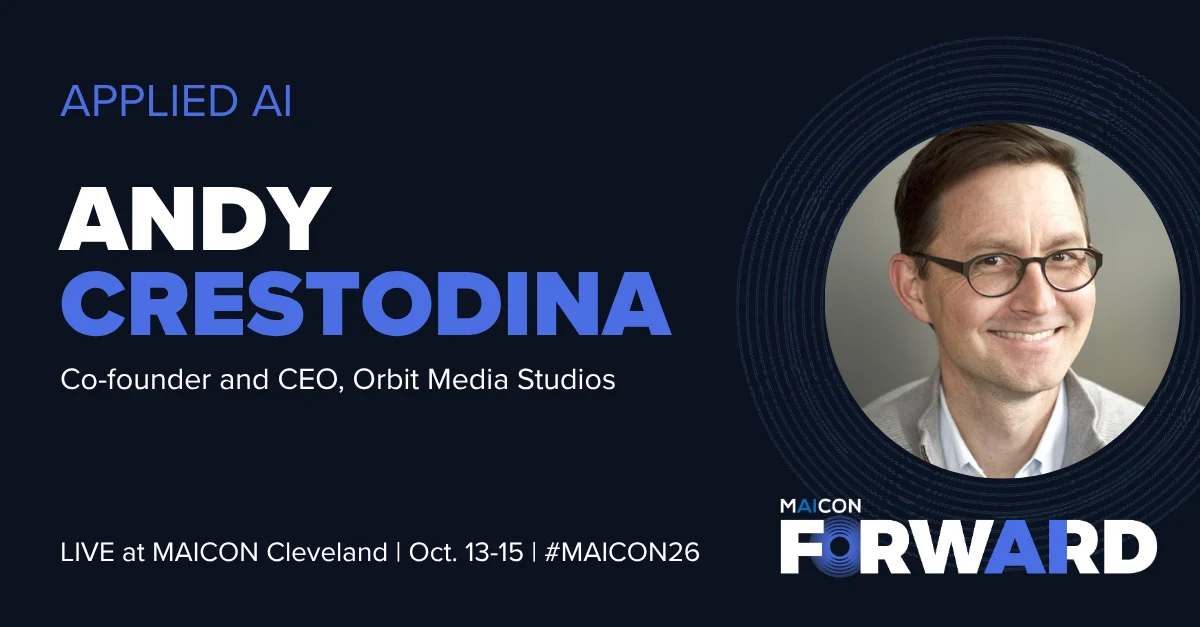
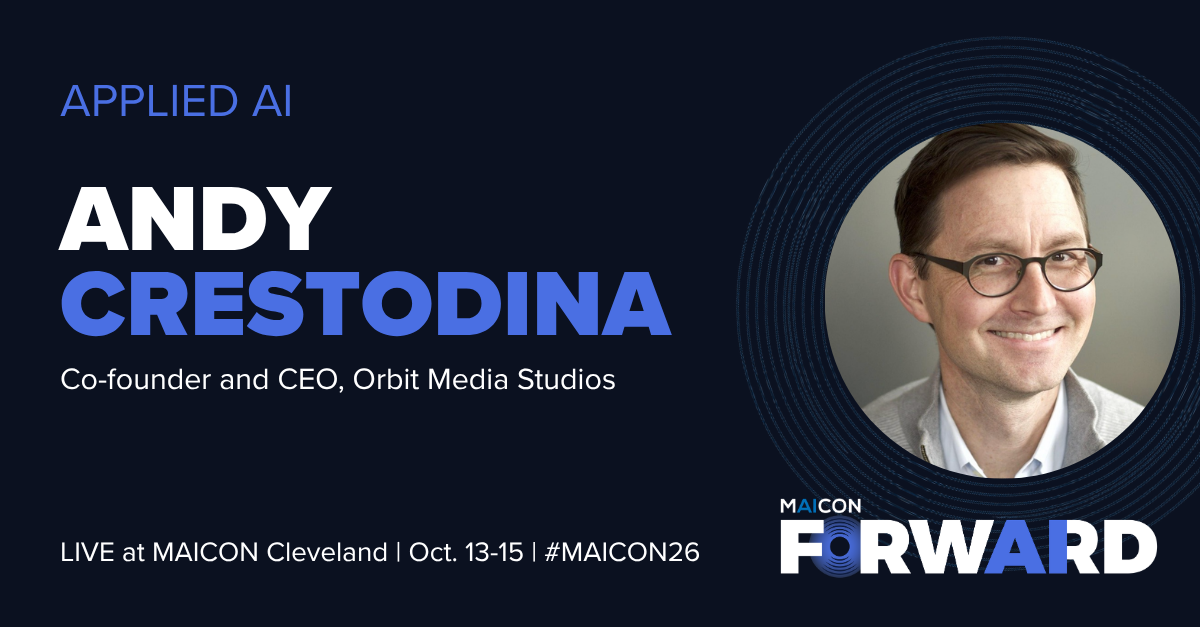
For years, the marketing industry has been swept up in a "tool-buying frenzy." Every month brings a new wave of AI-powered platforms promising to write faster, design better, and analyze data with god-like precision. But for Andy Crestodina, Co-founder and CMO of Orbit Media, the true competitive advantage in the age of artificial intelligence isn’t found in a subscription box—it is found in the architectural shift from being a user of tools to becoming a creator of them.
As the industry prepares for the Marketing Artificial Intelligence Conference (MAICON) 2026, Crestodina is shifting the conversation away from productivity hacks and toward the systematic engineering of marketing workflows. His upcoming keynote, "From Process to Prompt to Automation: How a Marketing Job Becomes a Marketing Tool," serves as a manifesto for a new era of agency and internal team operations.
The Evolution of Marketing Workflows: A Systematic Progression
The prevailing narrative around AI in marketing suggests that the technology is a magic wand—wave it over a task, and it is completed instantly. Crestodina argues that this is a dangerous misconception. "The work of marketing has changed," he notes. "Modern marketing workflows evolve in a specific sequence, beginning with 100% human-led tasks and migrating toward a model where AI acts as the engine, with human experts serving as the final, critical editorial filter."
This transition is not instantaneous. It is a developmental process. Crestodina emphasizes that teams fail when they try to "one-shot" an AI worker. Great AI assistants, he suggests, are built through iteration. They start as a series of manual tasks, move into the realm of structured prompt engineering, and finally stabilize into automated workflows that handle the heavy lifting while the human expert focuses on high-level strategy and nuance.
The Architect’s Advantage: Why Experts Make the Best Builders
One of the most persistent myths in the current AI landscape is that the "expert" is becoming obsolete. Crestodina flips this on its head: the expert is more vital than ever, not because they perform the manual labor, but because they are the only ones capable of building the digital assistants that will replace it.
"The best assistants are built by people who already do that job well," Crestodina asserts. Because an expert understands the subtle benchmarks of quality, tone, and strategic intent, they are uniquely qualified to train, test, and iterate on AI outputs. When a subject matter expert (SME) turns their process into a tool, they aren’t just saving time; they are codifying their expertise.
This concept of "skill transfer" is arguably AI’s most potent feature. By building an AI tool based on a senior strategist’s workflow, a company can effectively "clone" that strategist’s methodology, allowing less-experienced team members to operate at a significantly higher level of efficiency and output quality.
Prompts as Code: The New Language of Marketing Operations
To understand the shift Crestodina is advocating, marketers must adopt a new mental model: the prompt is not just a sentence; it is a line of code.
Drawing inspiration from Andrej Karpathy, the co-founder of OpenAI who famously noted that "the hot new programming language is English," Crestodina challenges marketers to stop viewing AI as a conversational partner and start viewing it as a programming environment.
"In other words, your prompts are code. They are functions. They are tools. Work hard on them," he says. This perspective shift is profound. It turns the act of prompt engineering into a rigorous exercise in software development.
- Input Engineering: Marketers must identify the specific, high-quality data points required for a successful output.
- Function Definition: The prompt itself must be structured to handle variables, context, and constraints.
- Output Analysis: Just like a developer debugging code, a marketer must look at the output, test it against real-world scenarios, and iterate to improve the "logic" of the prompt.
- Centralization: Once a prompt is "debugged" and perfected, it should not live in an individual’s browser history. It should be documented, shared, and integrated into the organization’s collective knowledge base.
The Strategic Implications for Marketing Teams
What does this shift mean for the future of the marketing department? It suggests a movement away from "buying the latest SaaS" and toward "building internal IP."
1. From Consumption to Creation
Most marketing departments are currently defined by their tech stack—the collection of subscriptions they pay for each month. The future-ready department will be defined by its "Tool Library"—a repository of proprietary, optimized prompts and automated workflows that the team has built for themselves.
2. The Rise of the Marketing Engineer
The role of the "Marketing Engineer" will become a central pillar in agency and in-house teams. These are individuals who may not know Python or C++, but who understand the logic of a business process well enough to translate it into a series of AI-driven, automated steps.
3. Institutionalizing Expertise
When expertise is locked inside the heads of individual employees, the company is vulnerable. By documenting these processes into automated AI tools, the organization creates an "institutional memory" that survives turnover and scales with the growth of the team.
Preparing for MAICON 2026: A Roadmap for Change
Crestodina’s session at MAICON 2026 is designed to be a practical workshop, not just a theoretical lecture. With 25 years of experience in the trenches of digital marketing—spanning the early days of SEO to the current AI revolution—he brings a unique perspective on what constitutes a "qualified" lead and how to build a website that consistently converts.
Attendees can expect to leave the session with a clear, actionable framework to transition from manual, high-friction processes to high-velocity, automated ones. Key takeaways will include:
- The Workflow Audit: How to identify which of your daily tasks are "ripe" for automation and which ones require the irreplaceable human touch.
- The Prototype to Product Lifecycle: A step-by-step guide on how to turn a successful manual task into a reusable, refined, and shareable AI prompt.
- The Culture of Iteration: Strategies for building a team culture that rewards the building and testing of internal tools over the constant, frantic pursuit of the next shiny marketing software.
The "Content Chemistry" Legacy
Crestodina’s influence in the industry is anchored in his seminal work, Content Chemistry. Even in the age of generative AI, the principles of his book remain remarkably relevant. His focus has always been on performance, evidence, and the repeatable frameworks that turn marketing activity into business results.
By applying this same rigorous, data-driven mindset to AI, Crestodina is providing a roadmap that moves beyond the hype cycle. The message is clear: stop looking for the "new" tool. The only gap between where your team is today and where it needs to be is your own imagination.
Conclusion: The Path Forward
The marketing industry stands at a crossroads. One path leads to a cluttered, expensive, and fragmented ecosystem of third-party tools that do the work for you. The other path leads to a lean, efficient, and highly capable organization that builds its own tools—tools that are customized to the business’s unique needs, values, and strategic goals.
As we look toward MAICON 2026, the question for every marketer is no longer "Which AI tool should I subscribe to?" but rather "What parts of my job can I turn into a tool today?"
The era of the "AI-enabled marketer" is ending; the era of the "AI-architect marketer" is beginning. Join Andy Crestodina and other industry leaders at MAICON 2026 to learn how to build the systems that will define the next decade of digital growth. Registration is now open for those ready to move from the passenger seat of technology into the driver’s seat of innovation.