In an era of fragmented media consumption, live sports remain the last true frontier for mass-audience engagement. Last year, nearly all of the top 50 most-watched telecasts in the United States were sports-related. With the exception of cultural monoliths like the 97th Oscars, the Saturday Night Live 50th anniversary special, a high-profile 60 Minutes interview, an episode of The Floor, and the 67th Grammys, the list was dominated by athletics. Even a broadcast titled "NFL Weather Delay" managed to crack the top 30—a testament to the audience’s insatiable appetite for anything under the sports umbrella.
This reality has triggered an arms race among streaming giants, media conglomerates, and global brands, all scrambling to secure broadcasting rights and sponsorship packages. However, as marketing budgets swell, a critical question is finally echoing in the boardrooms of the world’s largest companies: "We’ve enjoyed the hospitality suites and the photo opportunities with icons like Tom Brady, but for $38 million in spend, is this actually moving the needle for the business?"
The Paradox of Sports Marketing
Sports marketing has become a "must-have" for brands looking to maintain relevance, yet it is often executed with a lack of strategic rigor. Marketers are flooding the space, buying everything from stadium naming rights to the back panels of interview backdrops. The core issue, however, is that sports marketing is subject to the same fundamental laws of consumer behavior as any other medium—a fact often ignored by those blinded by the glamour of the arena.
The Myth of Guaranteed Attention
The primary misconception is that because sports are "live" and "shared," the brand visibility is inherently valuable. In reality, the sport itself acts as the ultimate filter. If a brand’s creative story cannot capture attention within the 1.2-second window of a TikTok scroll, placing that same logo on a jersey or a stadium wall will yield even lower returns. The audience is there to watch the game, not the corporate signage.
Furthermore, the "spike and silence" approach—common in low-effort campaigns—is the kiss of death in the sports world. To derive actual value from the halo effect of an athlete or a league, brands must shift to a "spike and sustain" model. Without consistent, high-frequency reinforcement, the initial investment is quickly eclipsed by the game itself.
Chronology of the Sports Marketing Shift
The transition from traditional advertising to sports-integrated marketing has occurred in distinct phases over the last two decades.
- The Era of Passive Exposure (Pre-2010s): Brands viewed sports as a simple awareness play. Naming rights and logo placements were the gold standards. Measurement was limited to "eyeballs" and basic reach statistics.
- The Rise of Digital Integration (2010–2018): As social media matured, the focus shifted to influencer-led sports marketing. Brands began partnering with individual athletes to leverage their personal followings.
- The Data-Driven Mandate (2019–Present): With the democratization of marketing analytics, CFOs began demanding accountability. The current phase is defined by the quest for incremental profitability and the rejection of vanity metrics like Ad Value Equivalency (AVE).
The Five Levels of Sophistication: An Analytical Playbook
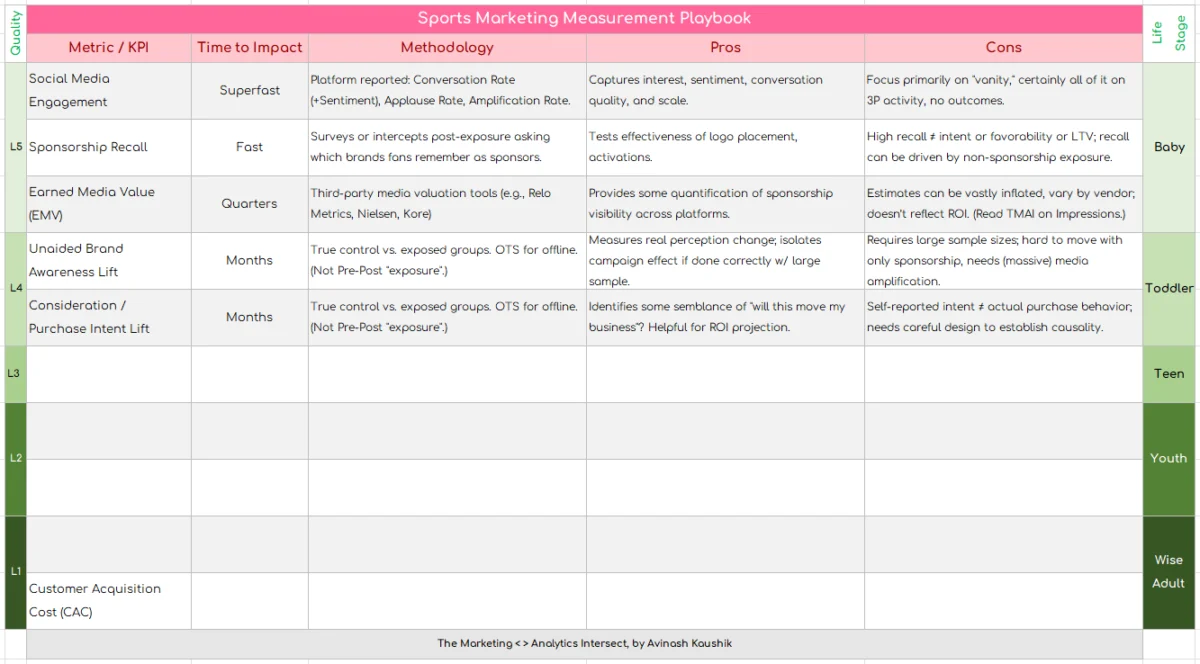
To navigate the complexity of sports marketing, organizations must move away from "vanity" reporting. The industry standard, as proposed by marketing analytics experts, categorizes measurement into five levels of sophistication, ranging from basic exposure to true incremental profitability.
Level 5: The Opening Gambit (Vanity Metrics)
This is the entry point for most brands, characterized by "Big Numbers." Reporting here focuses on impressions and social media engagement (conversation rates, applause rates).
- The Trap of Earned Media Value (EMV): Agencies often use EMV (or Ad Value Equivalency) to justify spend. By multiplying every logo appearance by the cost of an equivalent ad spot, agencies present impressive, yet largely fictitious, dollar figures. This metric is widely discredited because it ignores audience quality and the hyper-cluttered environment of live sports.
Level 4: The Quest for Brand Impact
This stage marks the first real attempt to measure human impact. Rather than asking "How many people saw the logo?" the question shifts to "Did the sponsorship shift what people think and feel about the brand?"
- UBA (Unaided Brand Awareness) Lift: This measures the long-term mental availability of a brand.
- Consideration and Intent: By utilizing traditional brand tracking surveys and comparing "exposed" groups against a control group (using propensity score matching), brands can begin to quantify the shift in consumer sentiment. This level is essential for B2B firms with long, complex sales cycles.
Supporting Data and Strategic Implications
The decision to invest in sports marketing should be a conscious trade-off. Because creative storytelling is responsible for 60% to 70% of brand marketing success, it can be highly profitable to "outsource" your brand values to a successful team or athlete. However, this is only effective if the brand is willing to support that creative with significant paid media.
The "Dirty Little Secret"
The dirty secret of the industry is that many brands are simply bad at storytelling. By aligning with a sports entity, they inherit a pre-built narrative. When executed correctly, with the right paid media amplification, the return on investment is not just possible—it is provable.
Official Perspectives: The Role of the CMO and CFO
Modern Chief Marketing Officers are under increasing pressure to prove the efficacy of high-ticket sponsorships. The shift in perspective from "hospitality" to "profitability" is non-negotiable.
- The CFO’s Perspective: Financial leaders are no longer satisfied with reports on "brand love." They are looking for correlations between sponsorship windows and customer acquisition costs (CAC) or lifetime value (LTV).
- The CMO’s Challenge: The CMO must bridge the gap between the experiential nature of sports marketing and the cold reality of the P&L statement. This requires moving beyond Level 5 (Vanity) and Level 4 (Brand Impact) into the higher-order levels of measurement:
- Level 3: Insights into compounding brand advantage.
- Level 2: Identifying digital traces that link exposure to financial outcomes.
- Level 1: Proving absolute incrementality.
Conclusion: Turning the Lights On
Sports marketing is not a magic bullet. It is a high-cost, high-stakes medium that demands the same level of analytical rigor as any other performance marketing channel.
The era of "sponsoring in the dark"—where millions are spent on suites and stadiums without a clear line of sight to revenue—is coming to an end. By adopting a tiered, sophisticated measurement framework, companies can move beyond the surface-level noise of impressions and start to understand the true business value of their sports investments.
Whether you are a global brand or a regional player, the path to success remains the same: stop measuring the noise, turn the lights on, and demand to see the money. The stadiums may be crowded, but only those with a data-driven strategy will find the path to real growth.