In the modern digital landscape, the success of a product is rarely the result of a single brilliant design or a lone talented developer. Instead, it is an emergent property of the organization itself. As User Experience (UX) continues to transition from a niche discipline to a core business pillar, practitioners are finding that their greatest challenge is no longer just mastering design tools, but navigating the complex sociopolitical landscape of their own organizations.
This article, the first in a three-part series, explores the concept of UX maturity—the organizational capacity to integrate design thinking into business strategy—and provides actionable tactics for those working in environments where UX is still in its infancy.
Understanding the Landscape of UX Maturity
UX maturity is defined as the level of sophistication and integration of user-centered design practices within an organization. It encompasses far more than the proficiency of individual designers; it reflects the processes, philosophies, and tools that underpin product development. As noted by Chapman and Plewes (2014), “Achieving great UX design is not just a function or talent of individuals; it is an organizational characteristic.”

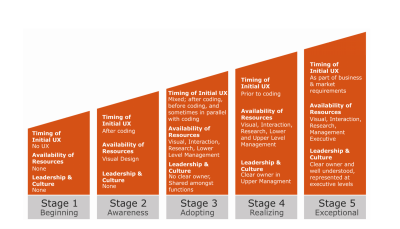
The Five Stages of Maturity
While there is no single universally accepted model, the framework proposed by Chapman and Plewes remains a standard for benchmarking. They categorize organizational maturity into five distinct stages:
- Beginning (Stage 1): The "no-UX" phase where design is an afterthought or non-existent.
- Awareness (Stage 2): Recognition that UX might be important, though it lacks formal processes or budget.
- Adopting (Stage 3): UX is practiced in pockets, usually in response to specific client complaints.
- Integrating (Stage 4): UX becomes a standard part of the development lifecycle.
- Exceptional (Stage 5): UX is fully ingrained in the company culture, with executive-level support and abundant resources.
Moving an organization along this continuum requires more than just high-quality design work. It requires a deliberate strategy to demonstrate value, build internal coalitions, and shift the organizational culture.
Tactic 1: Cultivating UX Champions
In organizations with low maturity, the primary barrier to progress is often political rather than technical. To overcome this, practitioners must identify and leverage "UX Champions"—individuals who, regardless of their formal job title, act as vocal advocates for user-centricity.
The Role of the Champion
Champions are essential for navigating the social and political resistance that often greets innovation. A champion does not necessarily need to be a designer; in fact, they are often product managers, engineers, or mid-level executives who recognize that a poor user experience is hurting the business.
Effective champions typically exhibit specific behaviors: they build internal networks, they are willing to challenge the status quo, and they possess the political capital to clear obstacles. As a UX practitioner, your role is to provide them with the ammunition they need: data, success stories, and clear explanations of how design processes can alleviate their pain points.
Identifying Potential Allies
When seeking a champion, look for individuals who:

- Have a vested interest in the success of a specific product or service.
- Are already expressing frustration with current, inefficient development processes.
- Maintain strong cross-departmental relationships.
- Are willing to invest political energy into new, unproven methodologies.
Case Study: Logistics Transformation
Consider the example of a large international logistics firm. Despite a corporate mission statement promising a "customer-first" approach, the reality on the ground was a patchwork of disjointed, non-UX-driven products. By identifying a key product owner—someone with deep organizational ties and a mandate to improve a critical backend system—consultants were able to insert UX research and design into a previously "code-first" development cycle. Within three months, this champion had successfully advocated for a permanent UX headcount and established a new, sustainable process for incorporating user feedback into the roadmap.
Tactic 2: Demonstrating the ROI of UX
The language of business is ROI (Return on Investment). While designers often speak in terms of "usability" and "delight," stakeholders often speak in terms of "profit and loss." To secure the resources necessary to scale UX maturity, practitioners must learn to translate user experience improvements into financial or operational metrics.
Debunking ROI Myths
Many practitioners hesitate to calculate ROI due to common misconceptions: the belief that UX is too subjective to measure, that metrics take too long to gather, or that ROI is strictly a monetary figure. However, failing to demonstrate the value of UX leaves the department vulnerable to budget cuts during economic downturns.

Measuring What Matters
Metrics should be tailored to the specific goals of the organization. For e-commerce, this might be conversion rates or average order value. For enterprise software, it might be the reduction in customer support calls or the decrease in time required to complete a task.
- Support Costs: High call volumes often correlate with poor UX. Tracking the reduction in support tickets post-redesign is a powerful, quantifiable metric.
- Task Efficiency: Measuring the time it takes to complete a core business process before and after design interventions provides concrete evidence of productivity gains.
- User Satisfaction (CSAT/NPS): While qualitative, consistent tracking of these scores provides a longitudinal view of how the organization is perceived by its users.
Case Study: Insurance Provider Efficiency
A major medical insurance provider provides a stark example of ROI in action. During a platform migration, the company faced a revolt from agents who found the new system unusable. By conducting a series of usability tests and implementing design fixes, the UX team was able to provide data showing a significant decrease in call-center inquiries and a rise in agent satisfaction. This data was presented to an executive committee, successfully securing ongoing funding for a permanent UX workstream. Crucially, the team established a "baseline" metric, allowing them to demonstrate progress in future phases of the project.
Implications for the Future of UX Practice
Growing UX maturity is not a linear process, nor is it the responsibility of one individual. It is a collaborative effort that requires patience, communication, and a willingness to step outside the comfort zone of pure design.

The Path Forward
The journey toward a higher level of UX maturity requires a fundamental shift in how designers view their role. We must evolve from "makers" to "educators" and "advocates." By building coalitions with champions and providing clear, data-driven evidence of ROI, we can transform even the most resistant organizations into entities that truly value the user.
As we look toward the next stages of this series, we will delve deeper into the internal processes required to document and share UX work, as well as the mentorship structures necessary to foster a culture of continuous learning. For those currently working in low-maturity environments, the message is clear: do not wait for permission to be a catalyst for change. Start small, find your allies, measure your impact, and build the business case for a more user-centered future.
Author Note: The insights provided in this article draw upon established frameworks in organizational behavior and design management. Special thanks to Dana Daniels for her contributions to the background research on UX maturity models.
Further Reading
- Chapman, C., & Plewes, M. (2014). "The Five Stages of UX Maturity."
- Nielsen Norman Group: "Three Myths About ROI and UX."
- Shea, C. (2010). "Champions of Product Innovation: Defining and Validating a Measure of Champion Behavior."