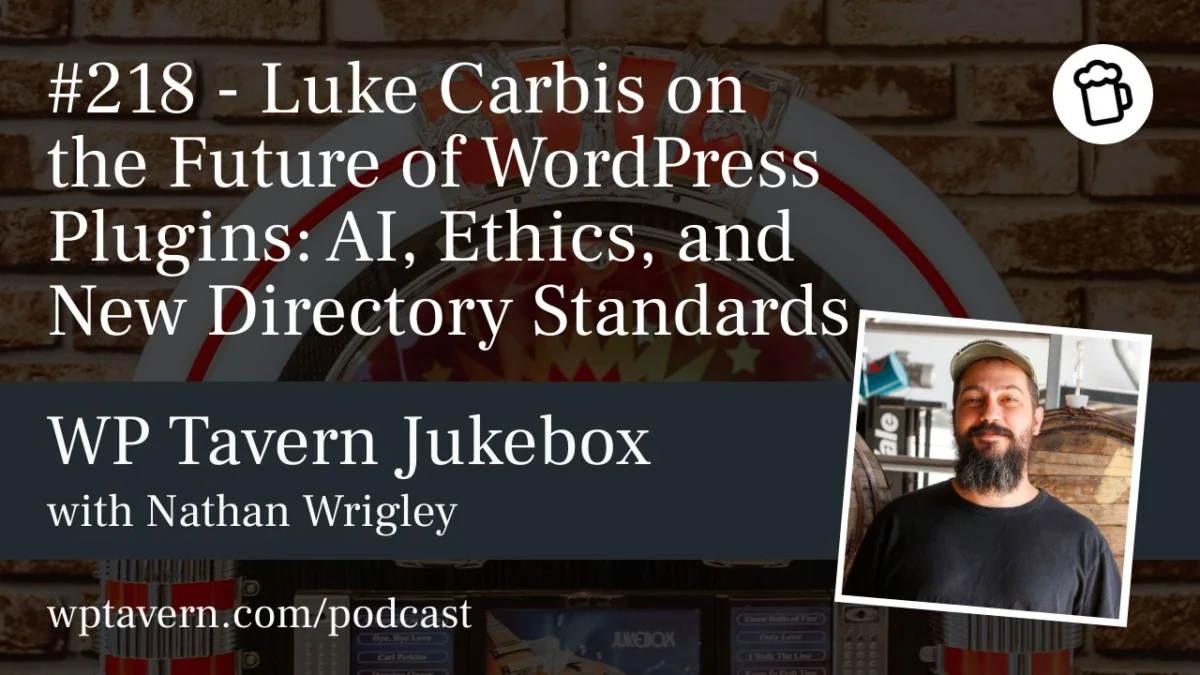
WordPress.org Plugin Directory faces an unprecedented wave of submissions, driven largely by AI-generated tools. In a wide-ranging discussion, Plugin Review Team member Luke Carbis explores the growing pains of the repository, the push for commercial evolution, and the generational divide over artificial intelligence in open source.
Main Facts
The WordPress plugin ecosystem stands at a critical crossroads. In the wake of widespread artificial intelligence adoption, submissions to the official WordPress.org Plugin Directory have surged to roughly four times their historical volume over the past twelve months. This exponential growth has strained the mechanics of discovery, ranking algorithms, and community governance.
During a recent appearance on the WP Tavern Jukebox podcast, hosted by Nathan Wrigley, long-time WordPress contributor and Plugin Review Team member Luke Carbis unpacked the themes of his WordCamp Asia presentation, titled "Beyond the Guidelines: It’s Time to Evolve Our Standards for a Safer Plugin Ecosystem." Carbis, who brings nearly two decades of experience across development, agency leadership, and product management, addressed the stark realities facing the repository today:
- The AI Deluge: While automated and manual reviews have kept wait times down to roughly one week, the sheer volume of code submissions makes it increasingly difficult for high-quality, human-crafted plugins to stand out.
- Algorithmic Disparity: Current ranking systems rely heavily on active installations and support forum responsiveness, a model vulnerable to gaming and one that can bury innovative new tools beneath legacy giants.
- The Commercial Debate: Carbis advocated for bold architectural experiments, including verified user accounts linked across installs, support for "untrusted sources" (such as Git repositories for custom and premium code), and a potential commercial marketplace built directly into WordPress.org.
Chronology: From Community Origins to the AI Inflection Point
To understand the current friction within WordPress, one must examine its evolutionary trajectory over the last twenty years.
The Era of Organic Growth
For much of its history, the WordPress ecosystem expanded organically. Developers built solutions to solve specific client problems, packaged them into plugins, and submitted them to the repository. The community functioned primarily on a philanthropic, open-source ethos where contributions were driven by passion, agency utility, and shared community norms. Discoverability relied on word-of-mouth, blog reviews, and early directory search algorithms.
The Lean Years and Review Bottlenecks
Even prior to the generative AI boom, the Plugin Review Team faced recurring backlogs. A few years ago, deliberate process improvements successfully drove the review queue down to nearly zero. However, this period of equilibrium was short-lived.
The Generative AI Turning Point
With the advent of accessible generative artificial intelligence, the barriers to writing functional software vanished almost overnight. Developers and novices alike could generate functional or semi-functional plugins in minutes. As a result, plugin submissions quadrupled. While the review team adapted by deploying internal tools and expanding their ranks to maintain a steady one-week turnaround, the downstream effects on directory noise and user discovery became acute.
Supporting Data and Ecosystem Metrics
While concrete metrics regarding the exact monetary value of the commercial WordPress plugin market remain opaque, the scale of the ecosystem is massive. Millions of dollars change hands annually through premium plugins, hosting providers, and enterprise extensions.
- Submission Multiplier: Plugin submissions have increased by roughly 400% compared to historical averages from twelve months prior.
- Review Turnaround: Despite the influx, internal process optimisations have kept the average wait time for plugin review at approximately one week.
- Financial Model Proposal: Carbis floated a conceptual fee structure for a hypothetical commercial directory: an 8% transaction fee split between payment processing (3%) and the Five for the Future initiative/Foundation (5%) to fund core development, WordCamps, and reviewer compensation.
Official Responses and Governance Perspectives
The tension between open-source purity and commercial pragmatism has sparked robust debate among project leadership and community veterans.
The Leadership Pivot
Following WordCamp Asia, project co-founder Matt Mullenweg exhibited renewed, hands-on leadership, issuing direct operational directives via community channels. For Carbis, this aggressive style—once viewed with skepticism—now represents a necessary corrective against institutional atrophy.
"On reflection, I’ve decided mentally to recast Matt in my mind from being this Elon Muskian figure, to being someone more akin to Steve Jobs, or DHH… We need clear, direct, active leadership," Carbis noted during the interview.
The Commercial Marketplace Dilemma
Proposals to allow direct commercial sales through the official WordPress.org repository remain contentious. Critics argue that introducing financial transactions to the core directory compromises its open-source integrity, potentially steering the platform toward commercial pressures reminiscent of closed app stores like Apple’s iOS App Store or Google Play. Conversely, proponents argue that a secure, integrated marketplace would streamline licensing, updates, and discovery while generating crucial revenue to sustain community infrastructure.
Implications for the Future of Open Source
The convergence of artificial intelligence, commercial ambitions, and generational shifts presents profound implications for the next decade of WordPress.
The Generational Divide on AI
A striking theme emerging from the community is the psychological and generational friction surrounding AI. While enterprise developers chase productivity gains, younger generations—particularly Gen Z—frequently exhibit deep skepticism toward AI tools, citing environmental concerns and fears of intellectual atrophy.
Carbis shared an anecdote from a media arts classroom where half the students vocally refused to use AI for academic referencing. This disconnect raises a vital question for project leaders: Will aggressive integration of AI in core contributions alienate the next generation of open-source talent?
Granular Disclosure and Trust
To bridge the gap between AI adoption and transparency, Carbis proposed introducing a granular AI disclosure standard within the plugin repository. Rather than a blunt binary checkbox, developers could voluntarily declare their level of AI utilisation—from minor syntax assistance and auto-complete to complete "vibe coding." This metadata would empower users to make informed choices while providing researchers with clear data on how AI impacts plugin maintenance and review scores.
Survival in a Changing Landscape
Ultimately, the WordPress community faces a stark choice. It can either maintain traditional methodologies and risk stagnating as users migrate to alternative, AI-native development platforms, or it can embrace strong leadership, experiment with directory modernization, and carefully integrate new technologies without losing the human-centric spirit encapsulated by the phrase "Code is Poetry."
As the ecosystem navigates these turbulent waters, the dialogue sparked by contributors like Luke Carbis ensures that the community remains actively engaged in shaping its own destiny.