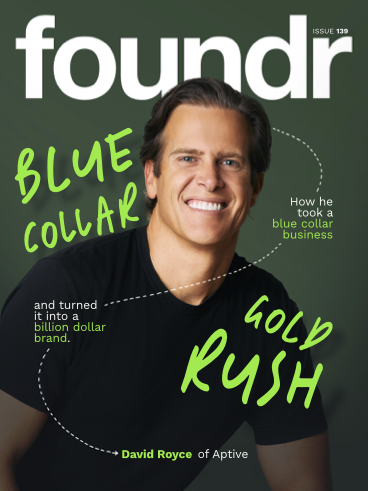
From Door-to-Door Rookie to Billion-Dollar Empire: The Unconventional Playbook of Aptive’s David Royce
By Business and Entrepreneurship Desk Published: October 2024
Main Facts
In the modern landscape of high-stakes entrepreneurship, conventional wisdom dictates that the path to a billion-dollar valuation runs through Silicon Valley venture capital, elite Ivy League credentials, or disruptive artificial intelligence software. David Royce, the founder and chairman of Aptive Environmental—currently the third-largest residential pest control service provider in North America—did not follow this playbook.
Instead, Royce built a multi-million and multi-billion-dollar empire in an industry that his peers with elite finance degrees would not touch with a ten-foot pole. His core thesis on success is deceptively simple: true achievement is rarely about picking the trendiest industry, holding a prestigious degree, or seizing an opportunity that looks polished on paper. Rather, success belongs to those willing to execute the unglamorous, difficult tasks that nobody else wants to touch, sustaining that effort long enough to master them.
Royce’s commercial footprint includes three lucrative, multi-million-dollar exits to the same strategic buyer, followed by the astronomical rise of Aptive, which scaled past $500 million in annual revenue. Sitting down with Foundr CEO Nathan Chan, Royce peeled back the layers of his journey, revealing how an undiagnosed childhood learning struggle, a relentless summer sales job, and an unflinching focus on cash flow converted him into one of American business’s stealthiest wealth builders.
Chronology: From Academic Struggles to Industry Titan
1. The Early Years and Finding a Superpower
Growing up, David Royce struggled intensely within traditional academic environments. Unable to focus unless he felt a deep, personal connection to the subject matter, he internalized the common childhood narrative: I guess I’m not smart.
That trajectory shifted permanently in the sixth grade when a teacher named Mrs. Luft recognized his potential and believed in him before he believed in himself. Propelled by that validation, Royce dedicated himself to earning strong grades. It was not until adulthood that he discovered the underlying driver behind his educational friction: undiagnosed Attention Deficit Hyperactivity Disorder (ADHD).
Rather than viewing the condition as a permanent liability, Royce reframed it as a double-edged sword. In monotonous, unengaging settings, it proved debilitating; in high-stakes environments that captured his interest, it functioned as an absolute superpower. Sales and entrepreneurship ultimately provided the first arenas where his wiring felt like an asset rather than a liability.
2. The Crucible of Door-to-Door Sales
Royce entered the pest control industry by accident during his college years, drawn by a friend’s claim of making $25,000 selling door-to-door over a single summer. Driving out to Sacramento, California, Royce faced immediate, humbling failure. Operating on a commission-only structure, he failed to secure a single sale during his entire first week, enduring five straight days of zeros while watching his peers close one to four accounts daily.
Refusing to call home in defeat, Royce spent the weekend at a local bookstore. He purchased half a dozen sales books and committed to 90 minutes of daily study. By the end of that summer, out of a cohort of 200 representatives, Royce emerged as the top sales rookie in the company.
Reflecting on that pivotal summer, Royce distilled his hard-earned sales methodology into three core pillars:
Option Closes: Replacing yes-or-no questions with alternative choices ("We’ll be in your area tomorrow at three or five; which works better?"), where both potential answers favor the salesperson.
The RAC Framework: Resolving the prospect’s underlying doubt, introducing an "ace" argument they have not yet considered, and closing through an alternative angle.
Body Language Mastery: Recognizing that physical posture communicates confidence before a script is ever spoken. As Royce frequently told his teams, deals are rarely lost because of a bad script; they are lost when a representative’s demeanor telegraphs anxiety.
3. Transitioning to Entrepreneurship
During his final year of college, Royce prepared for a conventional career path in investment banking, believing his finance degree and sales prowess naturally positioned him for mergers and acquisitions. When he asked his regional manager for a letter of recommendation, the manager challenged his assumptions: Why work 80 to 100-hour weeks making someone else rich when you could start your own pest control company?
Initially constrained by the perceived lack of prestige—associating business success exclusively with corporate suits and skylines—Royce remembered an earlier lesson in humility. At age fifteen, after being let go from a local pizza parlor, he took a job at McDonald’s simply because it was the only employer hiring. That minimum-wage experience taught him the critical value of operational best practices.
Swallowing his ego, Royce looked past the unsexy image of pest control and evaluated the raw business fundamentals. His former boss, who had successfully sold his startup to Terminix for $10 million after four years, offered him a blueprint. Armed with $300,000 saved from four summers of high-performing sales work—money originally earmarked for an MBA—Royce launched his entrepreneurial career.
4. The Near-Bankruptcy in Los Angeles
Year one in Los Angeles brought an existential business lesson: a company can be experiencing hyper-growth while simultaneously marching toward insolvency.
Royce had projected capturing 4,000 to 5,000 new customers in his inaugural year. Instead, his sales machine drove 7,500 new accounts—surpassing anything previously recorded from a single branch in the industry. However, the business model required paying sales commissions upfront before incoming customer revenues materialized, triggering a severe cash flow crisis.
Faced with impending payroll failure, Royce turned to his sales leaders. He negotiated to delay their bonus distributions by one to two months, sweetening the terms with an additional 10% interest return on their capital. Because his team had enjoyed a phenomenal summer, they agreed to back him.
The near-miss permanently altered Royce’s financial philosophy, cementing a foundational maxim that he would carry across all future ventures: "Revenues are vanity. Profits are sanity. But cash flow is reality."
Supporting Data: The Power of Blue-Collar Economics
Royce’s multi-company strategy relied heavily on an innovative asset deal structure. Across his first three ventures, rather than selling entire corporate entities, Royce executed asset sales transferring only customer accounts and servicing technicians to strategic buyers. Because the buyers already possessed established back-offices and corporate brands, they valued the recurring revenue streams above all else.
By retaining his core leadership team, operations managers, and elite salesforce, Royce preserved his organizational engine. He then deployed the capital from each exit to launch subsequent companies in fresh markets with superior capitalization—avoiding outside venture capital, bypassing equity dilution, and scaling faster than 95% of the market.
Data supports Royce’s affinity for blue-collar sectors. According to financial insights referenced from publications like The Wall Street Journal, the top 0.1% of U.S. income earners—individuals bringing in $2.3 million or more annually—feature a striking concentration in unglamorous, essential service industries. Approximately 43% of these ultra-high-earning business owners operate in mundane sectors such as waste management, HVAC, plumbing, and pest control.
Furthermore, macroeconomic tailwinds continue to amplify the value of these assets:
The Silver Tsunami: Millions of Baby Boomer business owners are reaching retirement age, the vast majority lacking an internal succession plan.
Recession Resistance: Essential services feature high customer retention and recurring revenue models. As Royce aptly notes: "Recessions come and go, but bugs don’t read The Wall Street Journal."
AI Insulation: While artificial intelligence rapidly automates entry-level office workflows, legal analysis, and software development, it cannot unclog a drain, climb a residential roof, or treat subterranean termite colonies.
Official Responses and Strategic Philosophy
Throughout his tenure as a chief executive, Royce intentionally cultivated a distinct organizational culture. Inspired by Tony Hsieh’s seminal book Delivering Happiness, Royce recognized that corporate culture cannot be left to organic chance; it must be engineered by design.
Culture as Design, Not Just Perks
While Aptive became famous for its over-the-top employee perks—including an indoor NCAA basketball court at headquarters, golf simulators, team trips to Thailand and Egypt, skydiving excursions, and Ferrari track racing—Royce remained pragmatic about their true utility.
"Perks are sugar. They’re not the protein," Royce explained. "The primary driver attracting top talent was always the training program. They wanted to sell more than at any other company."
The ultimate test of his cultural philosophy materialized during the eventual sale of Aptive. Royce chose to allocate 25% of the company’s equity directly to his employees. Given that companies in the residential services sector frequently command valuations between one and three times annual revenue, a $500-million-plus revenue business translated into a nine-figure payout distributed directly to team members.
Employees utilized their windfalls to clear mortgages, eliminate student debt, and purchase vehicles for their parents. To Royce, true ownership proved far more effective for long-term retention than any physical office amenity.
Stepping Aside and the Cost of Misaligned Hires
For a decade, Royce meticulously prepared his protégé—who had joined the company as a sales representative during Royce’s second year in business—to assume the chief executive seat. When the transition occurred, Royce confronted the ultimate leadership hurdle: learning to step back and stop acting as the operational hero.
"Leadership at that level means letting someone else win, even if they’d do it differently. I had to stop being the hero and start being the architect."
However, subsequent executive transitions underscored the fragility of scale. When Royce hired a seasoned Chief Financial Officer with a pedigree from a billion-dollar technology company, he granted him wide autonomy. The mismatch proved costly. Accustomed to managing massive corporate layers, the new CFO failed to track how operational expenses rippled through Aptive’s specific business model during a planned partial sale process.
As forecasts were repeatedly missed, prospective institutional buyers—who had initially valued the company between $1 billion and $1.6 billion—withdrew their offers one by one. The failed transaction delivered a stark operational lesson: resumes do not run companies; operational alignment does. Furthermore, missing financial forecasts during an active sales process hands complete negotiating leverage back to buyers.
Implications
David Royce’s trajectory offers a profound counter-narrative to modern startup culture. By deliberately choosing to ignore the superficial glamor of tech-centric entrepreneurship, he unlocked extraordinary wealth in an overlooked sector through relentless execution, rigorous cash flow discipline, and deep respect for the human element of business.
Reflecting on twenty years across four distinct companies, Royce noted that entrepreneurship ultimately transcends financial exits or valuation milestones:
"Entrepreneurship isn’t really about a big exit or financial freedom. It’s the expertise, discipline, and character you develop along the way. If you don’t enjoy the climb, the summit is going to disappoint you."
Ultimately, Royce’s enduring legacy is measured less by enterprise valuations and more by human capital development. True to the wisdom that a leader’s greatness is measured by the leaders they create, Royce’s blueprint stands as an invitation for modern founders to look past prestige, embrace unglamorous operational realities, and do the difficult work that nobody else is willing to do.