The landscape of digital analytics has undergone a seismic shift. Over the past twelve months, the team at Google Analytics (GA) has rolled out a suite of sophisticated features designed to move practitioners away from mere "reporting" and toward high-altitude, high-value strategic decision-making. These updates are not just cosmetic; they represent a fundamental change in how marketing functions—including Finance and C-suite leadership—interact with data.
For the serious marketing and analytics professional, these tools are the bridge between being a "Reporting Squirrel" (someone who gathers nuts/data without context) and an "Analysis Ninja" (a strategic partner who influences revenue). However, a critical caveat remains: many of these features are "forward-only," meaning they begin collecting and processing data from the moment of activation. There is no backfilling. As the industry moves toward a more predictive model, the urgency to activate these features is not just recommended—it is a competitive necessity.
1. The Era of Answer Engine Optimization (AEO)
The rise of AI-driven search has irrevocably altered the traffic funnel. As predicted by industry analysts, SEO traffic has faced a 20% to 30% decline as users increasingly rely on Answer Engines (AEs) like ChatGPT, Claude, and Google’s own AI Overviews.
New Visibility in GA
GA now provides native tracking for this phenomenon. Under Reports > Acquisition > Traffic Acquisition, users can now identify the "AI Assistant" channel. The system automatically maps traffic from major LLM-driven platforms to this channel, with the medium set to ai-assistant and the campaign tagged accordingly. No manual setup is required, though the data only begins appearing from mid-May 2026.
The Margin Story
While AEO traffic typically accounts for a small slice of total sessions (1%–5%), its quality is disproportionately high. Data from Adobe and Shopify indicate that AEO-driven conversions perform 42% better than traditional organic search, with users spending 48% more time on product pages and generating 37% higher revenue per visit.
Strategic Implication: This is not a traffic story; it is a margin story. AEO is about influence. Even if a user does not click through to your site, the influence exerted by an AI summary can drive offline sales or brand sentiment. Marketers should focus on "session key event rates" rather than raw volume.
Cautionary Note: Google currently categorizes its own "AI Overview" traffic as standard "Organic Search," which may artificially inflate organic performance metrics. Analysts are advised to manually tag reports to highlight this "understated LLM traffic" to ensure stakeholders understand the true source of demand.
2. Advanced Conversion Attribution Analysis
"Assisted Conversions" have returned to the forefront of Google Analytics, providing the necessary context to move beyond the flawed "Last Click" attribution model.
Moving Beyond Last Click
The new Advertising > Conversion Attribution Analysis tool allows marketers to visualize the entire consumer journey. For instance, while TikTok might appear to drive a modest number of direct conversions, a deep dive into assisted conversions often reveals it is present in 33% of multi-touch paths.
- Lone Rangers: Channels that function as single-touchpoint drivers.
- Influencers: Channels that appear in the early/mid-funnel but rarely close the deal.
- Closers: Channels that consistently finalize complex journeys.
By utilizing this, teams can stop "throwing spaghetti at the wall" and move toward data-backed investment. If a channel is a primary driver of assists, it should be defended, not cut, during budget reviews.
3. Cross-Channel Budgeting and Predictive Modeling
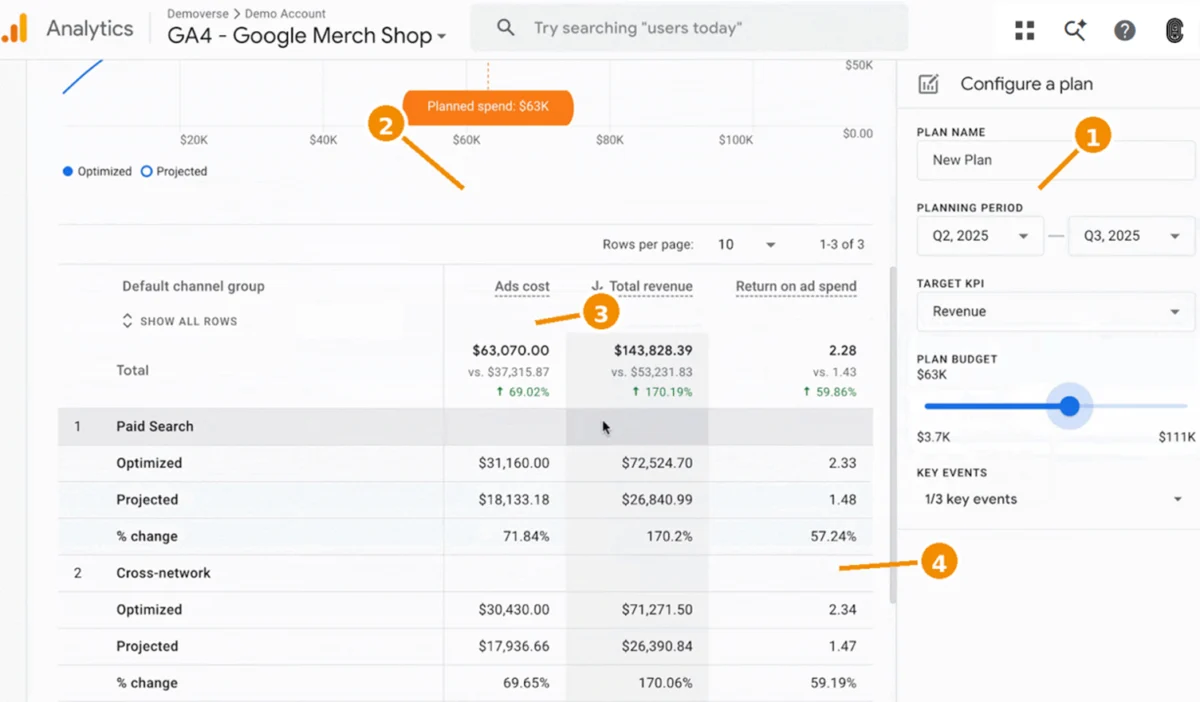
The gap between an insight and a decision is often where careers stall. The new Cross-Channel Budgeting feature, found under the Advertising tab, aims to close this gap by providing predictive scenarios.
Project Plans vs. Scenario Plans
- Project Plans: These address pacing, answering the question: "Is our current spend on track, and what will it deliver?"
- Scenario Plans: These address allocation. "What happens if I move $250,000 from Paid Social to Paid Search?"
These models leverage historical data, seasonality, and external factors to forecast outcomes. The most transformative aspect is the ability to run "What If" scenarios in front of leadership. Instead of presenting post-mortem reports, analysts can now facilitate a planning session, helping the business make informed, objective decisions rather than being swayed by the loudest voice in the room.
The "Substitutability" Discovery: Many organizations have found that shifting 20% of their budget between channels barely moves the revenue needle. This realization is profound; it suggests that the real lever for growth lies elsewhere—perhaps in user experience or product pricing—rather than in the minutiae of ad platform optimization.
4. Conversational Analysis: The "Ask Advisor" Revolution
The manual navigation of complex reports is becoming a relic of the past. The "Ask Advisor" feature, accessible via the magnifying glass icon in the GA interface, allows users to query their data in plain English.
Bridging the Gap with ESLs
Extremely Senior Leaders (ESLs) often struggle to extract value from standard GA interfaces. "Ask Advisor" empowers these leaders to self-serve. They can ask, "What changed for my top two revenue-generating products over the last 30 days?" and receive an immediate, synthesized response.
For deeper analysis, Google has released a GA MCP (Model Context Protocol) server. This allows developers to connect GA data directly to external LLMs like ChatGPT or Claude. This integration removes the boundaries of GA, enabling cross-referencing with internal promo calendars, offline sales data, and competitor analysis in a single, cohesive workflow.
5. Summary of Supplemental Features
Beyond the primary four, two additional features provide immediate value:
- Source Group Consolidation: This eliminates the "regex hell" of cleaning up fragmented source names (e.g.,
facebook,fb,meta-facebook). It allows for a single, clean view of platform performance, retroactive to past data. - LTV Percentile: GA now offers a field that automatically identifies the top percentile of Lifetime Value (LTV) users. By identifying the top 5% of customers who drive 40% of profit, marketers can feed this segment into Google Ads to find more "high-value lookalikes," shifting focus from quantity to profitability.
Implications for the Future
The evolution of Google Analytics in 2026 marks the end of the "Data Puke" era—where analysts simply dump numbers into a dashboard and hope for the best.
The new standard is predictive activation. By leveraging AEO tracking, assisted conversion funnels, cross-channel budget scenarios, and conversational AI, the modern analyst is no longer just reporting on what happened. They are now architects of what happens next.
Final Recommendations
- Audit Readiness: Check your GA settings today to ensure you are eligible for Cross-Channel Budgeting and Attribution features.
- Don’t Fear the Model: Remember that all models are wrong, but some are useful. Present your findings as "projections" or "estimates," not absolute forecasts.
- Prioritize Integration: Connect your GA data to your firm’s approved LLM via the MCP server to expand your analytical reach beyond the browser window.
We are currently in a transition phase. The professionals who embrace these tools will find their influence growing, their compensation increasing, and their role shifting from "back-office support" to "strategic business partner." The capability is there—it is now up to the practitioner to activate it.