Google has officially transitioned its next-generation advertising solution, AI Max, out of beta. The tool is designed to monetize the vast and growing ecosystem of complex, conversational search queries that have historically eluded traditional keyword-based targeting.
During Alphabet’s Q2 2026 earnings call, Google executives revealed that the technology is already being used by over half a million advertisers. This transition marks a fundamental shift in how search advertising operates, moving the industry away from exact-match keywords and toward semantic, intent-based matching powered by large language models (LLMs).
1. Main Facts: The Structural Shift in Search Monetization
The graduation of AI Max from a beta test to a fully realized commercial product represents one of the most significant changes to Google’s ad infrastructure since the introduction of Performance Max (PMax). The core objective of AI Max is to unlock what Google describes as "billions" of previously unmonetized or under-monetized search queries.
Historically, search advertising relied on a relatively straightforward architecture: advertisers bid on specific keywords or search phrases, and Google matched those bids with user queries. However, as user behavior has shifted toward natural, conversational language—largely driven by the rise of generative AI interfaces and voice search—queries have become longer, highly complex, and syntactically ambiguous.
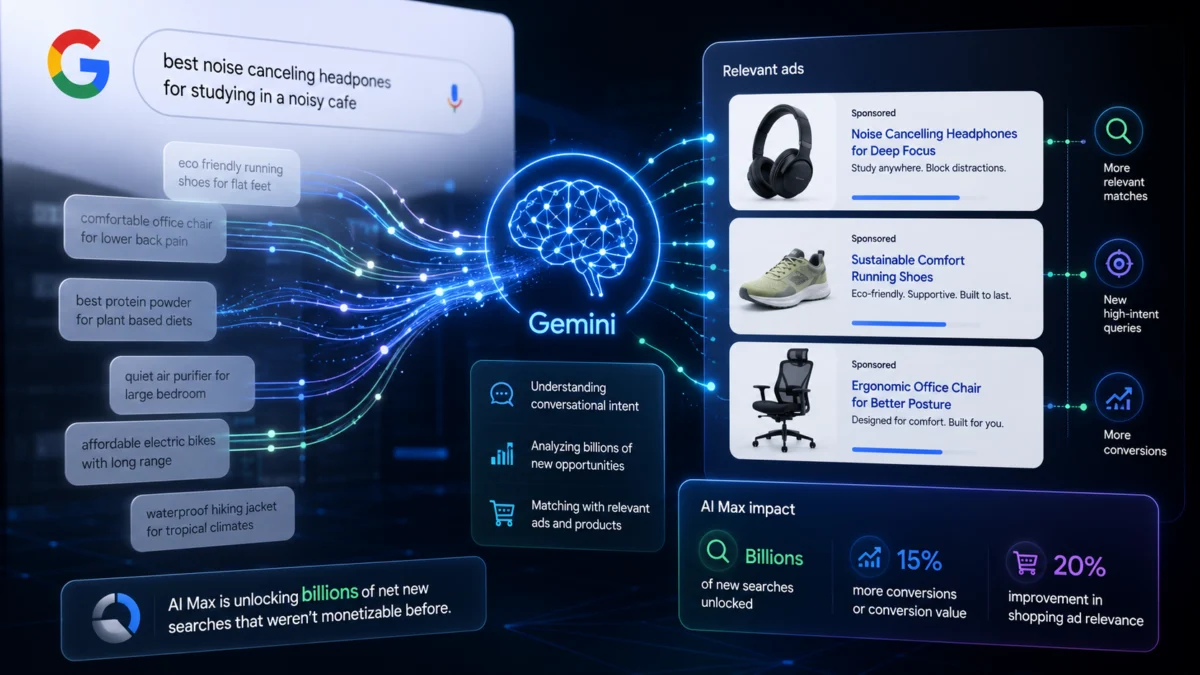
Traditional keyword targeting systems frequently fail to match ads to these long-tail queries because the exact phrasing does not exist in the advertiser’s keyword portfolio. AI Max addresses this structural limitation by using Google’s Gemini model to interpret the underlying commercial intent of a complex search, allowing Google to dynamically insert highly relevant ads without requiring exact keyword matches.
Key Takeaways from the Rollout:
- Beta Exit and Scale: AI Max has officially exited its beta phase and has been adopted by more than 500,000 advertisers globally.
- The Conversion Premium: Advertisers utilizing AI Max alongside or within Performance Max campaigns are experiencing an average 15% lift in conversions or conversion value at a similar return on ad spend (ROAS).
- Gemini-Powered Precision: The integration of the Gemini model has improved the relevance of Shopping ads for complex queries by approximately 20%.
- Inventory Expansion: Rather than merely optimizing existing ad placements, AI Max is actively generating new ad inventory by placing ads within conversational search results that previously carried no commercial messaging.
2. Chronology: The Evolution of AI-Driven Advertising at Google
To understand the launch of AI Max, it is necessary to trace Google’s multi-year transition from manual search bidding to an entirely algorithmic, AI-first advertising ecosystem.
[Pre-2020] Manual & Smart Bidding Era (Keyword-centric matching)
       │
[2020] Launch of Performance Max (PMax) (Cross-channel automation)
       │
[2023] Introduction of Search Generative Experience (SGE) & Gemini Integration
       │
[2024-2025] Beta Testing of AI Max (Targeting complex, conversational queries)
       │
[Q2 2026] Official Commercial Release (AI Max leaves beta; 500,000+ advertisers)
The Keyword-Centric Era (Pre-2020)
For over two decades, the search engine results page (SERP) was governed by keywords. Advertisers managed complex structures of exact match, phrase match, and broad match keywords, paired with manual or semi-automated bidding strategies. While highly precise, this system struggled to capture the "long tail" of search—the estimated 15% of daily searches that Google has never seen before.
The Rise of Performance Max (2020–2023)
In 2020, Google introduced Performance Max (PMax), a campaign type that allowed advertisers to access all of their Google Ads inventory from a single campaign. PMax marked Google’s first major step toward removing manual keyword management, relying instead on machine learning to optimize budgets across Search, YouTube, Display, Discover, Gmail, and Maps.
The Generative AI Inflexion Point (2023–2025)
With the launch of ChatGPT and Google’s subsequent rollout of Search Generative Experience (SGE)—later rebranded as AI Overviews—user search behavior underwent a rapid transformation. Users began treating the search box as a conversational partner, typing full paragraphs, asking multi-part questions, and seeking contextual advice.
In response, Google began integrating its Gemini LLM into its core search and advertising products. This integration allowed the search engine to understand semantic meaning rather than just syntactic matching. During this period, Google quietly initiated beta testing for "AI Max," an ad system specifically engineered to bridge the gap between LLM-generated conversational search results and commercial advertising.
Full Commercial Rollout (Q2 2026)
At the Q2 2026 earnings call, Google declared AI Max fully operational and out of beta. The technology is now a primary driver of Google’s search revenue growth, enabling the company to monetize highly specific, multi-sentence user queries that were previously left unmonetized.
3. Supporting Data: Quantifying the Impact of AI Max
The financial and operational metrics shared during Alphabet’s Q2 2026 earnings call highlight the rapid adoption and economic viability of AI Max.
Advertiser Adoption and Performance Metrics
According to data released by Google, the transition to AI-driven query matching has yielded immediate, measurable performance improvements for early adopters:
| Metric | Performance Impact | Context / Details |
|---|---|---|
| Advertiser Adoption | 500,000+ | Total active advertisers utilizing AI Max globally. |
| Conversion Uplift | ~15% Increase | Average lift in conversions or conversion value achieved at a stable ROAS. |
| Shopping Ad Relevance | 20% Improvement | Increase in the semantic alignment of Shopping ads to complex search queries, driven by Gemini. |
| Unmonetized Query Capture | "Billions" of searches | The volume of long-tail queries successfully monetized for the first time. |
The Mechanics of a 20% Relevance Gain
The 20% improvement in Shopping ad relevance is particularly significant for e-commerce brands. Under traditional keyword systems, if a user searched for "waterproof lightweight hiking boots with wide toe box and arch support under $150," the system might struggle to match the query with a specific product because no advertiser bid on that exact 13-word string.
With Gemini-powered AI Max, the system parses the query to extract key attributes:

- Category: Hiking boots
- Technical Specifications: Waterproof, lightweight
- Fit Requirements: Wide toe box, arch support
- Price Sensitivity: <$150
The model then scans the advertiser’s product feed to find inventory matching those specific semantic parameters, serving a highly targeted Shopping ad despite the absence of an exact keyword match.
4. Official Responses: Executive Commentary and Corporate Strategy
During the Q2 2026 earnings call, Alphabet’s executive leadership framed AI Max not merely as a new campaign tool, but as a fundamental pillar of Google’s long-term monetization strategy.
Philipp Schindler, SVP and Chief Business Officer
Philipp Schindler detailed how AI Max is solving the long-standing challenge of complex query monetization:
"AI Max is helping us bridge the gap between highly complex, ambiguous search behavior and real-world commercial intent. Historically, when users typed long, conversational queries, our systems struggled to match those searches with relevant ads because they didn’t align with traditional keyword portfolios. Today, with the power of Gemini, we are able to understand the nuances of these queries and match them with the perfect advertiser offering. This is opening up billions of previously unmonetized searches to our advertising partners, driving performance at scale."
Schindler also emphasized that AI Max is expanding the total addressable market (TAM) for search advertising by creating new ad inventory inside search formats that did not exist prior to the deployment of generative AI.
Sundar Pichai, CEO of Alphabet (Contextual Strategy)
While Schindler focused on the operational mechanics, Sundar Pichai addressed the broader strategic implications of Gemini-driven search. Pichai noted that as generative AI experiences like AI Overviews become the default search interface for hundreds of millions of users, the monetization of these formats must keep pace. AI Max, according to Pichai, is the engine that ensures Google’s ad-supported business model remains highly profitable in the conversational search era.
5. Implications: What AI Max Means for the Search Ecosystem
The commercialization of AI Max has profound implications for digital marketers, search engine optimization (SEO) professionals, and the broader digital advertising industry.
1. The Decline of the Keyword as the Primary Optimization Lever
For decades, keyword research was the foundation of search engine marketing (SEM). Marketers spent billions of dollars optimizing keyword match types, negative keyword lists, and bids. AI Max signals a transition toward an era where the keyword is secondary to intent and asset quality.
To succeed in an AI Max-dominated landscape, advertisers must shift their focus to:
- Rich Product Feeds: E-commerce advertisers must ensure their Google Merchant Center feeds are incredibly detailed, containing exhaustive product attributes, high-quality images, and structured data.
- Semantic Landing Pages: Landing pages must be written in natural language that clearly explains the utility and specifications of a product or service, allowing Google’s crawlers to easily match the page to complex conversational queries.
- Creative Asset Variety: Advertisers must provide a diverse matrix of headlines, descriptions, images, and videos, allowing the AI to dynamically assemble the most relevant ad creative for any given user context.
[Traditional Search Ad Flow]
User Search Query ──> Keyword Match ──> Static Ad Creative ──> Landing Page

[AI Max Search Ad Flow]
User Search Query ──> Gemini Intent Parsing ──> Dynamic Ad Assembly ──> Semantic Landing Page Match
2. The "Black Box" and the Transparency Trade-off
While a 15% average increase in conversions is highly appealing, it comes at a cost: transparency. AI Max operates as a "black box" solution. Because the system matches ads based on real-time semantic understanding rather than pre-defined keywords, advertisers have significantly less visibility into exactly which search queries triggered their ads.
This lack of granular search query data makes it more difficult for brands to:
- Identify negative search trends.
- Protect brand bidding terms.
- Extract direct consumer insights from search query reports (SQRs).
Marketers will need to balance the efficiency and reach of AI Max against the loss of control over their brand safety and strategic data.
3. The Rise of "AI Search Optimization" (AISO)
The shift toward conversational search and automated ad matching is also reshaping the SEO industry. As search engines evolve into answering engines, organic visibility is no longer just about ranking blue links on a page. Brands must now optimize their web presence to ensure that AI models—like Gemini—can easily read, understand, and cite their content in conversational outputs. This emerging discipline, often referred to as AI Search Optimization (AISO), focuses on digital footprint management, structured schema, and authoritative, answer-oriented content.
4. Financial Outlook for Alphabet
From a macroeconomic perspective, AI Max provides a clear runway for Alphabet to sustain search revenue growth. As search volumes plateau in mature markets, the ability to extract higher average revenue per query (ARPU) by monetizing the "long tail" of conversational search is highly lucrative. By turning billions of previously unmonetized, highly specific queries into high-converting ad opportunities, Google is effectively expanding its ad inventory without needing to increase the overall density of ads on standard search queries.