Main Facts
Cloudflare’s trajectory over the past year offers a masterclass in modern tech industry pivots, highlighting how aggressive AI adoption, strategic workforce restructuring, and surging developer metrics can coalesce to drive hyper-growth. Reporting a staggering latest-quarter revenue of $696.1 million—a 36% year-over-year increase that annualizes to an impressive $2.8 billion run rate—Cloudflare has decisively altered its financial standing.
This financial acceleration stands in stark contrast to the company’s position just months prior. Earlier, Cloudflare underwent a massive restructuring, cutting over 1,100 roles (roughly 20% of its workforce) and absorbing a steep 23% stock drop. Yet, Q2 results shattered expectations, sending the stock surging 17% in after-hours trading. Shortly thereafter, the company capitalized on its momentum by raising $2.5 billion at a 0% coupon.
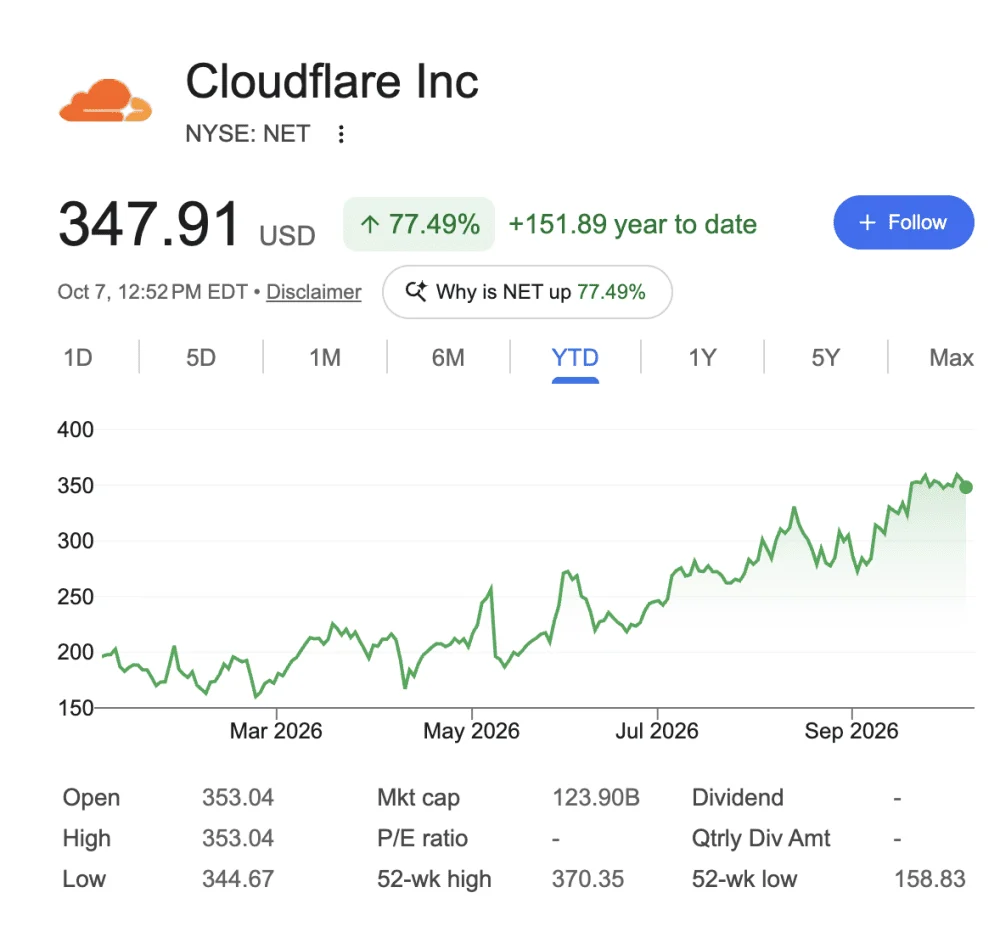
By October 6, Cloudflare’s stock closed at $355.01, bringing its market capitalization to approximately $126 billion—a dramatic leap from its $214.59 close in September 2025. Over this 12-month period, the company’s stock skyrocketed by 65%, driven by a combination of a 34% increase in trailing revenue and a roughly 25% expansion in its revenue multiple (climbing from roughly 40x to 50x trailing twelve-month revenue).
Chronology of a Turnaround
To understand how Cloudflare achieved this velocity, one must trace the timeline of strategic decisions, workforce adjustments, and macroeconomic tailwinds that defined its explosive fiscal year.
The Restructuring and the AI Pivot (Early 2025 – Mid 2025)
- May 7 (Q1 Earnings Call): Cloudflare announced the elimination of 1,100 positions, impacting about one-fifth of its employees. CEO Matthew Prince shocked observers by stating the move was "not a cost-cutting exercise," but rather a structural realignment made possible by hyper-efficient internal AI integration.
- The Internal AI Wave: Prince revealed that internal AI usage at Cloudflare had surged by more than 600% over a three-month span, with 97% of its Research & Development teams actively utilizing AI coding assistants. Notably, departing employees were kept on the payroll through December, softening the human blow while immediately capturing operational efficiencies.
- Q1 to Q2 Acceleration: Following the restructuring, quarterly growth rates accelerated sequentially. Moving from 27% in Q1 2025, the growth series climbed steadily: 28%, 31%, 34%, 34%, and finally culminating in 36% for Q2.
The Product and Developer Explosion (Late 2025 – October 2026)
- August 2026: Recognizing the market appetite for automated business workflows, Cloudflare open-sourced "Cloudflare OS"—the internal agentic tooling originally built for its finance, legal, and procurement teams.
- October 1 (Birthday Week): Cloudflare opened a waitlist for a fully managed version of Cloudflare OS, drawing immediate interest from major systems integrators.
- October 6: Cloudflare closed at $355.01, cementing its status as an elite enterprise software darling fueled by both human and autonomous agent activity.
Supporting Data and Financial Metrics
Cloudflare’s performance metrics across Q2 underscore a healthy balance of self-service (PLG) momentum and massive enterprise deal-making.
Revenue and Growth Accelerations
- The Beat: Q2 revenue reached $696.1 million, easily beating the consensus estimate of $664.7 million by $31 million.
- Net Retention Rate (NRR): Moving in tandem with top-line growth, Cloudflare’s NRR climbed from 114% to 120%.
- Forward Guidance: Management offered a prudent outlook for the subsequent quarters. Q3 was guided to a range of $736 to $737 million (roughly 31% growth), while full-year guidance was set at $2.864 to $2.870 billion (approximately 32% growth). This implies a Q4 growth rate of around 29%. CFO commentary noted that shifting contract mixes make short-term quarterly revenue forecasting increasingly complex, justifying the conservative guide.
Developer and Customer Acquisitions
- Developer Growth: Cloudflare closed Q2 with 7.4 million developers, welcoming nearly 2 million new sign-ups in a single quarter—outpacing the 1.5 million developers added during the entirety of 2025.
- Paying Customers: The platform added over 80,000 paying customers in Q2 alone, matching its total paying customer count at the time of its 2019 IPO and representing a 74% year-over-year increase.
- Remaining Performance Obligations (RPO): Total RPO reached $2.732 billion, up 38% year-over-year, with current RPO rising 35%.
Enterprise Deal Structures
While self-serve platforms fueled by "vibe coding" platforms (such as Replit, Lovable, and Base44) drove massive developer influxes, Cloudflare’s enterprise sales motion set record-shattering milestones:
- A 5-year, $31.8 million contract with a major media organization.
- An 18-month, $15.9 million deal with a Fortune 1000 technology company.
- A 3-year, $11 million contract with a European Global 2000 enterprise.
- Pool-of-Funds Contracts: Notably, three of the eight highlighted enterprise deals utilized "pool-of-funds" structures—flexible dollar commitments that customers can draw down across any product line (predominantly the Workers developer platform), mirroring models like CrowdStrike’s Falcon Flex.
Official Responses and Strategic Vision
Management commentary during the earnings disclosures provided crucial context regarding how artificial intelligence is fundamentally rewriting the economics of cloud computing.

CEO Matthew Prince emphasized that the unprecedented surge in developer adoption is heavily tied to the rise of autonomous coding and agentic workflows. As non-human traffic officially surpassed human traffic on Cloudflare’s global network in May 2026—more than a year ahead of previous forecasts—the company recognized an existential shift in internet architecture. Prince projects that non-human traffic could eventually eclipse human traffic by a factor of 1,000 within five years.
To capture this paradigm shift, Cloudflare introduced an innovative infrastructure layer tailored for machine-to-machine commerce:
- Monetization Gateway: Allows customers to effortlessly monetize any web resource, API, dataset, or Model Context Protocol (MCP) tool behind Cloudflare’s security perimeter.
- Wallets & Cloudflare.pay: Infrastructure designed to handle identity, trust, and secure financial transactions executed autonomously by AI agents.
While these emerging payments layers have yet to contribute meaningfully to the top line—with Workers and SASE remaining the primary revenue engines—they position Cloudflare uniquely at the intersection of web security, edge computing, and agentic commerce.
Regarding internal operations, Prince defended the controversial workforce reduction, reiterating that internal efficiency gains driven by AI coding tools allowed a leaner team to achieve unprecedented output. Rather than abandoning enterprise sales for a pure product-led growth (PLG) model, leadership reaffirmed its commitment to high-touch enterprise agreements, noting dryly regarding multi-million-dollar deals that "no one’s putting it on a credit card."
Implications for the Industry
Cloudflare’s Q2 financial triumph and strategic evolution carry profound implications for the broader SaaS, cloud computing, and enterprise technology landscapes:
- The Validation of AI-Driven Restructuring: Cloudflare has provided the market with a rare, empirical case study showing that workforce reductions paired with deep internal AI adoption can actively accelerate revenue growth rather than stifle it. By productizing its internal automation tools (Cloudflare OS), the company has opened up entirely new commercial avenues.
- The Era of Non-Human Internet Traffic: With bots officially outnumbering humans on its network, Cloudflare’s pivot toward building financial and security rails for autonomous agents establishes a blueprint for internet infrastructure providers. As AI agents increasingly negotiate, code, and transact on behalf of humans, specialized gateway and payment protocols will become mission-critical.
- The Evolution of Consumption Pricing: The migration away from rigid, ratable software subscriptions toward flexible, multi-product "pools of funds" and consumption-based models reflects changing enterprise demands. While this complicates predictability for CFOs and investor guidance, it drastically lowers friction for enterprise adoption and early renewals.
- The Rise of "Vibe Coding" and Edge Deployment: The influx of nearly 2 million developers in a single quarter demonstrates how generative AI coding environments are democratizing software creation. Because platforms like Workers efficiently bill only when code is actively executing, they are uniquely optimized for the bursty, dynamic execution profiles of AI agents and automated scripts.
Ultimately, Cloudflare has transitioned from a traditional content delivery network and cybersecurity provider into a foundational compute and transaction layer for the agentic internet. If the company can maintain its current growth cadence while navigating the forecasting challenges of consumption-based enterprise contracts, its $2.8 billion run rate may soon look like a mere stepping stone in its AI-fueled ascent.