Introduction and Main Facts
At 8:49 a.m. Eastern Time on Tuesday, September 11, 2001, the world changed forever. CNN abruptly cut away from a commercial break to broadcast a live, trembling video image of thick, dark smoke billowing from a gaping, jagged wound in one of the twin towers of the World Trade Center in New York City. Anchor Carol Lin delivered the first tentative, unconfirmed reports to viewers, stating that a plane had apparently crashed into the skyscraper and noting that the CNN Center in Atlanta was scrambling to contact sources to verify what had happened.
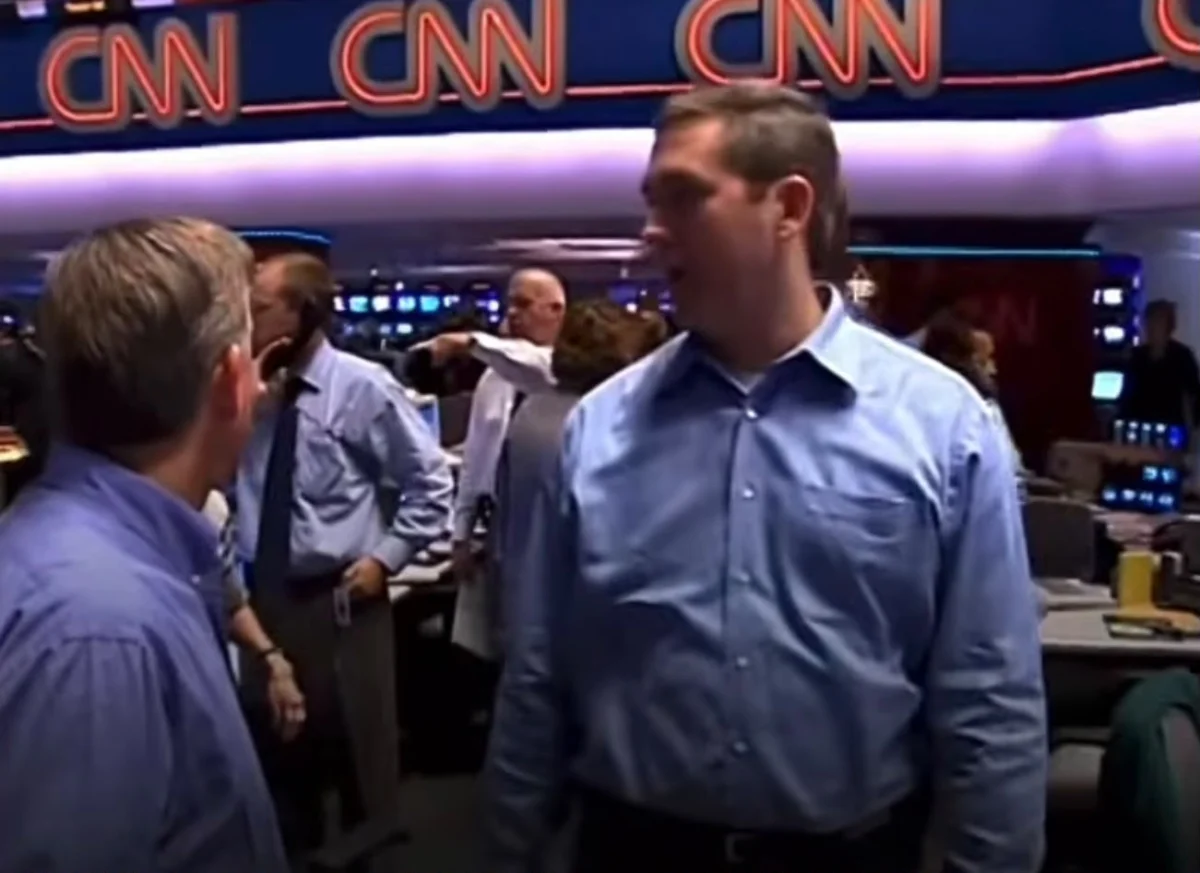
Behind the scenes, far from the polished anchors and graphic packages seen by millions of television viewers, an unfiltered historical record was quietly being captured. Ric Blackburn, an Atlanta-based CNN videographer, happened to be on "bump-shot duty" that morning—the routine assignment of capturing brief footage of the CNN newsroom during transitions into and out of commercial breaks for morning programming. Recognizing the escalating chaos as an epoch-defining moment, Blackburn’s journalistic instincts took over. Armed with his camera and a boom microphone, he began documenting the raw, unscripted reality of how a major global news network reacts to an unprecedented catastrophe in real time.
Now available in two parts on YouTube, Blackburn’s archival footage offers an invaluable, rare vantage point on the mechanics of broadcast journalism during a historic crisis. It captures the frantic energy, the panic, the leadership decisions, and the gradual, grim acceptance of a new reality inside the CNN Center newsroom. More than two decades later, this footage stands as a vital historical artifact, preserving the human element of a day that reshaped modern history.
Chronology: The Morning of September 11 Inside the CNN Center
The timeline of that Tuesday morning, as experienced both on air and behind the scenes inside the Atlanta headquarters, reveals a rapid escalation from confusion to national emergency.
Early Morning and the First Impact
Ric Blackburn’s shift began at 5:00 a.m. ET, scheduled to run until 2:00 p.m. As part of a rotating assignment system designed to give traveling video journalists a respite, Blackburn was stationed in the newsroom to film standard transitional shots. At 8:46 a.m., American Airlines Flight 11 struck the North Tower of the World Trade Center. Moments later, CNN broke into coverage, and Lin went on air with the initial, chaotic fragments of information.
Realizing the gravity of the unfolding story, Blackburn contacted his supervisor to request his primary camera and a boom microphone to capture ambient audio. His continuous recording officially began around 9:25 a.m. ET. By this point, United Airlines Flight 175 had already crashed into the South Tower at 9:03 a.m., leaving no doubt that the United States was under a coordinated attack.
Escalation and the Newsroom Crescendo
As Blackburn roamed the newsroom, the atmosphere shifted rapidly. Staff members were glued to monitors, shouting across desks, and frantically working phones.
"I just started roaming the newsroom, people on the phone, people looking up at the monitors, people talking to each other, and it just crescendoed, like a loud crescendo as time went on," Blackburn recalled in an exclusive interview.
The footage documents a cascade of harrowing breaking news announcements echoing through the building:

- Initial reports of a fire and subsequent explosion at the Pentagon.
- The unprecedented decision by federal authorities to evacuate the White House.
- The grounding of all commercial flights nationwide and the complete closure of U.S. airspace.
- The catastrophic collapse of the South Tower, followed shortly by the collapse of the North Tower.
- Reports of a hijacked aircraft crashing in a field in Somerset County, Pennsylvania (United Airlines Flight 93).
Amidst the pandemonium, Blackburn’s camera captured the intense pressure placed on technical and editorial teams. The footage records a brief verbal altercation in the control room, technical difficulties in pulling down the network’s broadcast signals from New York City, and the logistical scramble to lock down the CNN Center, restricting access strictly to essential personnel while rushing food and beverages to exhausted staff.
Supporting Data and Personnel Dynamics
The archival footage is remarkable not only for its historical timeline but for its intimate portrayal of media executives and on-air talent grappling with a crisis of unimaginable scale.
Leadership Under Pressure
The video features a who’s who of CNN’s executive leadership at the turn of the millennium, including Sid Bedingfield, Tom Johnson, Jim Walton, Earl Casey, Jamie Kellner, Eason Jordan, Sue Bunda, and Jane Maxwell.
Notably, Walter Isaacson, then-president of CNN, was initially hostile toward Blackburn’s presence with the camera. Unaccustomed to having an internal documentary lens focused on the raw, frantic debates of executive leadership, Isaacson repeatedly ordered Blackburn out of the newsroom.
"He told me several times to ‘get the F out of the newsroom with that camera,’" Blackburn remembered. "I just kind of ignored him because he seemed too serious. Because I knew what I was doing."
Ted Turner’s Reaction
Perhaps the most poignant executive appearance in the footage is that of CNN founder Ted Turner. Blackburn recalled the profound shock visible on Turner’s face when he walked into the newsroom shortly after the first plane struck.
"His hands [were] clasped over his face, just looking up at the monitors, and kind of shaking his head," Blackburn said.
At one point, Blackburn’s camera recorded Turner, Isaacson, and Eason Jordan deep in discussion regarding whether Turner Broadcasting’s entertainment and other non-news networks should preempt their regular programming to simulcast CNN’s continuous news coverage. Shortly after, Jordan walked over to inform Turner that the first tower had collapsed. Visibly shaken, Turner openly wondered who could orchestrate such a devastating assault, at one point speculating about the involvement of the Taliban.
On-Air Talent and Programmatic Shifts
The footage also preserves the frantic behind-the-scenes discussions regarding editorial strategy. Cameras caught early operational talks about introducing anchor Aaron Brown to CNN’s airwaves to lead specialized coverage, alongside glimpses of prominent on-air personalities of the era, including Daryn Kagan, Leon Harris, Bill Hemmer, and Lou Waters, as they prepared to face the cameras under unprecedented emotional and professional strain.
Official Responses and Operational Shifts
As the morning progressed, the atmosphere inside the CNN Center underwent a psychological evolution. The initial shock and panic gradually gave way to a grim, professional resolve. Staff members transitioned from reactive chaos to an acceptance of their new, historic mandate.

"I believe that that’s what’s amazing about CNN is they knew what’s ahead of them," Blackburn observed, noting how reporters, producers, and technicians locked into an endurance mindset knowing that the coverage would span days, weeks, and months.
Simultaneously, the physical security and operational protocols of the network changed overnight. The CNN Center—usually a bustling, open public complex in downtown Atlanta—was rapidly locked down. Access was restricted exclusively to essential personnel as building management and local authorities heightened security in response to nationwide threats against prominent infrastructure and media institutions.
For many staffers, the shift meant preparing for immediate deployment. At 12:30 p.m. ET, halfway through his shift, Blackburn received his next assignment: an arduous 18-hour van ride to New York City, where he would be stationed for the next month and a half to document the ongoing aftermath at Ground Zero.
Implications: The Legacy of 9/11 Journalism and Pre-Digital Archiving
Blackburn’s footage provides deep implications regarding how major historical events were documented at the cusp of the digital age. Captured on magnetic tape before the era of ubiquitous smartphones, high-speed digital streaming, and social media citizen journalism, the video represents an analog time capsule of traditional broadcast infrastructure.
The Surreal Aftermath in New York City
Upon arriving in New York, Blackburn encountered an environment that felt entirely detached from ordinary reality. The city was enveloped in a heavy, solemn atmosphere of disbelief. Compounding the psychological weight was a visceral sensory detail that haunted survivors and responders alike: the persistent, acrid smell of burning bodies and hair hanging in the air.
"It was like a twilight zone," Blackburn said, describing the city as existing in a sad, expressionless state where citizens frequently approached camera crews holding up photographs of missing loved ones, searching desperately for answers.
A Lasting Window into the Past
Reflecting on his 34-year career with CNN, Blackburn acknowledges the profound emotional toll of that period, admitting he was not fond of the lingering sadness in New York. However, looking back from his retirement, he recognizes the immense historical value of the footage he serendipitously preserved.
In an era when newsroom operations are heavily sanitized, PR-managed, or filtered through corporate messaging, Blackburn’s raw tape remains a rare, unvarnished window. It reminds the public of the human cost, the instantaneous decision-making, and the sheer psychological weight borne by journalists who stood at the front lines of history on September 11, 2001, tasked with explaining the unthinkable to a grieving nation.