Main Facts
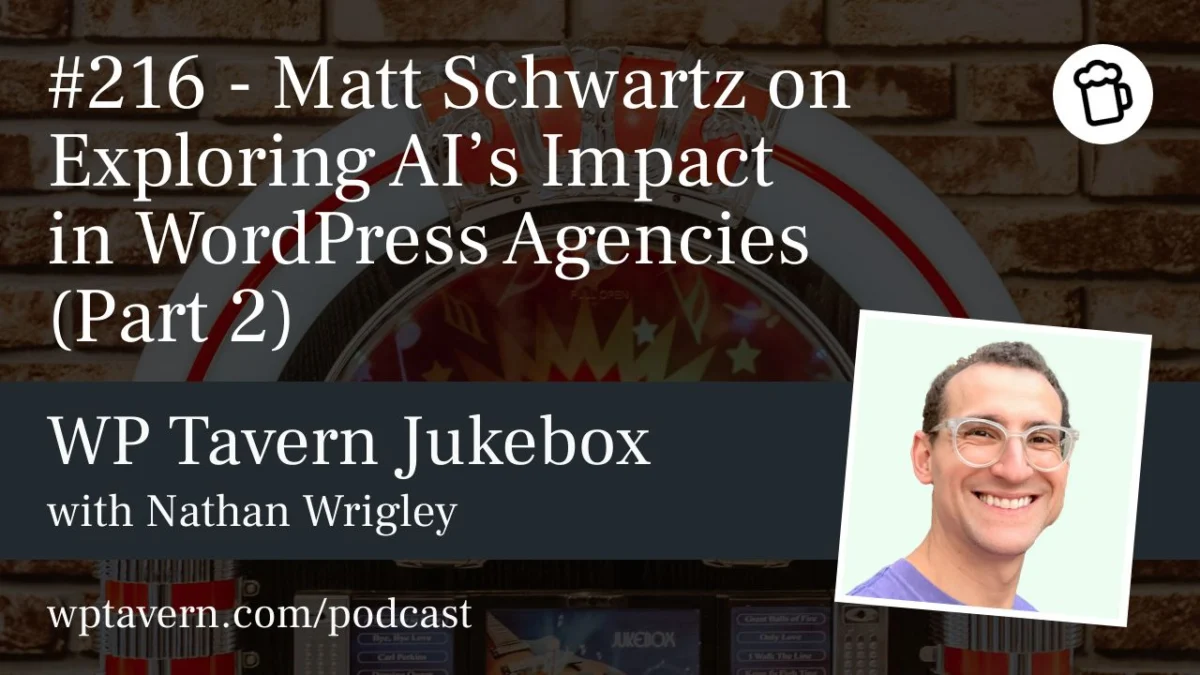
The intersection of artificial intelligence and agency operations has shifted from speculative experimentation to mandatory strategic integration. In the conclusion of a two-part special series on the WP Tavern Jukebox podcast, host Nathan Wrigley caught up with Matt Schwartz, a seasoned WordPress agency owner based in Atlanta who has operated in the ecosystem since 2011 and developed the form and checkout QA tool CheckView.
This deep-dive conversation focuses on actionable frameworks, cutting-edge architectural patterns like Model Context Protocols (MCPs), and critical risk management strategies for digital agencies looking to leverage AI securely. Rather than blindly adopting every shiny tool, Schwartz outlines a methodical blueprint for embedding AI across agency infrastructure, from centralized knowledge bases to automated quality assurance.
Chronology of the Discussion: Building a Blueprint for Agency AI
The conversation picks up mid-stream in a comprehensive 16-point framework curated by Schwartz. Building on foundational concepts established in the first episode—which covered initial workflow optimizations and low-risk efficiencies—this second installment explores advanced integration protocols, internal development, community impacts, and long-term economic sustainability.
1. Centralizing Organizational Knowledge: Giving AI Access to the "Agency Brain"
Schwartz highlights a powerful, low-barrier integration strategy popularized within agency communities like The Admin Bar: linking AI chat assistants directly to project management systems and internal wikis (such as ClickUp or Asana).
Instead of relying purely on generalized training data or risking fabricated outputs, agencies can instruct advanced language models to query internal documentation in real-time.
"Whenever I ask a question about the agency, go confirm what I’m doing by visiting our ClickUp or visiting our Asana… It will actually retrieve and confirm it’s using the latest proper information instead of just guessing or hallucinating," Schwartz explains.
This practice allows teams to maximize the value of existing Standard Operating Procedures (SOPs), customer relationship management data, and knowledge bases without engineering complex custom APIs.
2. The Rise of Model Context Protocols (MCPs)
Moving past basic chat interfaces, the conversation transitions to Model Context Protocols (MCPs)—an open-source standard originally championed by Anthropic (creators of Claude). MCPs serve as secure, standardized bridges connecting AI agents to external systems, databases, and third-party software.
While traditional Application Programming Interfaces (APIs) require developers to manually configure endpoints, handle authentication keys, and write bespoke code for every service, MCPs provide a pre-structured environment tailored specifically for AI agents.
Schwartz notes that forward-thinking agencies are beginning to build internal MCP proxies. Under this architecture, team members interface with a single, highly secure agency-managed MCP rather than scattering disparate API keys across various personal AI accounts. This setup centralizes control, streamlines tool communication, and establishes strict organizational boundaries.
3. Vibe-Coded Agency Tools vs. Public-Facing Risks
The term "vibe coding"—writing software via natural language prompts rather than traditional syntax—has dominated tech circles. Schwartz evaluates this trend strictly through the lens of risk management:
- Low Risk: Internal tools, operational dashboards, and financial reporting aggregators. Combining QuickBooks, time-tracking software (like Everhour or Harvest), and subscription platforms via AI can unearth valuable profitability patterns and time-allocation metrics that were previously hidden due to reporting friction.
- High Risk: Public-facing or mission-critical client infrastructure, such as custom-built website management dashboards or bespoke site migrators. Because AI lacks true comprehension and relies on statistical pattern matching, deploying unreviewed code to production environments invites catastrophic failures, such as accidental database deletions.
4. Automated Quality Assurance and Checklist Execution
Testing and quality assurance (QA) are historically under-resourced due to time constraints. Schwartz details how agencies are utilizing AI "skills" and custom instructions to automate repeatable pre-launch and onboarding checklists.
While binary checks (such as verifying whether a staging site’s "noindex" tag is properly toggled) can be swiftly delegated to AI, human oversight remains vital for complex strategic evaluations. By automating the exhaustive, low-level verification tasks that humans frequently skip, agencies can achieve broader test coverage without burning out billable resources.
5. The WordPress Plugin Market and Community Dynamics
The proliferation of AI code generation has introduced notable turbulence to the WordPress economy. Plugin developers—particularly those offering smaller utility plugins—are experiencing noticeable drops in sales as agencies and end-users increasingly prompt bespoke, single-use code snippets rather than purchasing off-the-shelf solutions.
While larger enterprise-grade plugins with deep moats remain resilient, the decline of smaller micro-plugins raises broader questions about community health. Historically, independent developers building niche plugins represented the grassroots entry point into the WordPress ecosystem. If AI diminishes the commercial viability of small-scale product development, the industry risks losing the vibrant developer pipeline that fueled its growth over the last two decades.
Supporting Data and Technical Context
- The Security and Privacy Paradox: Major AI vendors often process user prompts as part of public training corpora or data-retention frameworks unless specific enterprise-grade opt-outs or secure private instances are deployed. Agencies handling sensitive client credentials, proprietary business metrics, or personal identifiable information (PII) must exercise extreme caution.
- Subscription and Cost Escalation: As illustrated by recent platform adjustments (such as Anthropic modifying advanced developer features like Claude Code on standard consumer tiers), AI tooling costs are poised to escalate. Agencies that build their operational foundation entirely on subsidized developer utilities must budget for potential 10x price increases as venture-backed subsidies phase out.
- Error Handling and Technical Debt: Vibe-coded internal tools frequently lack robust error handling and edge-case management. Without rigorous logging and code reviews, these disposable scripts can introduce hidden vulnerabilities that accumulate over time.
Official Responses and Ecosystem Perspectives
Industry reactions to the AI wave remain sharply polarized between unbridled techno-optimism and cautious pragmatism.
- The Optimists’ View: Proponents argue that AI democratizes development, allowing small freelance teams to punch above their weight, rapidly prototype solutions, and eliminate administrative drag.
- The Pragmatists’ Warning: Seasoned operators like Schwartz emphasize that execution is increasingly commoditized. The true differentiator for agencies moving forward will not be raw coding speed, but rather strategic oversight, risk management, productized service packaging, and deep client alignment.
Furthermore, community leaders within the open-source space stress the unique advantage WordPress holds: its fully open-source documentation. Because core WordPress architecture, hooks, and developer handbooks are publicly accessible, AI models index WordPress frameworks exceptionally well, giving the CMS a fighting chance against proprietary website builders in the AI era.
Implications for Agencies and Freelancers
As the industry stabilizes around these technological shifts, several clear implications emerge for WordPress professionals operating in 2026:
- Shift in Hiring Priorities: Routine execution tasks traditionally assigned to junior developers or contractors are increasingly automated. Consequently, agency hiring is pivoting toward specialized strategic thinkers, client strategists, and human-in-the-loop AI managers.
- The Rise of Productized Services: AI empowers agencies to craft hyper-niche, industry-specific service packages (e.g., tailoring web infrastructure specifically for plumbers or legal practices) backed by automated SOP execution.
- Guardrails as Table Stakes: Implementing strict internal governance—such as prohibiting raw API keys in public chats, enforcing manual code reviews for critical patches, and maintaining independent backups—is no longer optional; it is fundamental to corporate survival.
- Resilience Through Independence: While leveraging advanced AI vendors is essential for competitive advantage, agencies must avoid building critical business logic so tightly coupled to a single AI vendor that a sudden pricing restructure could paralyze operations.
Conclusion
As Nathan Wrigley and Matt Schwartz conclude in their extensive series, the future belongs to agencies that approach AI with open eyes, structured documentation, and unwavering vigilance. Dabbling is encouraged, but recklessness will be penalized by the market. By balancing automation with strict risk management, WordPress agencies can successfully navigate the AI frontier and thrive in an evolving digital landscape.