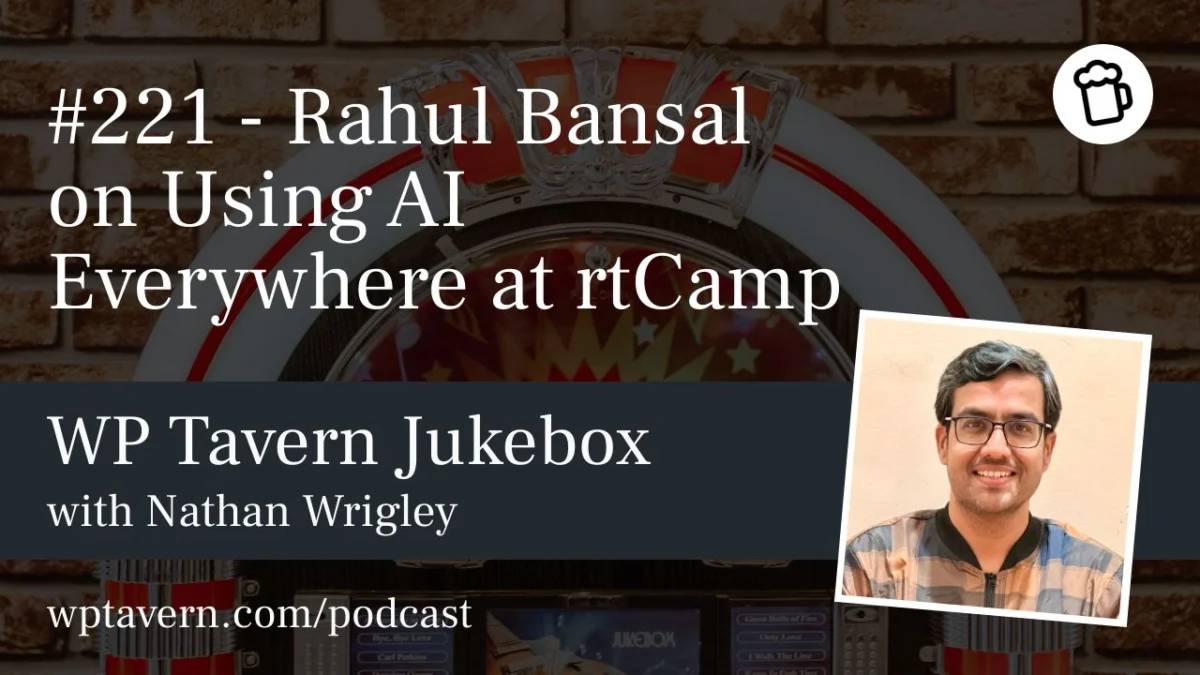
In the rapidly evolving digital ecosystem, few leaders have witnessed the maturation of the web quite like Rahul Bansal. As the founder and chief executive officer of rtCamp, Bansal has steered his enterprise-level agency through nearly two decades of technological disruption. What began 17 years ago as a fledgling technology blog network has since transformed into a globally recognized powerhouse, delivering bespoke WordPress-based solutions, Chrome extensions, and SaaS connectors for Fortune 500 companies and tech giants like Google.
Speaking recently on the WP Tavern Jukebox Podcast with host Nathan Wrigley, Bansal offered a candid, retrospective look at rtCamp’s journey, while simultaneously laying out a provocative roadmap for starting and scaling an enterprise WordPress agency in 2026. Revisiting the themes of his recent talk at WordCamp Asia, Bansal tackled the uncomfortable truths of agency growth, the mathematical approach to team building, and a radical, all-in adoption of artificial intelligence that is currently reshaping rtCamp’s entire operational spine.
The Genesis of an Enterprise Powerhouse: Chronology and Early Gambles
To understand where rtCamp is heading, one must look at how the agency arrived at its current standing. In the mid-2000s, the web development landscape looked vastly different. When Bansal first encountered WordPress in 2006, it was predominantly utilized as a simple blogging platform. Custom post types did not yet exist in core, and developers were primarily focused on crafting unique aesthetic layouts and chasing metrics like raw traffic and email subscriptions.
The Blog Network Roots
rtCamp did not start as a traditional agency. Its origins lay in a high-traffic technology media company—a contemporary of major digital publications like WP Beginner. Because rtCamp’s internal tech blog required heavy customization to handle massive traffic spikes on modest server setups, Bansal and his team honed their engineering chops early.
They utilized Nginx long before it became an industry standard and mastered high-scale WordPress performance. Soon, technical competitors began asking rtCamp to customize their blogs. Recognizing that custom development yielded faster and more lucrative returns than digital publishing, the team gradually phased out editorials and pivoted entirely into a WordPress custom development agency.
The Joomla Dilemma
Looking back, Bansal openly admits that luck played a massive role in rtCamp’s survival and eventual dominance. In the company’s infancy, one of the original co-founders departed because Bansal flatly refused to adopt Joomla, which was the market leader at the time.
The decision to stick exclusively with WordPress was not born out of sophisticated market data or forward-looking industry analytics; rather, it was driven by the dogfooding principle: rtCamp used WordPress, so they built with WordPress. Had that gamble failed, the agency’s trajectory could have taken a vastly different turn.
Supporting Data and Core Philosophy: The Mathematics of Hiring and Client Selection
During his WordCamp Asia presentation, titled "How to Start an Enterprise WordPress Agency in 2026," Bansal pivoted away from nostalgia to deliver hard-won, practical advice for modern agency owners. He emphasized that the playbook that built rtCamp two decades ago would no longer work for a new agency launching today.
The "Complementary Set" Hiring Model
One of the most resonant takeaways from Bansal’s framework is his philosophy on scaling human resources, which was deeply inspired by set theory from a middle-school math class.
When transitioning from freelancing to a formal agency structure, human beings possess a natural psychological bias to hire people who mirror their own skill sets. Bansal argues this is a critical mistake.
- Bridging Weaknesses: Early in rtCamp’s growth, Bansal recognized his own strengths lay in engineering, while his communication and sales skills needed reinforcement. He systematically listed his weaknesses and hired co-founders and early team members who were his exact opposites—individuals with polished language skills and robust sales acumen.
- The Value of Ignorance: In his earliest hiring phases, Bansal even posed interview questions to candidates where he personally did not know whether their answers were correct. By assembling a "complementary set" of disparate skills, the leadership team successfully covered each other’s blind spots, weathering major industry shifts.
Moving Beyond Commoditization
This complementary philosophy extends directly to client acquisition. Agencies that sell web development services to other digital agencies often find their profit margins squeezed into irrelevance. Bansal advises agencies to target clients who possess zero understanding of the underlying technology—such as WordPress. When clients fundamentally depend on your specialized expertise because they cannot execute the work themselves, your services stop being commoditized, and your value proposition scales accordingly.
The 2026 Niche Imperative: Drilling Down into Micro-Specializations
When rtCamp planted its flag as an exclusively WordPress-focused agency years ago, it was virtually the only player in India making that specific commitment amidst a sea of general outsourcing.
Today, however, the digital landscape is saturated. If a new agency launches in 2026 and merely advertises itself as a "WordPress agency," it faces insurmountable competition from tens of thousands of similar operations.
Niches Within Niches
Bansal stresses that modern agencies must hyper-specialize to survive:
- The Breadth of WordPress: WordPress now powers a massive swath of the entire web. Consequently, generalized claims are no longer enough.
- Vertical Integration: Agencies should begin by carving out micro-niches—starting with e-commerce, narrowing down to WooCommerce, and drilling further into payment gateway specializations, enterprise resource planning (ERP) integrations, back-office workflows, or subscription-based business models.
- Bottoms-Up Positioning: By starting with a hyper-specific niche, positioning yourself as an undeniable expert in that narrow vertical, and gradually expanding outward, new agencies can successfully break through the noise.
Official Responses and Strategic Pivot: The AI Operational Overhaul
Perhaps the most startling revelation regarding rtCamp’s current trajectory is its aggressive, uncompromising integration of artificial intelligence. While many agencies are dipping their toes into AI by experimenting with prompt writing or isolated code-generation tools, rtCamp has committed to an all-in operational philosophy: If a task can be done by AI, it will be done by AI.
The Single Source of Truth
This AI mandate did not happen overnight; it was enabled by preparatory work executed years prior. Post-COVID, rtCamp recognized the need to refactor its internal tooling to manage a rapidly expanding workforce. They adopted an open-source back-office operating system, Frappe ERPNext, which unified their accounting, payroll, project management, and CRM into a single, centralized database.
When the generative AI explosion occurred, rtCamp was uniquely positioned. Unlike competitors whose data is scattered across six or seven siloed SaaS platforms (such as Jira for project management and QuickBooks for accounting), rtCamp enjoyed first-party, clean metadata sitting in a unified system. This allowed them to immediately feed AI into the very core of their business operations.
Squeezing Operational Waste
Bansal points out that when a customer purchases a product or service, they ultimately pay for every operational expense the company incurs—from office rent and electricity bills to executive salaries and marketing campaigns.
By utilizing AI to automate and optimize non-build costs, rtCamp has radically slashed its overhead:
- Sales and Lead Qualification: Inquiries submitted through rtCamp’s website are now automatically vetted, researched via LinkedIn, and documented by AI within minutes, eliminating the need for entry-level administrative sales vetting.
- Pre-Sales and Prototyping: Instead of spending weeks building static PowerPoint presentations or Figma designs, rtCamp’s teams now "vibe code" working WordPress demo sites and functional playgrounds, attaching live links directly to their proposals.
- Compressed Timelines: Complex data mapping and migration projects that once took weeks can now be scoped, mapped, and tested using automated bots in a matter of days.
Implications: The Shifting Role of the Developer and the Expanding Market Pie
As rtCamp pushes its operational costs down through automation, the direct implications are already reverberating through the company’s internal structure and the broader enterprise market.
Headcount Shifts and the Death of Code-Only Roles
The most sobering reality of rtCamp’s AI overhaul is its impact on traditional hiring. For the first time in the company’s history, rtCamp’s career portal features zero engineering openings. While the volume of incoming project work is rising, the sheer number of developer hours required to execute that work has plummeted.
Bansal notes that tasks like pure coding are facing a race to the bottom. Consequently, rtCamp is actively pivoting its hiring strategy:
- Growth Engineers: rtCamp now deploys senior coders—termed "Growth Engineers"—onto initial client calls to act as consultants, making realistic, feasible promises on behalf of WordPress rather than writing lines of code.
- The Rise of Prompt and Context Engineering: Over the next few years, a significant percentage of rtCamp’s workforce will not write traditional code at all. Instead, they will act as AI prompters, context engineers, and strategic architects.
- Sales and Marketing Expansion: While engineering headcounts stabilize, rtCamp plans for its next wave of hiring to focus overwhelmingly on sales, marketing, and high-level consulting—shifting from a 90/10 operational-to-sales skew toward a much heavier emphasis on consultative growth.
A Rising Tide for Open Source
Far from killing the web agency business, Bansal believes AI will ultimately expand the market pie. By dramatically reducing build times and lowering operational costs, agencies can pass those savings on to enterprise clients. Projects that once carried a prohibitive multi-month downtime and a six-figure price tag can now be executed faster and more affordably, pulling hesitant enterprises off the fence.
Furthermore, WordPress stands to emerge as a primary beneficiary. Because WordPress exposes structured data cleanly without proprietary walls, its open-source nature allows AI workflows to integrate at a speed that closed, proprietary content management systems simply cannot match.
A Final Word of Caution to the Industry
Bansal offers a vital warning to agencies struggling to find their footing in the age of AI. Too many businesses are attempting to act like foundational AI model creators—building experimental applications that nobody wants to buy—while ignoring the boring, fundamental problems right in front of them.
The true power of AI for agencies does not lie in inventing new algorithms; it lies in acting as intelligent consumers and consultants. By focusing on mundane, practical inefficiencies—such as streamlining migrations, cutting down proposal times, and lowering operational friction—agencies can leverage AI not as a superficial bolt-on feature, but as the efficient, resilient operational backbone of a sustainable modern business.