Main Facts
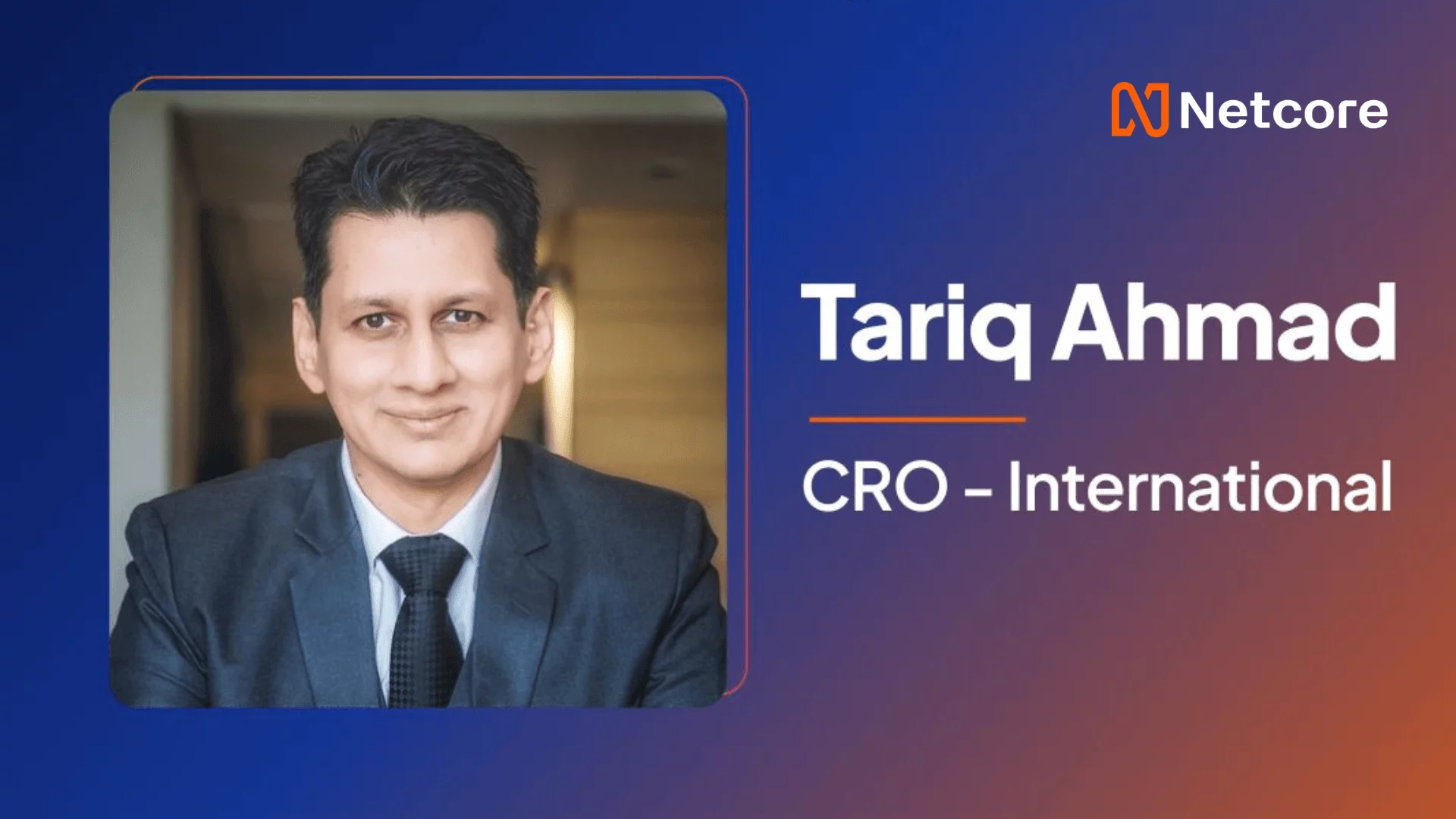
In a strategic move designed to accelerate its footprint beyond domestic borders, customer engagement and marketing technology powerhouse Netcore.ai has officially appointed Tariq Ahmad as its new Chief Revenue Officer (CRO) for International Markets. In this pivotal leadership role, Ahmad will assume direct, end-to-end responsibility for driving global sales strategies, scaling international operations, and optimizing customer success ecosystems across all geographies outside of India.
The appointment is accompanied by an ambitious corporate mandate: Netcore.ai has publicly stated its intent to double its international revenue over the next three-year cycle. While the firm has historically kept its exact baseline international revenue figures under wraps, the explicit growth target underscores a period of aggressive global scaling. This strategic pivot comes on the heels of a significant corporate rebrand in July, which saw the company transition from "Netcore Cloud" to "Netcore.ai" as it repositions itself at the bleeding edge of artificial intelligence-driven, agentic marketing automation.
Ahmad enters the role with a formidable pedigree in enterprise sales leadership. Spanning a career of over two decades, his professional journey includes high-profile senior leadership stints at tech titans IBM and LinkedIn, followed by critical global sales leadership positions at high-growth SaaS and infrastructure platforms BrowserStack and Sprinto. Notably, Netcore highlighted that Ahmad has successfully overseen and executed revenue operations scaling up to $250 million in Annual Recurring Revenue (ARR). Beyond his corporate achievements, Ahmad brings academic rigor to his operational playbook, having recently completed a PhD in management at the prestigious ESCP Business School, with a specialized research focus on revenue operations (RevOps).
The leadership announcement highlights a roster of recent international client acquisitions, demonstrating traction in key overseas markets. Netcore’s growing global portfolio now proudly includes iconic enterprise brands such as Yamaha, Baskin-Robbins Malaysia, telecommunications giant CelcomDigi, and department store chain BHG Singapore.
Chronology of Events
To understand the trajectory of Netcore.ai leading up to the appointment of Tariq Ahmad, it is vital to trace the chronological evolution of the company’s structural shifts, technological pivots, and strategic executive placements over recent years.
1. The Foundation and Regional Expansion (Pre-2020)
Netcore has spent over two decades evolving from an early messaging and email delivery pioneer in India into a comprehensive digital marketing ecosystem. For years, the company solidified its dominance within the South Asian market, building a robust infrastructure capable of handling massive volumes of customer communications. As digital adoption surged globally, the leadership team recognized that sustainable long-term growth required looking beyond domestic frontiers, prompting early exploratory expansions into Southeast Asia, the Middle East, Africa, and eventually, the Americas and Europe.
2. The Shift to "Netcore Cloud" and SaaS Maturity (2020–2023)
As the martech landscape shifted rapidly toward cloud-native architectures, real-time personalization, and omnichannel engagement, Netcore rebranded its product suite under the umbrella of Netcore Cloud. During this phase, the company focused heavily on acquiring global martech capabilities—including the acquisition of US-based interactive email content platform Boxx.ai and Dublin-based artificial intelligence startup Dazo. These moves laid the technical groundwork for international enterprise sales, allowing Netcore to compete directly with legacy Western marketing clouds.
3. The Rebrand to Netcore.ai and the "Agentic" Pivot (July 2024)
A critical turning point occurred in July of this year, when the company officially dropped "Cloud" from its moniker to become Netcore.ai. This was not merely a cosmetic change; it signaled a profound technological evolution toward autonomous, agentic marketing platforms. In the modern martech vernacular, "agentic" implies artificial intelligence systems that do not merely suggest actions or analyze data, but actively execute complex, multi-channel marketing workflows on behalf of brands with minimal human intervention.
4. The Appointment of Tariq Ahmad (Late 2024)
Following the July rebrand and the operational restructuring required to support an AI-first product suite, Netcore recognized the need for a seasoned global revenue architect. By bringing in Tariq Ahmad—a leader with deep experience in scaling SaaS operations to the $250 million ARR threshold—Netcore initiated the execution phase of its three-year international doubling strategy. Ahmad’s arrival marks the transition from technological transformation to aggressive global market penetration.
Supporting Data and Market Context
The appointment of a high-caliber CRO like Tariq Ahmad does not happen in a vacuum; it is a calculated response to shifting macroeconomic realities, enterprise buyer expectations, and structural transformations within the global marketing technology sector.
The Scale of the Martech Landscape
The global marketing technology (martech) industry is a multi-billion-dollar juggernaut. Enterprise CMOs are constantly besieged by thousands of point solutions, leading to "tech stack fatigue." According to various industry analysts, companies routinely spend upwards of 25% of their total budgets on martech tools. However, return on investment (ROI) has increasingly come under scrutiny. Buyers are no longer content with software that sits on the shelf requiring massive internal resources to configure, deploy, and maintain.
Navigating the $250M ARR Benchmark
Tariq Ahmad’s background in managing revenue operations up to the $250 million ARR mark is a vital data point for Netcore’s stakeholders. Scaling a software business from early international traction to the quarter-billion-dollar revenue threshold requires a sophisticated, repeatable blueprint. It demands standardized sales motions, localized go-to-market strategies, streamlined partner ecosystems, and rigorous pipeline visibility—all areas where academic research (such as Ahmad’s PhD from ESCP Business School) and practical enterprise execution intersect.
Strategic Client Wins as Validation
Netcore’s ability to secure marquee international brands serves as empirical proof of its platform’s global competitiveness:
- Yamaha: Requiring hyper-personalized, multi-region customer journeys that resonate with diverse consumer demographics.
- Baskin-Robbins Malaysia: Utilizing advanced customer data platforms (CDP) and engagement tools to drive localized loyalty and repeat purchases.
- CelcomDigi: Managing massive subscriber bases requiring real-time, event-driven communications at a scale that only enterprise-grade infrastructure can support.
- BHG Singapore: Blending online and offline retail touchpoints through seamless omnichannel orchestration.
These wins demonstrate that Netcore is successfully punching above its weight class against deeply entrenched Western competitors in Asia and beyond.
Official Responses and Industry Perspectives
The announcement of Tariq Ahmad as CRO has elicited strong reactions from both corporate leadership and industry observers, providing deep insight into the philosophical shifts occurring within the company.
Netcore’s Corporate Vision
In announcing the appointment, Netcore emphasized that Ahmad’s primary mandate is clear: to spearhead sales, expand market share, and elevate customer success operations outside of India. The company’s leadership views international markets as the primary engine for its next phase of exponential growth, explicitly tying this ambition to the goal of doubling international revenues within three years.
Tariq Ahmad on the "Broken" Martech Model
While corporate press releases often lean on sanitized corporate jargon, Ahmad’s own framing of his new role and the state of the industry was notably blunt and provocative. In reflections shared upon joining Netcore, Ahmad dissected what he views as a fundamental structural flaw in how marketing technology has been commercialized for decades.
"Marketing technology has traditionally been sold as software," Ahmad observed. "Under this legacy model, the vendor is strictly accountable for software deployment, while the customer is left entirely on their own to own the ultimate outcome. That model is increasingly broken."
Ahmad’s critique strikes at the heart of modern enterprise buyer frustration. For years, software-as-a-service (SaaS) vendors have profited from license fees regardless of whether the software actually drove revenue, engagement, or business outcomes for the client. By aligning Netcore’s international revenue operations under an "outcomes-focused" philosophy—supercharged by agentic AI that actively performs marketing tasks—Ahmad aims to redefine the vendor-client relationship. In this new paradigm, the software provider shares skin in the game by ensuring that automated agents successfully drive customer conversion and retention metrics.
Implications for the Industry and Netcore.ai
Tariq Ahmad’s appointment and Netcore’s aggressive three-year growth strategy carry profound implications for the global marketing technology sector, the company’s competitive positioning, and enterprise buyers alike.
1. Disrupting the Status Quo of Global Martech Vendors
For years, the global enterprise martech space has been dominated by a handful of Western legacy giants—such as Salesforce, Adobe, and Oracle. These monoliths have historically commanded premium pricing while often burdening clients with complex implementations and rigid integration cycles. By positioning itself as an agile, AI-first, agentic marketing platform, and pairing it with a seasoned RevOps leader like Ahmad, Netcore is signaling that it is ready to challenge these incumbents directly on global turf. If Ahmad can successfully export Netcore’s value proposition—combining advanced AI agents with a shared accountability model—it could force legacy vendors to rethink their own commercial terms and deployment strategies.
2. The Rise of Agentic Marketing and Outcome-Based Pricing
Ahmad’s critique of the traditional software model hints at a broader industry evolution toward outcome-based or value-aligned partnerships. As artificial intelligence moves from generative text creation to autonomous execution (agentic workflows), software buyers will increasingly demand proof of performance. Netcore’s structural pivot to an agentic platform, managed by a revenue leader who understands the mechanics of scalable RevOps, positions the company at the vanguard of this shift. If Netcore can reliably demonstrate that its AI agents reduce human toil while driving superior campaign ROI, it will unlock massive pricing power in competitive international markets.
3. Execution Risks and the Road to Doubling Revenue
While the strategic vision is compelling, the path to doubling international revenue in three years is fraught with execution challenges. Scaling enterprise sales organizations across diverse cultural and regulatory landscapes—from the data-sensitive corridors of Europe to the fast-growing digital economies of Southeast Asia—requires meticulous operational discipline. Ahmad will need to harmonize regional sales teams, build robust channel partner networks, and ensure that customer success metrics keep pace with top-line customer acquisition. However, given his extensive track record of running revenue operations up to the $250 million ARR mark, Netcore has placed its global ambitions in capable hands.
Conclusion
Netcore.ai’s appointment of Tariq Ahmad as International CRO is much more than a routine executive shuffle; it is a definitive statement of intent. Backed by a fresh corporate identity, cutting-edge agentic AI technology, and a proven roster of enterprise clients, the company is locking sights on global dominance. As Ahmad sets out to dismantle the outdated "software-only" vendor model and execute a playbook designed to double international revenue, the broader martech ecosystem will be watching closely to see how this bold new chapter unfolds.
Disclosure: Netcore is a Strategic Partner Member of emailexpert. Editorial coverage decisions and judgements are made strictly independent of all commercial relationships. Members receive factual accuracy verification and standard editorial access, which emailexpert considers the foundational standard of independent journalistic integrity.