By Andrew Bonar
Published: October 20, 2026 | 5 min read
Topic: Mergers and Acquisitions
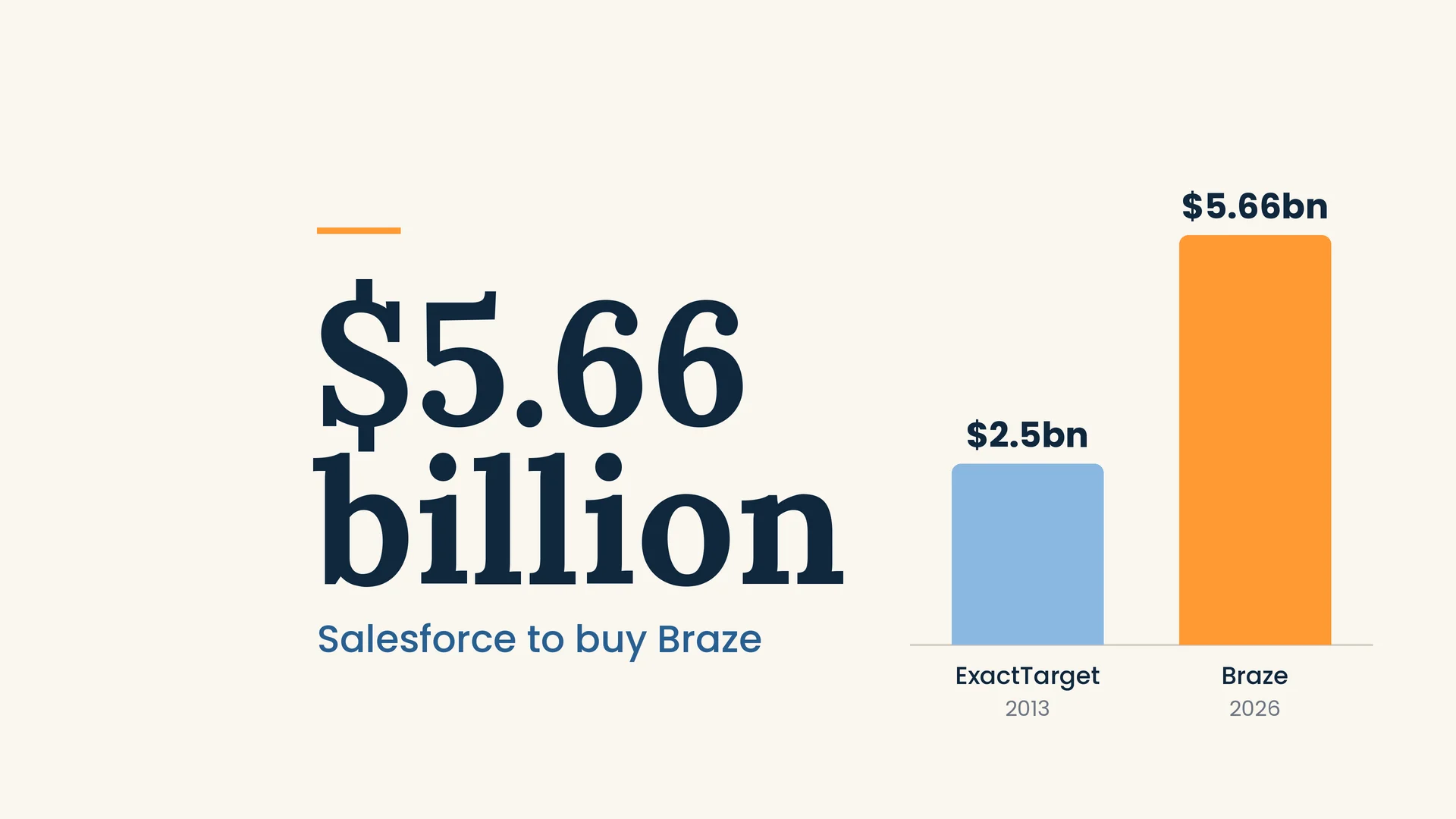
In a landmark consolidation move within the enterprise software and customer engagement sectors, Salesforce has officially entered into a definitive agreement to acquire Braze for an enterprise value of approximately $5.66 billion. Announced on October 20, 2026, the transaction dictates that Braze Class A shareholders will receive $47.50 per share in cash.
While the strategic rationale highlights a massive leap forward for Salesforce’s Customer 360 and Marketing Cloud ecosystems, Wall Street reacted with initial caution. Following the announcement, Salesforce shares experienced a 2.6% dip in premarket trading, reflecting typical investor scrutiny over multi-billion-dollar enterprise technology integrations.
This transaction brings together two giants of customer communication. It effectively unites Braze—renowned for its dominant mobile-first B2C engagement infrastructure—with Salesforce, which has historically commanded the enterprise marketing space via its legacy ExactTarget-derived Marketing Cloud. If approved by regulators and shareholders, the deal is projected to close during Salesforce’s fiscal year 2028 (running from February 2027 to January 2028).
1. Main Facts and Deal Overview
The core parameters of the acquisition outline a definitive cash transaction valuing Braze at $5.66 billion in enterprise value:
- Acquirer: Salesforce, Inc.
- Target: Braze, Inc.
- Acquisition Price: $47.50 per share in cash for Class A shareholders.
- Enterprise Value: ~$5.66 billion.
- Financial Advisers: J.P. Morgan is acting as exclusive financial adviser to Salesforce, with legal counsel provided by Wachtell, Lipton, Rosen & Katz and Covington & Burling. Qatalyst Partners is serving as financial adviser to Braze, with Davis Polk & Wardwell acting as legal counsel.
- Market Reaction: Salesforce shares fell 2.6% in premarket trading immediately following the news, as reported by Reuters.
- Guidance Impact: Salesforce confirmed that its financial guidance for Fiscal Year 2027 remains unchanged by the announcement.
- Closing Timeline: Expected to close in Salesforce’s fiscal year 2028, pending standard regulatory clearances and a formal shareholder vote, for which Braze will file a preliminary proxy statement with the SEC.
Braze is widely recognized as a premier customer engagement platform spanning mobile applications, web browsers, email, SMS, and WhatsApp messaging channels. Built specifically for high-volume Business-to-Consumer (B2C) senders, Salesforce notes that the platform currently processes trillions of messages and complex customer journey actions annually. Braze boasts an elite portfolio of approximately 2,770 enterprise customers, including prominent global brands such as Canva, Dairy Queen, Equinox, Instacart, Urban Outfitters, and Venmo.
2. Chronology: From Appboy to a $5.66 Billion Salesforce Acquisition
To understand the weight of this acquisition, it is essential to trace the historical trajectory of both entities, highlighting how the enterprise engagement landscape has evolved over the past decade and a half.
[2011] Appboy founded in NY
  └──> [2017] Rebranded to Braze
         └──> [2021] Public Debut
                └──> [2025] Acquires OfferFit ($325M)
                       └──> [2026] Acquired by Salesforce ($5.66B)
The Early Years: Appboy and the Mobile Revolution (2011–2016)
- 2011: Braze was originally founded in New York City under the name Appboy by Bill Magnuson, Jon Hyman, and Mark Ghermezian. The startup was conceived at a time when the mobile app ecosystem was exploding, identifying a critical gap in how brands could meaningfully communicate with users through push notifications and in-app messaging.
- 2014: Salesforce acquires ExactTarget for $2.5 billion, formally absorbing the Indianapolis-based email powerhouse into its portfolio to rebrand it as Salesforce Marketing Cloud. At this time, Appboy operates as an independent, nimble startup primarily focused on mobile engagement channels while ExactTarget dominates traditional email.
Scaling Up and Rebranding (2017–2024)
- 2017: Recognizing that its product roadmap had expanded far beyond simple app notifications to encompass cross-channel orchestration (email, web, SMS), Appboy officially rebrands as Braze. Co-founders Bill Magnuson and Jon Hyman solidify their executive leadership roles to steer the company through its next phase of enterprise growth.
- November 2021: Braze officially lists on the public markets via an Initial Public Offering (IPO), establishing itself as a standalone powerhouse in the modern marketing stack and winning over high-growth B2C brands.
Strategic Consolidation and AI Expansion (2025–2026)
- March 2025: In a move signaling its aggressive push into automated decision-making, Braze agrees to acquire AI decisioning firm OfferFit for $325 million in cash and stock, as detailed in regulatory SEC filings. This technological enhancement bolstered Braze’s capacity for automated experimentation and machine learning-driven customer journeys.
- October 20, 2026: Salesforce signs a definitive agreement to acquire Braze for $5.66 billion, bringing two historic market rivals—Marketing Cloud and Braze—under the exact same corporate umbrella.
3. Supporting Data and Architectural Integration
Industry analysts have scrutinized how Salesforce intends to absorb Braze without cannibalizing its existing product lines. According to Salesforce leadership, Braze will not be sidelined; rather, it is strategically designed to supercharge all four foundational layers of the modern Salesforce architecture: Data 360, Customer 360, Agentforce, and SIForce.
+-------------------------------------------------------------+
|                     SALESFORCE ARCHITECTURE                 |
|                                                             |
|  [ Data 360 ]  -->  [ Customer 360 ]  --> [ Agentforce ]    |
|                          |                                  |
|                          v                                  |
|         ( Braze integrated for Cross-Channel )              |
|               [ Marketing Cloud Boost ]                     |
+-------------------------------------------------------------+
Specifically within the Customer 360 ecosystem, Braze is positioned to radically improve cross-channel personalization inside the Salesforce Marketing Cloud. While legacy enterprise marketing tools historically struggled with real-time, event-driven mobile execution, Braze’s architecture was explicitly engineered to capture live user interactions and immediately translate them into targeted messaging campaigns at scale.
Infrastructure and Deliverability Considerations
Within the email and messaging communities, major acquisitions frequently spark immediate questions regarding underlying sending infrastructure, IP pools, and specialized personnel.
While official press releases and investor briefings have remained largely silent on technical infrastructure adjustments, market data indicates that Braze has continued active recruitment for specialized email deliverability talent leading up to the announcement. This suggests that Salesforce recognizes the critical importance of maintaining high inbox placement rates and protecting sender reputation across the massive volumes of communication handled by Braze.
4. Official Responses and Industry Reactions
Key executives from both companies have offered statements addressing the acquisition’s vision, culture, and operational future.
Patrick Stokes, President of Applications and Marketing at Salesforce:
"Braze was built from the ground up to turn live customer behavior into personalized engagement at scale. Bringing their cutting-edge capabilities into our ecosystem allows us to offer enterprises an unmatched toolkit for consumer-facing interaction, driving deeper brand loyalty across every imaginable channel."
Bill Magnuson, Co-founder and CEO of Braze:
"As we enter this next chapter, our commitment to our users remains absolute. We will continue building as Braze, ensuring that our customers and partners experience seamless continuity while benefiting from the immense technological backing, AI scale, and global footprint of Salesforce."
Market observers have noted that while Braze and Marketing Cloud have historically positioned themselves as direct competitors—particularly in the enterprise space, where Braze gained market share due to its superior mobile-first agility—the combined entity creates a formidable monopoly over both traditional web/email communication and modern mobile messaging applications.
5. Implications for the Market, Competitors, and Marketers
The merger of Salesforce and Braze carries profound implications for the enterprise software landscape, digital marketers, and competing tech vendors.
1. Consolidation of the MarTech Stack
For over a decade, enterprise marketers have grappled with "point-solution fatigue," stitching together disparate tools for mobile push, email, SMS, and data warehousing. By absorbing Braze, Salesforce provides a unified, consolidated ecosystem that threatens standalone Customer Engagement Platforms (CEPs) and Marketing Automation Platforms (MAPs). Competitors such as Adobe, Oracle, and HubSpot will undoubtedly feel pressure to counter this move with aggressive product enhancements or strategic acquisitions of their own.
2. The Intersection of AI and Real-Time Data
With Braze’s recent integration of OfferFit’s AI decisioning technology coupled with Salesforce’s Agentforce initiative, the merged roadmap points heavily toward autonomous, hyper-personalized customer journeys. Enterprises will no longer rely solely on static segmentation rules; instead, AI agents will dynamically orchestrate multichannel messaging based on live behavioral triggers across web, mobile, and in-app environments.
3. What It Means for Practitioners
For digital marketers, email operations specialists, and CRM managers, the day-to-day immediate impact will likely be minimal as regulatory approvals process through 2027. However, over the medium-to-long term, practitioners should anticipate deeper native integrations between Salesforce Data Cloud (Data 360) and Braze’s execution engines. Deliverability professionals and operations teams will watch closely to see how Salesforce manages IP reputation migration, data governance, and potential UI consolidations between Marketing Cloud and Braze dashboards.
As the regulatory review process moves forward ahead of the anticipated fiscal 2028 closing date, the enterprise software industry will be watching closely to see how effectively Salesforce can blend Braze’s agile, developer-friendly culture with its own massive enterprise engine.