In the modern digital landscape, the success of a product is rarely a reflection of individual talent alone. While brilliant UI design, seamless code, and clever engineering are essential ingredients, they exist within a broader ecosystem. Increasingly, industry experts agree that achieving exceptional user experience (UX) is an organizational characteristic—a cultural and procedural baseline known as UX maturity.
When an organization’s UX maturity is high, user-centric philosophies are woven into the fabric of daily operations, business strategies, and product development lifecycles. However, for many UX practitioners and design managers, the reality on the ground is starkly different. Finding oneself siloed in an organization with little to no structural appreciation for UX can lead to professional stagnation, frustration, and products that fail to resonate with end users.
In this first installment of a three-part series, expert Victor Yocco explores the foundational concept of UX maturity. Moving beyond theoretical frameworks, this report examines two actionable, high-impact tactics—identifying UX champions and demonstrating tangible Return on Investment (ROI)—that practitioners can leverage to elevate UX maturity, particularly within early-stage environments.

The Anatomy of UX Maturity: From Theory to Practice
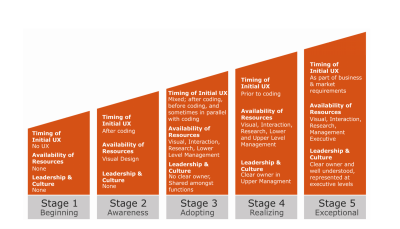
UX maturity measures the presence, depth, and sophistication of user experience practices within an enterprise. According to structural frameworks established by researchers like Chapman and Plewes (2014), organizational UX maturity spans five distinct stages:
- Beginning (Stage 1): Essential absence of UX. Design decisions are made without user research, and resources are non-existent.
- Awareness (Stage 2): Pockets of recognition. Leadership acknowledges UX in theory, but formal processes are absent.
- Adopting (Stage 3): Project-level integration. UX is applied reactively to address specific crises or major client complaints.
- Integrating (Stage 4): Standardized practices. UX is a mandatory, proactive step in product lifecycles, backed by dedicated resources.
- Exceptional (Stage 5): Fully embedded philosophy. User-centricity drives the entire corporate culture, supported by well-funded, executive-backed frameworks.
While many digital professionals work in environments past Stage 1, a vast number still grapple with environments stuck in the "Awareness" or early "Adopting" phases. In these settings, simply executing design tasks well is insufficient. Practitioners must step into the roles of advocates and educators, bridging the gap between isolated design work and enterprise-wide business impact.
Tactic 1: Finding and Utilizing UX Champions
When attempting to steer a large, resistant corporate ship toward a more mature UX framework, structural change rarely happens from the bottom up through sheer force of will. Instead, it requires internal navigation, social engineering, and the strategic cultivation of UX champions.
Identifying the Right Allies
Innovation researchers have long documented that champions—enthusiastic supporters of a new idea or methodology—are critical for breaking through institutional red tape and political barriers. A UX champion does not need to be a trained designer or researcher. Rather, they must be strategically positioned individuals who hold informal or formal power, possess robust internal networks, and are intrinsically motivated to see their products succeed.
To identify prospective champions within an organization, practitioners should evaluate colleagues against a specific matrix of questions:
- Who consistently spends time and energy championing ideas they believe in?
- Who manages a product or service that would see immediate, measurable benefit from improved UX?
- Who has expressed vocal dissatisfaction with current, broken development processes?
- Who possesses the relationship-building networks necessary to bridge disparate departments?
Case Study: The Logistics Sector Transformation
The efficacy of this tactic is well-documented in real-world scenarios. Consider the case of a major international logistics company undergoing a massive backend technology transformation. Despite public claims of being a "customer-first" organization, the company’s product teams operated at a breakneck development pace, with developers handling interface designs based on raw specifications from product managers. UX was treated as a luxury, relegated to ad-hoc firefighting teams.

Upon engaging as a consultant, the lead UX practitioner initiated a listening tour across different project groups. By mapping interpersonal relationships and workflow bottlenecks, the consultant identified a key product owner who was deeply frustrated by user friction points, well-connected across corporate lines, and highly motivated to see their product succeed.
Though this champion did not hold executive-level authority, their operational influence proved transformative. Within three months, the champion successfully integrated a structured UX research and design pipeline into their product stream. This foothold eventually unlocked executive-level buy-in, established a permanent UX resource allocation for the product line, and shifted corporate philosophy from mere lip service to actionable customer-centric behavior.
Tactic 2: Demonstrating the ROI and Value of UX
While securing internal allies provides the social capital necessary for change, speaking the language of executive leadership requires cold, hard data. In corporate environments governed by profit-and-loss statements, UX cannot be justified purely on the grounds of aesthetic satisfaction or empathetic alignment with users. It must demonstrate a clear Return on Investment (ROI).

Dispelling the Myths of UX Metrics
According to the Nielsen Norman Group (NNG), three common myths frequently prevent teams from calculating and presenting UX ROI:
- Myth 1: UX value is entirely subjective and cannot be quantified.
- Myth 2: Calculating ROI is too complex and resource-intensive to be practical.
- Myth 3: Financial metrics are the only measurements that matter to executives.
In reality, ROI is simply the ratio of value gained (return) to resources expended (investment). Furthermore, ROI extends far beyond direct monetary figures. Depending on the industry and product type, organizations can leverage a diverse array of Key Performance Indicators (KPIs) to tell the story of UX value:
- E-commerce & Consumer Apps: Conversion rates, average order value, cart abandonment rates, and app store ratings.
- Enterprise & Internal Software: Task completion speed, error rates, reduction in onboarding time, and corporate training costs.
- Customer Support Ecosystems: Volume of support tickets, call center wait times, and customer satisfaction (CSAT) scores.
Case Study: Navigating Insurance Platform Rollouts
A compelling example of this metric-driven strategy unfolded within a major medical insurance provider. Having acquired several smaller entities over a decade, the company sought to consolidate disparate agent platforms onto a single, unified system.

Rolled out in geographic phases without any initial UX budget or resources, the new platform was met with disaster. Independent agents immediately revolted, abandoning policies and flooding call centers for basic operational help. The company was forced to halt subsequent releases.
Brought in to establish a usability workstream, UX consultants immediately partnered with project leaders to define baseline metrics. Recognizing that past performance data was unrecorded, they established a strict "line in the sand" benchmark tracking user satisfaction, task success rates, and call center inquiry volumes.
Through targeted user surveys, usability testing, and analytics dashboards, the team demonstrated that Phase 2 users—who benefited from UX interventions—exhibited significantly higher satisfaction and lower support dependencies than Phase 1 users. Armed with this concrete operational dashboard, project leaders successfully petitioned the executive committee for expanded, permanent funding. Years later, UX testing had evolved from an emergency patch into a mandatory, funded prerequisite for all digital product releases.

Organizational Implications and Next Steps
The journey toward high UX maturity is rarely linear, but its benefits ripple across every level of an enterprise. By deliberately identifying and cultivating internal UX champions, practitioners can break through the bureaucratic inertia typical of low-maturity environments. Concurrently, by translating abstract design principles into quantifiable business metrics and ROI dashboards, design teams can secure the executive sponsorship necessary for long-term survival and growth.
As Victor Yocco emphasizes, the responsibility of maturing an organization’s UX practice falls squarely on the shoulders of its practitioners. Becoming an effective advocate requires looking beyond personal design outputs, building robust cross-functional alliances, and speaking fluently in the language of business value.
The second installment of this series will explore internal processes for documenting and sharing UX success stories, alongside mentorship frameworks designed to propel organizational maturity to advanced stages.