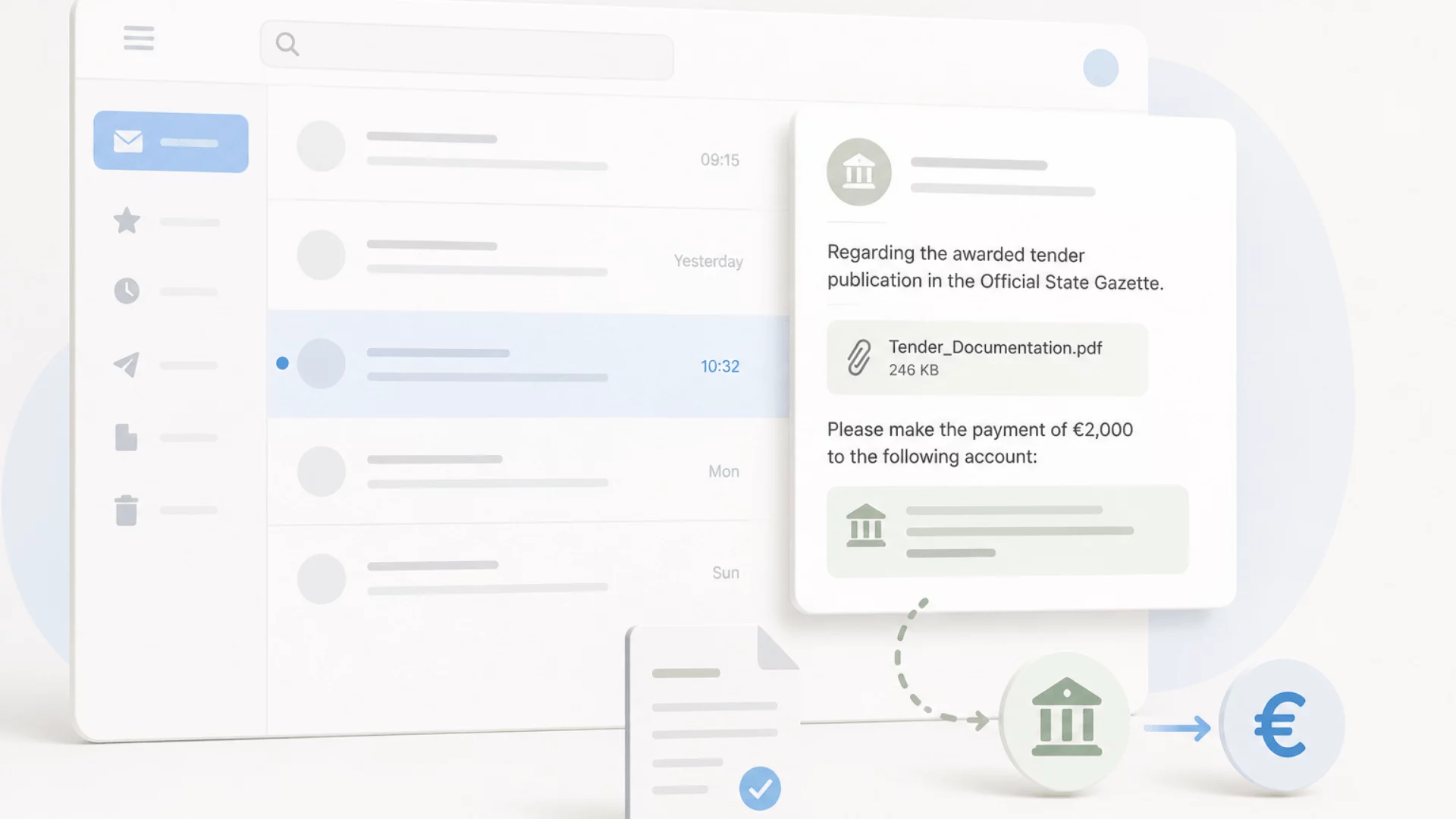
MADRID, SPAIN — Spain’s Guardia Civil has successfully identified two individuals suspected of orchestrating a targeted Business Email Compromise (BEC) attack that weaponized a legitimate public procurement process. By combining a near-identical "lookalike" email domain with hyper-specific administrative data regarding an awarded public tender, the fraudsters successfully deceived a Córdoba-based business into transferring €2,000 under the guise of official state publication fees.
While the financial loss associated with this specific incident is relatively modest when compared to multi-million-dollar corporate wire frauds, cybersecurity experts and law enforcement agencies consider the attack method highly sophisticated. The incident highlights an evolving threat landscape where cybercriminals leverage publicly available open-source intelligence (OSINT) to execute hyper-targeted social engineering campaigns.
Main Facts
The ongoing investigation, spearheaded by the Guardia Civil’s specialized cyber command unit (CiberComandancia), centers on a carefully plotted deception that exploited the communication channels between a private enterprise and a regional public entity.
According to official law enforcement briefings, the key elements of the case include:
- The Target: A private business located in the Andalusian province of Córdoba that had recently secured a public sector procurement contract.
- The Impersonation Vector: The perpetrators spoofed a public administration entity using an email domain described by investigators as "practically identical" to the legitimate institutional address.
- The Ploy: The fraudulent email demanded an immediate administrative fee allegedly covering advertising and publication costs associated with the tender in Spain’s official state gazette, the Boletín Oficial del Estado (BOE).
- The Social Engineering: To bypass the victim’s natural skepticism, the attackers embedded authentic references, tender identification numbers, and official documentation matching the active procurement procedure.
- The Financial Impact: Believing the communication originated from their established institutional point of contact, the company transferred €2,000 to a designated bank account controlled by the fraudsters.
- The Discovery: The fraud came to light when the Córdoba business independently contacted the legitimate public entity through a secondary, trusted communications channel to confirm receipt of payment. The administration confirmed it had issued no such invoice and had no association with the receiving bank account.
- The Law Enforcement Response: Investigators traced the digital footprint of the fraudulent communications and the subsequent movement of funds, ultimately identifying two male suspects residing in the province of Valencia. Both individuals are currently under formal judicial investigation for alleged fraud and money laundering.
Chronology of the Attack and Investigation
The timeline of events—spanning from the initial reconnaissance phase to the identification of the suspects in Valencia—demonstrates the methodical nature of modern targeted cybercrime.
Phase 1: Reconnaissance and Open-Source Intelligence Gathering
Weeks prior to the attack, the target company was awarded a public tender. Details regarding this award, including the identity of the procuring entity, the monetary value, and specific administrative references, were published across public contracting platforms. Cybercriminals routinely monitor these platforms to identify active business relationships and administrative workflows. Armed with this data, the perpetrators mapped out the communication styles and institutional hierarchy of the public body.
Phase 2: Domain Spoofing and Infrastructure Setup
The attackers registered a domain name that closely mirrored the legitimate domain of the public entity—employing subtle typosquatting or character substitution techniques designed to evade casual visual inspection by corporate accounting staff. They also set up mail server configurations capable of sending emails that appeared to originate from the trusted institution.
Phase 3: The Execution (The Phishing Strike)
With the infrastructure prepared and the target’s tender details in hand, the fraudsters dispatched a formalistic payment request. The email cited the specific procurement process won by the Córdoba firm and requested a €2,000 fee for BOE publication costs. Because the message contained accurate internal project references, it bypassed the cognitive defenses of the company’s finance department.
Phase 4: Discovery and Reporting
Shortly after executing the wire transfer, company officials sought verbal or secondary confirmation regarding the transaction status from their primary administrative contact at the public entity. Upon learning that the invoice was fictitious, corporate leadership immediately alerted the authorities, setting off a formal criminal investigation.
Phase 5: Digital Forensics and Law Enforcement Action
The Guardia Civil’s CiberComandancia initiated a multi-faceted digital forensics operation. Investigators analyzed server headers, routing logs, IP addresses, and document metadata associated with the fraudulent email. Simultaneously, financial intelligence units tracked the wire transfer through the banking sector, following the trail of the capital as it was moved and dispersed. This financial and digital tracing led directly to two individuals living in the Valencian Community, who are believed to have managed the mule accounts used to launder the proceeds.
The investigative file has been formally transferred to the competent judicial authority in Alzira, Valencia, where legal proceedings are advancing.
Supporting Data and Technical Context
To fully understand the mechanics of this incident, it is necessary to examine the broader context of Business Email Compromise and how threat actors utilize technical manipulation alongside psychological coercion.
The Anatomy of Domain Impersonation
Domain spoofing remains one of the most reliable vectors for business email compromise. While organizations often implement robust defenses against generic spam, lookalike domains (often referred to as typosquatting or cousin domains) present a unique challenge.
In this case, the attackers did not necessarily compromise the internal servers of the public entity; instead, they created an external mirror structure. When an employee receives an email from [email protected] instead of [email protected], the human brain frequently glazes over the microscopic discrepancy, assuming legitimacy based on the contextual accuracy of the message body.
The Weaponization of Public Data
Public transparency laws require governments to publish tender awards, contractor names, and project values openly. While these transparency measures are vital for democratic accountability, they inadvertently provide cybercriminal syndicates with a readymade reconnaissance feed.
| Attack Vector Component | Traditional BEC / Phishing | Advanced Targeted Procurement Fraud (This Case) |
|---|---|---|
| Target Selection | Mass spray-and-pray campaigns | Highly targeted (Specific companies winning specific bids) |
| Content Customization | Generic invoice requests or CEO fraud | Integrates exact tender IDs, legal references, and administrative jargon |
| Infrastructure | Randomized free webmail accounts | Dedicated lookalike domains mimicking specific state or municipal bodies |
| Detection Difficulty | Low (Easily flagged by filters or common sense) | High (Blends seamlessly into ongoing business operations) |
Financial Crime Statistics in Spain
While €2,000 is a minor sum compared to corporate BEC incidents involving six- or seven-figure losses, Spanish law enforcement agencies note that micro-frauds targeting small and medium-sized enterprises (SMEs) have seen a steady uptick. SMEs often lack the dedicated, enterprise-grade Security Operations Centers (SOCs) and multilayered financial approval protocols found in multinational corporations, making them disproportionately vulnerable to precision-engineered social engineering.
Official Responses and Law Enforcement Statements
The Guardia Civil has released limited details regarding the identities of the two suspects due to ongoing judicial privacy protocols, but emphasized the collaborative nature of the inter-provincial operation between Andalusia and Valencia.
In official statements released via regional media channels including Europa Press and El Día de Córdoba, law enforcement reiterated that the suspects are currently under formal investigation for crimes spanning digital fraud (estafa) and money laundering (blanqueo de capitales). While no physical arrests were publicized at the time of the announcement, the legal summons require the individuals to answer to charges before the judicial court in Alzira.
Cybersecurity authorities have taken the opportunity to issue renewed advisories to corporate entities across Spain. The Guardia Civil’s cybercrime division stressed that businesses engaging in public procurement or routine B2B supply chains must institute strict verification checkpoints independent of email communication channels.
"The sophistication of modern cybercrime lies not in complex cryptographic malware, but in the abuse of human trust and business processes," a digital forensics specialist noted in relation to the case. "When an email arrives bearing the exact identifiers of an active project, the psychological barrier to verification drops significantly. Organizations must treat every unexpected payment request—regardless of how authentic the supporting documents appear—with rigorous skepticism."
Implications for Businesses and Public Procurement
The Córdoba incident serves as a critical case study for corporate risk management, illuminating several broader implications for how businesses must adapt their security postures in an era of OSINT-driven fraud.
1. The Breakdown of Traditional Perimeter Security
Traditional email security gateways (Secure Email Gateways, or SEGs) scan for known malicious payloads, phishing links, and obvious spam markers. However, a text-based email originating from a newly registered lookalike domain that contains valid public sector metadata often slips past automated defenses because it contains no malicious attachments or links—only a fraudulent text instruction and a bank account routing number. Consequently, technological defenses must be augmented by robust human controls.
2. Reinforcing Out-of-Band Verification Protocols
The primary failure point in this incident was the reliance on email as both the delivery mechanism and the verification medium. Security experts recommend the implementation of strict "out-of-band" confirmation policies for any financial transaction or billing modification:
- Independent Verification: Finance departments must verify payment instructions by calling a pre-established, trusted phone number obtained from official internal records—never by replying to the incoming email or calling phone numbers listed within the suspicious correspondence.
- Dual-Authorization Workflows: Instituting mandatory dual sign-offs for wire transfers exceeding nominal thresholds can prevent a single employee from falling victim to high-pressure or time-sensitive administrative demands.
3. Training Staff Beyond Basic Phishing
Standard corporate cybersecurity awareness training often focuses on spotting obvious red flags, such as poor grammar, urgent threats of account closure, or generic prize notifications. Employees must be specifically trained to recognize Procurement Fraud and BEC scenarios where the communication is grammatically immaculate, highly professional, and contextually accurate. Staff must understand that threat actors routinely harvest public records to build convincing pretexts.
4. Securing the Administrative Interface
For public entities, the weaponization of their institutional identity highlights a reputational risk. While administrative transparency cannot and should not be compromised, public bodies should consider issuing guidance alerts to winning contractors warning them of potential billing scams that exploit upcoming tender publications, actively advising vendors on how official fees (if any) are legitimately collected.
Conclusion
The Guardia Civil’s identification of the two suspects in Valencia closes an important chapter for the Córdoba company that lost €2,000, but it underscores a wider systemic challenge. As cybercriminals increasingly refine their tactics to mimic legitimate commercial and administrative workflows, corporate vigilance remains the ultimate line of defense. In the modern threat landscape, verifying the sender is no longer just an IT best practice—it is an indispensable pillar of corporate financial survival.