Remember when the “I’m Feeling Lucky” button was Google’s biggest gamble? Today, that gamble has evolved into the company’s entire business model—and your organic web traffic is the casino’s take.
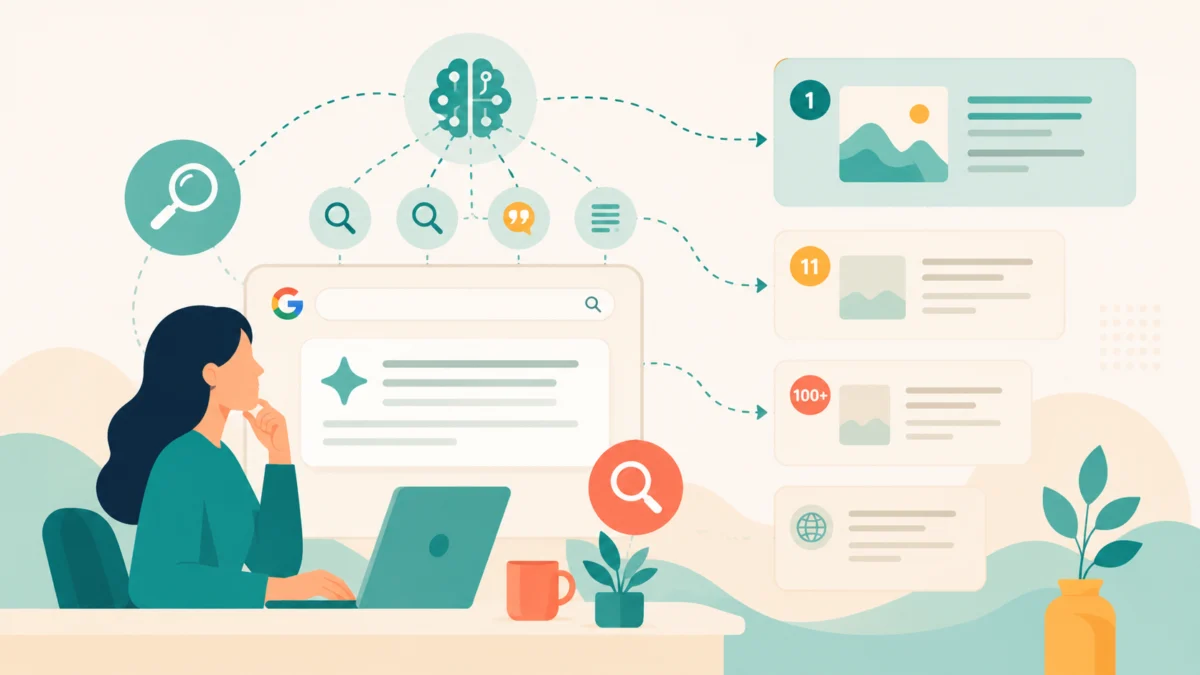
Your best-performing article still holds the coveted #1 ranking, yet your analytics dashboard tells a grim story: traffic is down 30%. You type your primary keyword into a search engine, and there it is: a gleaming, AI-generated overview perfectly summarizing your hard-earned content. No click required.
Welcome to the era of zero-click search, a blunt industry term that means exactly what it sounds like—searches where users extract the information they need without ever visiting the underlying website. Industry veterans have dubbed this phenomenon “Google Zero,” a moniker that sounds ominous because the stakes are genuinely existential for digital publishers, media companies, and brand marketers alike.
In this new paradigm, traditional search engine optimization (SEO) and high rankings no longer guarantee engagement. When your audience absorbs AI-generated answers directly on Google’s platform, your site is entirely bypassed. This is the defining challenge of modern content marketing. In an era dominated by AI-powered Search Engine Results Page (SERP) previews, winning means creating digital destinations worth actively visiting, not just pages that pull rank.
The Main Facts: The Anatomy of Zero-Click Search
To understand how we arrived at Google Zero, we have to examine the fundamental shift in how internet users source information. Google’s AI Overviews—and similar large language model (LLM) implementations across competing search engines—represent a structural change in internet consumption. By compressing thousands of words of reported content, analysis, and research into punchy, bulleted summaries, search engines offer unprecedented instant gratification to the consumer.
For brands, publishers, and content creators, however, this efficiency translates into an immediate crisis.
Data from a comprehensive 2024 SparkToro analysis revealed that for every 1,000 Google searches in the United States, only 374 clicks actually made it to the open web (with EU markets faring similarly at around 360 clicks). Let that implication settle: out of every 1,000 queries, over 600 now lead to zero clicked results.
By 2025, this trend accelerated dramatically. According to a landmark study by eMarketer, the widespread rollout of Google AI Overviews decreased click-through rates (CTRs) by an average of 34.5% across analyzed sectors. Publishers operating in reference-heavy verticals—such as science, health, law, government, and consumer technology—reported devastating traffic losses. Ironically, many of these outlets watched their keyword rankings hold completely steady while their actual referral traffic flatlined.
Chronology: From Keyword Stuffing to the AI Overview
The path to Google Zero was paved over two decades of constant algorithm updates, shifting user habits, and technological leaps. Tracing this timeline clarifies why traditional SEO strategies are no longer sufficient:
- The Early 2000s (The Keyword Era): Search engines relied heavily on keyword density, metadata, and basic backlinks. Content creators focused on gaming the algorithm, leading to the proliferation of keyword-stuffed, low-quality articles.
- The 2010s (The Content Saturation Boom): Driven by the mandate to feed the content beast, brands churned out millions of generic listicles ("10 Best Tools for X") and derivative blog posts. SEO became an exercise in out-optimizing competitors rather than offering distinct value.
- The Early 2020s (Featured Snippets and PAA): Google introduced "People Also Ask" (PAA) boxes and Featured Snippets, slowly teaching users that they could get direct answers without scrolling down to organic search results.
- 2023–2024 (The Generative AI Pivot): The mainstream debut of generative AI forced search engines to pivot toward conversational, synthesized answers. SparkToro and Semrush began documenting the collapse of the open web’s click-through rates.
- 2025 and Beyond (The Google Zero Reality): AI Overviews became ubiquitous. Publishers realized that ranking on page one no longer guaranteed a viable business model, forcing a mass migration toward "destination content" and community-led distribution.
Supporting Data: Who Is Feeling the Squeeze?
The erosion of web traffic is not distributed evenly across the internet. According to extensive research from Semrush’s AI Overviews study, the impact is surgical, targeting specific informational niches while leaving others relatively untouched.
Industry Vulnerability Index
- Science and Technology: Highly vulnerable. Factual, data-driven answers are easily synthesized by LLMs.
- Health and Wellness: Severely impacted. General medical queries are routinely answered within the AI Overview box, bypassing health publishers.
- Law and Government: Witnessing massive double-digit drops in referral visits despite stable keyword positions.
- Niche Lifestyle and Opinion: Moderately protected. Readers seeking personal perspective, unique voice, and nuanced commentary still click through to the source.
Despite these sobering statistics, many digital strategists argue that the rise of zero-click search is not a content apocalypse, but rather a long-overdue process of natural selection. Commodity content—the endless sea of generic listicles and surface-level explainers—is effectively extinct.
Furthermore, early data suggests a fascinating twist: AI search algorithms frequently surface sources that live deep beyond the traditional first page of Google. Content that was once buried in the old SEO hierarchy can occasionally become citable and top-of-mind in AI summaries, provided it contains unique, authoritative insights.
Official Responses and Industry Reactions
The publishing industry’s reaction to Google Zero has oscillated between aggressive pushback, legal scrutiny, and strategic reinvention.
Major media organizations, trade associations, and independent publishers have entered what NPR aptly described as "panic mode." Publishers have increasingly raised alarms regarding intellectual property theft, arguing that search engines are scraping proprietary journalism to train models and serve answers, starving the original creators of the ad revenue and subscription conversions required to fund that journalism.
Concurrently, tech platforms have defended AI Overviews as a natural evolution of search utility. Google executives maintain that AI search tools help users find more diverse sources of information and send high-intent traffic to specialized websites.
However, independent digital marketers are largely voting with their strategy adjustments. Rather than fighting an uphill battle against Google’s search real estate, forward-thinking brands are fundamentally decoupling their business models from reliance on organic search traffic, investing heavily in owned media channels, community building, and alternative discovery engines.
Implications: Building a "Destination Content" Strategy
Escaping the gravitational pull of the SERP requires inverting the classic SEO playbook. Instead of obsessing over keyword density and search volume to capture fleeting traffic, brands must focus on building digital destinations that users actively seek out.
Here are four foundational strategies brands are using to thrive in the Google Zero era:
1. Utility and Interactivity
Google’s AI Overviews can summarize general best practices, frameworks, or steps to use a tool, but they cannot generate dynamic, personalized outcomes tied to an individual user’s unique inputs and data.
Consider HubSpot’s legendary Website Grader. While an AI can explain how website speed matters, it cannot evaluate a user’s specific URL and deliver a personalized score based on proprietary metrics. Brands that invest in calculators, diagnostic assessments, and interactive software create a direct exchange of effort for individualized insight that no zero-click summary can replicate.
2. Memorable Narrative and Voice
Readers return for evolving narratives, strong opinions, and a distinct human voice. While AI can aggregate facts, it cannot replicate original reporting, personal vulnerability, or strategic nuance.
For instance, direct-to-consumer brand Rare Beauty utilizes Substack for long-form, behind-the-scenes storytelling that blends personal anecdotes, mental health advocacy, and candid product development updates. This fosters deep emotional affinity, giving readers a tangible reason to subscribe rather than passively consume information.
3. Immersive Experiences
Flat, text-heavy articles are prime targets for AI summarization. To combat this, innovative publishers are deploying interactive flipbooks, multi-step quizzes, immersive data visualizations, and rich content hubs. These formats encourage progressive disclosure, significantly increasing dwell time and brand recall.
4. Unmatched Credibility and Proprietary Research
Original research remains one of the strongest defensive moats against AI scraping. When Edelman publishes its annual Trust Barometer—surveying tens of thousands of respondents globally—the resulting data is widely cited across media outlets. Because the proprietary insights cannot be found anywhere else, readers are compelled to click through for the underlying methodology, charts, and nuanced analysis.
Diversifying Discovery and Distribution
Smart brands are no longer putting all their digital marketing chips on Google. Instead, they are engineering resilient distribution networks that remain completely immune to shifting SERP formats.
- Email Newsletters: Newsletters remain the gold standard of owned media. Immune to zero-click harvesting, an engaged subscriber base represents a direct, unmediated line of communication with your audience.
- Native Social Discovery: Platforms like Reddit have experienced a massive resurgence, serving not only as community hubs but also as the single-largest text source feeding modern LLM search results. Brands winning on Reddit and LinkedIn focus on contributing genuine expertise before dropping links, prioritizing community trust over transactional promotion.
- Events and Repurposing Playbooks: Live webinars, workshops, and virtual summits generate immediate, high-value interaction while simultaneously producing a wealth of modular content—clips, templates, FAQs, and case studies—that can be repurposed across multiple channels.
Redefining Performance Metrics
Organic sessions, once the undisputed bedrock KPI for digital success, are no longer a reliable indicator of business health. In the Google Zero era, traffic volatility is the norm. Future-proof organizations are shifting their measurement frameworks from tracking visits to measuring value:
- Relationship Metrics: Prioritize email signups, subscriber retention, and community participation over raw pageviews.
- Engagement Signals: Track engaged reading time, scroll depth, recirculation rates, and direct, repeat visits.
- Utility and Habit Metrics: Measure tool completion rates, template downloads, and resource revisits. A user who actively saves and reuses your proprietary tool is exponentially more valuable than a user who skims a single search result.
Conclusion: Winning Commitment Over Clicks
The rise of zero-click search does not signal the death of content marketing; rather, it marks the definitive end of lazy content tactics. Google Zero is forcing brands to confront a truth that has been building for years: visibility is entirely meaningless without genuine engagement. Traffic is inherently volatile, but trusted relationships endure.
Survival in the Google Zero era is not about winning clicks—it is about winning commitment. Brands that cultivate trusted relationships, deliver irreplaceable utility, and foster vibrant communities will discover a liberating reality: when your audience actively chooses to seek you out, no algorithm can ever make you disappear.