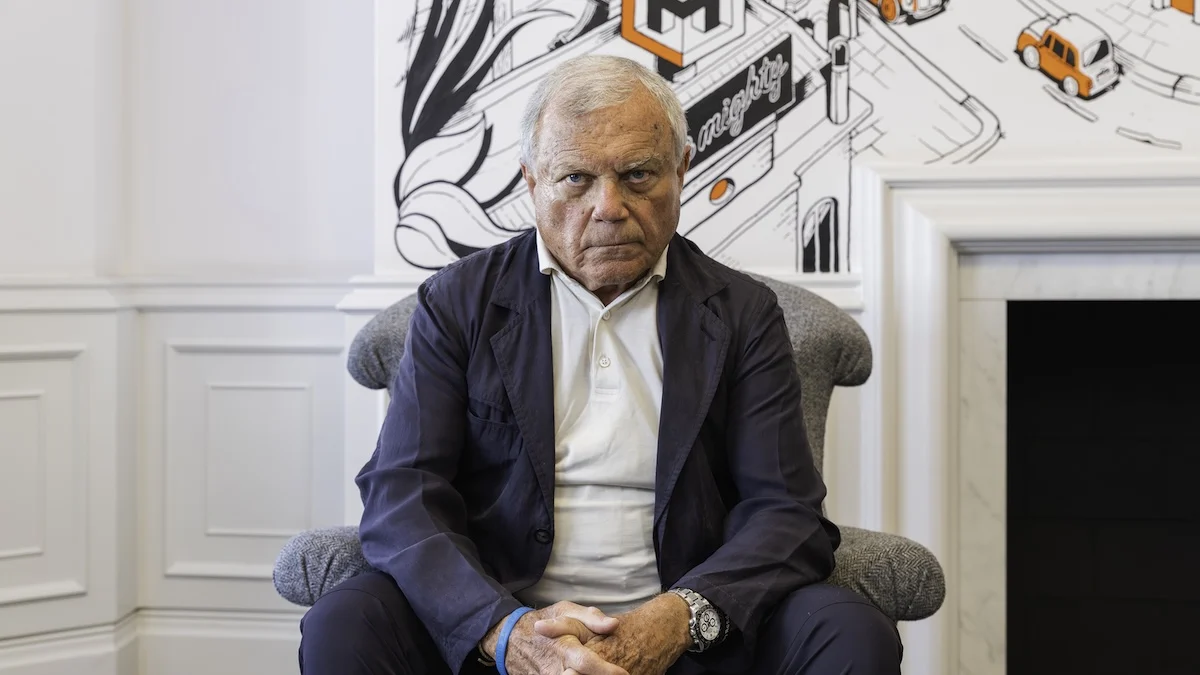
For nearly half a century, Sir Martin Sorrell has served as the industry’s most prominent—and often most polarizing—chronicler of the advertising landscape. Having transformed WPP from a manufacturer of shopping baskets into a global marketing titan through a series of aggressive acquisitions, his name has become synonymous with the "holding company" model.
Following his departure from WPP in 2018 and the subsequent birth of S4 Capital, Sorrell has transitioned from the industry’s consolidator-in-chief to a challenger looking to navigate a "tech winter." In an exclusive sit-down with Adweek, the veteran executive offered a candid assessment of the current M&A environment, the structural failures plaguing his former rivals, and the path forward for S4 Capital as it attempts to pivot from a period of turbulence toward sustainable growth.
The Evolution of a Titan: From WPP to S4 Capital
To understand Sorrell’s current outlook, one must look at the trajectory of his career. In 1985, Sorrell used a reverse acquisition to take control of Wire and Plastic Products (WPP). Over the next three decades, he orchestrated a shopping spree that saw the integration of legendary creative shops including J. Walter Thompson, Ogilvy & Mather, and Young & Rubicam. Under his tenure, the "holdco" became the dominant species in the advertising ecosystem.
However, his 2018 exit—precipitated by an investigation into allegations of personal misconduct and misuse of company assets—marked a dramatic inflection point. Within weeks of leaving WPP, Sorrell launched S4 Capital, a digital-first, data-driven alternative to the legacy models he once perfected. Through the acquisition of powerhouses like MediaMonks and MightyHive, Sorrell attempted to prove that a lean, tech-focused agency could outmaneuver the lumbering giants of Madison Avenue.
The thesis, however, hit a wall. S4 Capital’s heavy exposure to big-tech clients—who began shifting marketing budgets toward capital-intensive AI infrastructure—triggered a revenue contraction. With shares falling approximately 38% over the past year, the company is currently in a state of consolidation, prioritizing stability over the aggressive deal-making that defined its early years.
M&A Stagnation: The "No-Takers" Market
One of the most pressing questions in the industry is why the long-predicted wave of private equity takeovers of major advertising holding companies has failed to materialize. As Sorrell notes, the lack of activity is not for lack of interest, but for lack of feasibility.
"There are very few, if any, exits," Sorrell explains. "No activists have stepped in. There are no takers. Most of the big deals would involve syndicates. One PE firm couldn’t write the check for WPP or Dentsu. Maybe Bain Capital could have done it on their own."
When asked about the current buying appetite among the major players, Sorrell is dismissive of most. He views Omnicom and Dentsu as sidelined, while noting that Stagwell remains one of the few likely to test the waters. The irony, he posits, is that while valuations are currently battered, the appetite for risk is at an all-time low.
"If anyone was going to take a risk, who do you think it would be?" Sorrell muses. "Havas. Maybe not of scale. But Yannick Bolloré always sends you in the wrong direction. Always. Keeps you guessing."
Perhaps his most provocative suggestion involves the intersection of management consulting and advertising. "I think Accenture," he suggests. "If I was Julia Sweet, I would go for WPP. With them, they could get significantly better. I think the media piece in their hands would be very valuable. But whether they’ve got the balls, though… it would be messy. But you’ve got David Droga there."
The Structural Divide: Capability vs. Geography
Sorrell’s critique of the legacy holdcos often centers on their organizational design. He argues that WPP and Omnicom have fallen into a trap: prioritizing "capability" over "client."
"The reorganization of WPP and the reorganization of Omnicom is capability-first, client second, geography third," he explains. "Publicis and, indeed, ourselves is geography first, client second, capability third."
According to Sorrell, organizing by capability creates "warring factions" that prevent true integration. By contrast, a geographic focus forces internal collaboration to solve client problems, even if it creates regional rivalries. He points to Publicis as the gold standard of this philosophy, though he admits the transition was far from smooth.
"Publicis got it right," Sorrell says. "Can they maintain it? Well, the industry wisdom is these things go in cycles. John Wren, if you look at Omnicom Advertising Group before they acquired IPG, had a better strategy. He was trying to push them together. Publicis didn’t nudge. They were quite forceful. And it was painful for them. They were more violent than probably I would have been. But directionally, it was the same thing."
S4 Capital: Navigating the Tech Winter
For S4 Capital, the last 18 months have been a sobering exercise in reality. With nearly 45% of its revenue tied to tech giants like Google, Amazon, and Meta, the company felt the direct impact of the sector’s shift toward AI-related capital expenditure. When clients cut marketing budgets to fund data centers and LLM development, S4’s growth engine sputtered.
"It’s tough," Sorrell admits. "We rely on wholesale AI adoption. We really depend on more car verticals, more financial services verticals, more packaged goods. If we can get a little bit more traction, it will be fine."
Addressing the internal operational challenges, Sorrell is characteristically blunt: "Our integration has not been perfect by any means. Liquidity is much better."
The strategy for recovery is simple: diversifying the client base to reduce reliance on Big Tech and strengthening internal cohesion. By building deeper relationships across traditional sectors, S4 hopes to weather the current macroeconomic volatility. While the early results from 2026 show signs of improvement, Sorrell acknowledges that the company is in a stabilization phase, not a growth phase. "We need more traction," he says.
The Future of the Holdco Landscape
When asked to forecast the state of the industry three years from now, Sorrell remains cautious but confident in the survival of the major players, even if their forms shift significantly.
"I don’t know what Cindy Rose is going to do [at WPP]," he says, citing the company’s ongoing balance sheet struggles. "But I would guess Omnicom will still be here. Publicis will still be here. Dentsu will be in a different form. Havas will be in a different form. WPP will be in a different form."
The implications for the industry are clear: the "scale at all costs" era is over. The survivors will be those who can successfully balance the high-level integration of technology with the foundational need for client-centric service.
For the man who built the modern holding company, the future of the industry is no longer about just "snapping up" agencies. It is about proving that these massive entities can actually provide value to clients who are increasingly wary of bloated, siloed organizations. As S4 Capital looks to find its footing, Sorrell finds himself in a familiar position—arguing for a new way of doing business in an industry that is notoriously resistant to change.
Conclusion: The Long View
Sir Martin Sorrell’s influence on the advertising world remains undeniable, even as he navigates the most difficult period of his post-WPP career. His critique of the "matrix" model at firms like WPP and Omnicom serves as a warning to those who prioritize internal architecture over market reality.
Whether his own vision for S4 Capital—a geography-first, tech-forward, integrated entity—can achieve the scale he once commanded remains to be seen. However, in an industry defined by cycles, shifts, and the constant threat of disruption, Sorrell’s ability to force the conversation remains his most enduring asset. As the industry grapples with the integration of AI, the stagnation of traditional M&A, and the rise of consulting giants, Sorrell’s "long view" remains a critical, if controversial, compass for where the business of brands is headed.