In the traditional landscape of digital marketing, the "set it and forget it" mentality has long been the default for many teams. Marketers launch a campaign, monitor the initial burst of traffic, and—depending on whether the results hit the mark—either celebrate a victory or mourn a loss before moving on to the next project. However, this binary approach to success leaves significant value on the table.
Today, the most sophisticated growth teams are shifting toward a methodology borrowed from product engineering: iterative testing. Rather than treating marketing as a series of disconnected, high-stakes events, iterative testing transforms it into a perpetual cycle of refinement. By implementing small, evidence-based improvements, marketers can adapt to fluid consumer behaviors, minimize wasted ad spend, and compound their conversion rates over time.
The Core Concept: What is Iterative Testing?
Iterative testing is a process characterized by the continuous loop of testing, measuring, and refining. Instead of aiming for a radical "overhaul" of a landing page or email sequence, teams make incremental adjustments to specific elements. Each experiment serves as a data point, informing the next step.
While this approach has been a staple of software development for decades—where agile methodologies dominate—it is only recently becoming the gold standard for performance marketing. The primary philosophy is that marketing failures are rarely explosive; instead, they are often "slow leaks" that drain budgets over months. Iterative testing plugs these leaks by systematically questioning every assumption in the funnel.
A Chronology of the Testing Shift
To understand why this shift is happening now, one must look at the evolution of the digital advertising ecosystem.

- The Early Web (2000–2010): Testing was rare and expensive. A/B testing was a luxury for high-traffic e-commerce giants. Most decisions were based on intuition or "best practices" provided by agencies.
- The Era of Complexity (2010–2020): Tools for A/B testing became democratized. However, many marketers fell into the trap of over-testing, attempting to run multivariate tests that lacked statistical significance, leading to "analysis paralysis."
- The Modern Data-Driven Era (2020–Present): With the rise of AI-driven tools, such as Smart Traffic, even low-traffic sites can now benefit from iterative optimization. The focus has moved away from "winning a test" to "building a knowledge base."
Supporting Data: Why Small Changes Drive Big Results
The efficacy of iterative testing is not merely anecdotal; it is backed by significant industry research. According to Unbounce’s 2024 Conversion Benchmark Report, the impact of granular adjustments can be profound. For instance, the report highlights that landing pages written at a 5th-7th grade reading level convert at a rate of 11.1%—more than double the rate of content written at a professional or academic level.
Furthermore, data suggests that complexity is the enemy of conversion. The same report found a -24.3% negative correlation between word complexity and conversion rates. Iterative testing allows a team to take these industry-wide benchmarks and validate them against their specific audience. Instead of blindly simplifying all copy, a team can run a quick, iterative test on a small segment of their traffic to see if the trend holds true for their specific demographic, thereby reducing risk while maximizing ROI.
The Six-Step Iterative Framework
For marketing teams looking to move away from "home run" culture—where every campaign is a gamble—the following six-step framework provides a blueprint for consistent, incremental growth.
1. Define a Focused Hypothesis
Most failed tests are a result of "variable soup"—testing headlines, images, and buttons simultaneously. A focused hypothesis targets a single element. A strong hypothesis sounds like: "By simplifying the primary call-to-action (CTA) button text, we expect to see a 5% increase in click-through rates because it reduces user cognitive load."
2. Prioritize Through Impact and Effort
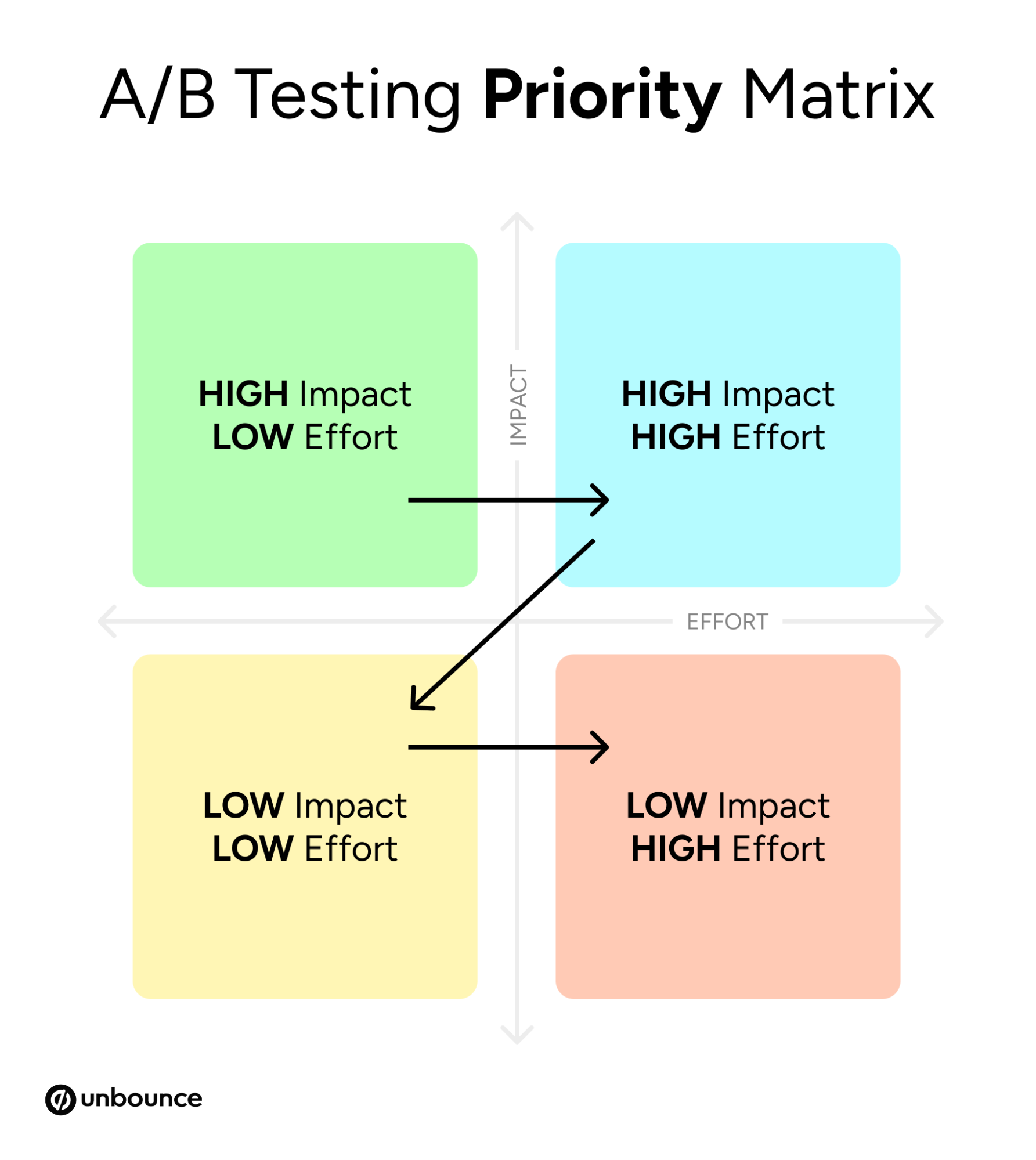
Use a simple 2×2 prioritization matrix. Plot your potential tests on two axes: "Expected Impact" and "Implementation Effort." Focus on the "Quick Wins"—tasks that require little effort but promise high visibility or impact. This builds organizational momentum and secures buy-in from stakeholders.

3. Build Minimal, Testable Variations
Resist the urge to redesign the entire page. A minimal variant allows for cleaner data. If you are testing a headline, keep the background, the form, and the CTA identical. This ensures that when the conversion rate changes, you know exactly which variable caused the shift.
4. Launch and Reach Statistical Significance
Patience is the marketer’s greatest challenge. Launching a test and pulling the plug after two days because the numbers look "promising" is a recipe for false positives. Ensure your sample size is sufficient to reach statistical significance, meaning the results are likely a result of your change rather than random chance.
5. Extract Actionable Insights
If Variant B wins, don’t just say "B is better." Ask why. Did it win because of the tone, the length, or the specific keyword used? Transforming raw data into a narrative helps the team develop a "conversion intuition" that makes future hypotheses more accurate.
6. Iterate, Expand, and Scale
Once you have a winner, the test isn’t finished—it’s just beginning. If a specific style of headline performs well on a landing page, that insight should be propagated to email subject lines, PPC ad copy, and social media headers.
Official Perspectives: The Role of Organizational Culture
Industry leaders emphasize that the biggest hurdle to iterative testing is not technological, but cultural. "Building a culture of experimentation means breaking down silos," notes Josh Gallant, founder of Backstage SEO. When customer support, sales, and product teams contribute to the "testing backlog," the quality of hypotheses improves dramatically.
For instance, if the support team reports that users frequently ask about pricing after a trial, the marketing team can immediately create an iterative test to surface pricing information earlier in the user journey. This cross-departmental collaboration ensures that tests are not just "marketing experiments" but solutions to real customer friction points.
Implications for Future Marketing Performance
The implications of adopting an iterative mindset are twofold:
- Risk Mitigation: By testing small segments, companies avoid the "massive launch" failure that can waste an entire quarter’s budget. If a test fails, the impact is contained, and the learning remains intact.
- Competitive Advantage: In a digital economy where attention spans are shrinking, the ability to pivot based on real-time data is a massive differentiator. Companies that can iterate faster than their competitors will naturally capture more demand and retain more users.
Ultimately, iterative testing is not about finding the "perfect" landing page—that page doesn’t exist. It is about fostering a culture of perpetual progress. When marketing becomes an ongoing experiment, the brand becomes more resilient, the messaging becomes more precise, and the ROI becomes more predictable.
By prioritizing speed, maintaining a clear focus on core metrics, and ensuring that every test informs the next, marketers can transform their department from a cost center into a powerful, data-driven engine for sustainable growth. The goal is no longer to hit a home run; it is to hit a string of base hits that ultimately change the game.