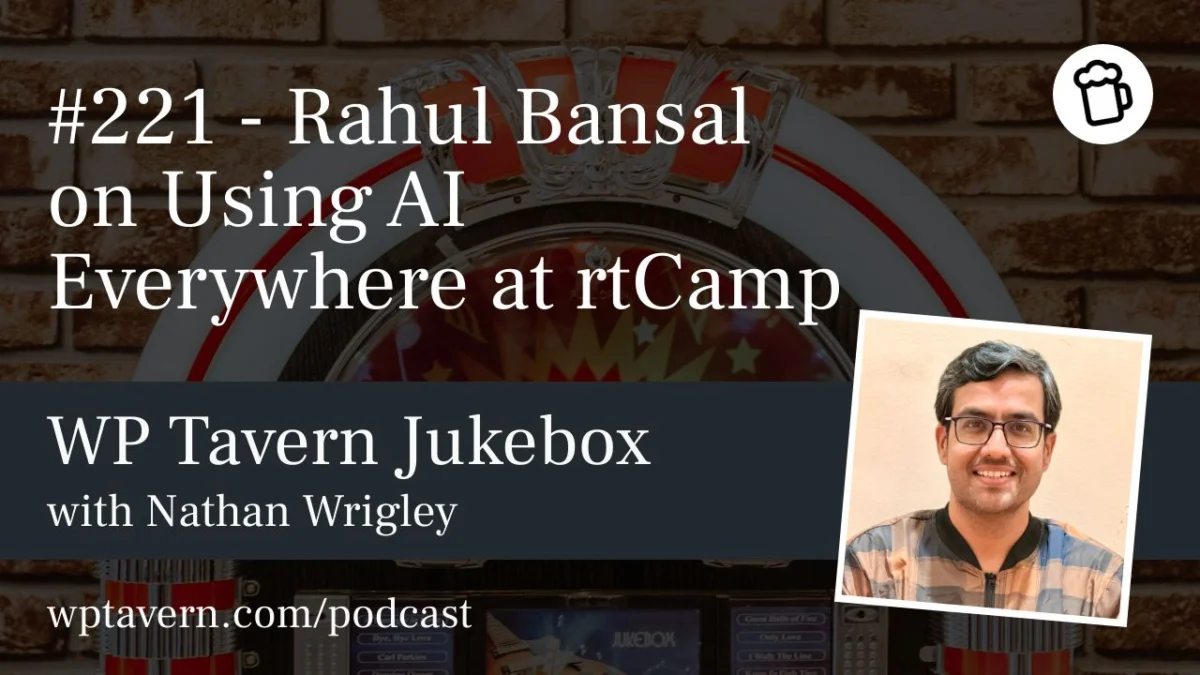
The web development landscape has shifted dramatically over the past two decades. What began as a fragmented digital frontier of custom PHP scripts and nascent content management systems has matured into a consolidated ecosystem heavily powered by WordPress. At the forefront of this evolution is rtCamp, an enterprise-grade agency that has spent the last 17 years navigating the rapid currents of web technology.
Founded and led by CEO Rahul Bansal, rtCamp has grown from a humble regional tech blog into a globally recognized powerhouse. Trusted by Fortune 500 companies, major publishers, and tech giants like Google, the agency now stands at another monumental crossroads. Following his recent appearance at WordCamp Asia, Bansal outlined a radical, forward-looking roadmap for scaling an enterprise agency—not just by adapting to emerging trends, but by fully integrating artificial intelligence into every operational fiber of the business.
Main Facts: Redefining Agency Operations Through AI and Niche Specialization
The core takeaway from Bansal’s recent insights is that the traditional playbook for running a web development agency is broken. Legacy methods of linear scaling—hiring dozens of junior developers to match project volume—are no longer economically viable in an era defined by automation.
- Total AI Integration: rtCamp’s operational mandate is clear: if a business process can be executed by artificial intelligence, it will be. This includes everything from automated CRM lead qualification and proposal writing to proof-of-concept builds and quality assurance testing.
- The "Complementary Set" Philosophy: Drawing on mathematical set theory, Bansal stresses that early-stage businesses should not hire people who mirror the founder’s skill set. Instead, leadership must actively recruit individuals whose strengths counterbalance their weaknesses.
- Hyper-Specialization Over Generalization: In 2006, positioning rtCamp simply as a "WordPress agency" was a massive differentiator. In today’s hyper-saturated market, agencies must drill down into granular niches—such as complex WooCommerce integrations, payment gateways, and enterprise data migrations—to remain competitive.
- Unified Open-Source Infrastructure: rtCamp relies on a single source of truth for its back-office operations—utilizing open-source ERP platforms like Frappe ERPNext for accounting, CRM, and project management—allowing the agency to seamlessly layer custom AI automation on top of clean, first-party data.
Chronology: From Tech Blog to Global Enterprise Powerhouse
To understand rtCamp’s aggressive embrace of modern automation, one must examine the chronological trajectory that brought the company to this juncture.
2006–2009: The Accidental Agency
rtCamp did not begin as an enterprise service provider. Originally, the business operated as a prominent media company and expansive technology blog network running on WordPress. In an era when minimalism was sidelined in favor of heavy Flash animations and advanced jQuery, rtCamp’s internal need to customize and scale its own high-traffic blog forced the team to write exceptionally resilient, high-performance code.
As other digital publishers and tech bloggers took notice of the site’s performance under massive loads, custom development inquiries began to outpace editorial revenue. The founders made a pivotal pivot, stepping away from publishing to establish a dedicated WordPress development agency.
2010–2020: Scaling and the Digital Boom
During the subsequent decade, the agency rode the wave of the global digital boom. As enterprises rapidly abandoned proprietary content management systems in favor of flexible, open-source alternatives, rtCamp scaled its workforce to hundreds of employees. The agency successfully positioned itself as a trusted partner for elite brands, building custom web architectures, SaaS connectors, and specialized browser extensions.
Post-COVID to 2026: Operational Refactoring
In the wake of the COVID-19 pandemic, leadership recognized that managing a rapidly expanding global workforce required radical internal efficiency. Rather than relying on a fragmented web of disparate enterprise SaaS tools, rtCamp consolidated its operations into a unified open-source backend. This foundational restructuring fortuitously prepared the agency for the seismic arrival of generative AI and large language models.
Supporting Data: Efficiency Gains and Shifting Headcounts
The integration of artificial intelligence into rtCamp’s daily workflows has yielded measurable, quantifiable shifts in how the business operates:
- Drastic Cost Reductions in Pre-Sales: Tasks that previously required hours of manual labor—such as initial prospect research, LinkedIn profiling, and project scope estimation—are now executed in minutes by AI agents.
- Accelerated Project Delivery: Complex enterprise migrations that historically took weeks of manual data mapping and testing are now frequently compressed into compressed windows, such as a fully validated Zendesk-to-WordPress migration completed in just five days.
- Headcount Rebalancing: While net engineering headcount growth has plateaued—reflecting a broader industry trend where code generation is heavily automated—rtCamp is heavily pivoting its hiring strategy. Future expansion will focus primarily on sales, marketing, and "growth engineers" who act as technical consultants rather than traditional line-by-line coders.
- Projected Operational Savings: Leadership anticipates that within two years, internal operational and build costs will fall by 70%, allowing the agency to pass savings onto enterprise clients while maintaining premium profit margins.
Official Responses and Strategic Philosophy
In discussions regarding the future of the web development sector, Bansal has been remarkably transparent about the anxieties and opportunities facing modern business owners.
When reflecting on the early days of rtCamp, Bansal readily acknowledges the role of serendipity. "It could have backfired," he notes regarding the early, data-free decision to commit exclusively to WordPress over competitors like Joomla. However, this willingness to steer into favorable winds has remained a cornerstone of the company’s philosophy.
Addressing the industry-wide panic surrounding generative AI, Bansal draws a sharp distinction between technology creators and technology consumers:
"People are trying to act like ChatGPT or OpenAI—it’s their job to invent AI algorithms. We are an agency. Our job is to apply AI, not invent AI. We need to understand we are AI’s consumers and consultants."
Rather than attempting to build futuristic, unproven AI applications that clients do not understand or want, rtCamp focuses on applying automation to notoriously boring, routine enterprise bottlenecks—such as data migration, proposal drafting, and project management—thereby making complex digital transformations cheaper, faster, and more accessible.
Implications: What This Means for the Future of WordPress Agencies
The strategic roadmap laid out by rtCamp carries profound implications for the broader WordPress ecosystem and agency owners worldwide.
1. The Commoditization of Pure Coding
The days of building a profitable agency solely on the backs of junior developers who write boilerplate code are numbered. Because AI can generate, refactor, and test code at unprecedented speeds, the intrinsic value of software development has shifted. Agencies must pivot toward higher-value services: strategic consulting, UX architecture, deep vertical specialization, and expert prompt engineering.
2. The Rise of the Open-Source Advantage
Proprietary SaaS platforms often lock user data behind expensive enterprise paywalls and API limitations. rtCamp’s trajectory demonstrates the immense strategic power of a unified, open-source operational stack. Agencies that control their own first-party data and infrastructure are uniquely positioned to train custom internal models and deploy agentic workflows rapidly.
3. A Larger Pie for the WordPress Ecosystem
By utilizing AI to lower the operational cost and compressed timelines of enterprise migrations, agencies remove the primary psychological and financial barriers that keep major brands tethered to legacy enterprise systems. As digital transformation becomes faster and more affordable, the overall market expands, establishing WordPress not merely as a blogging tool, but as the dominant operational operating system of the enterprise web.