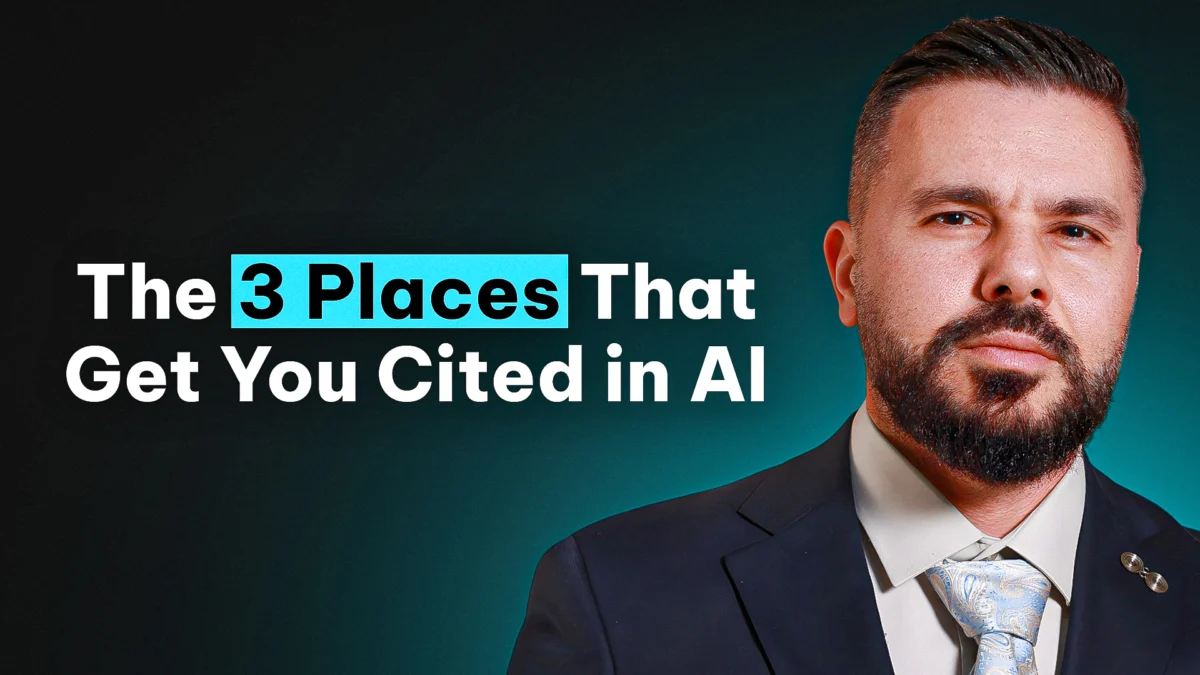
As artificial intelligence fundamentally transforms how consumers discover products, traditional search engine optimization (SEO) is experiencing its most radical evolution in decades. In a recent in-depth interview, digital marketing veteran Besmir Bregasi sat down to break down the mechanics of AI visibility, sharing hard data from his rapidly scaling SaaS startup, ZeroRank.
Tracing his path from traditional SEO to the emerging realm of Answer Engine Optimization (AEO), Bregasi provides a masterclass on how brands can secure citations in ChatGPT, Google AI Overviews, and other large language model (LLM) search experiences. Furthermore, his journey scaling ZeroRank from a three-month MVP to a mid-six-figure Annual Recurring Rate (ARR) business offers valuable lessons for modern entrepreneurs navigating the shifting digital landscape.
Main Facts: The Paradigm Shift to Answer Engine Optimization
The core takeaway from ZeroRank’s extensive visibility data is clear: traditional on-site SEO is no longer enough. While a technically sound website remains a mandatory baseline, the algorithms powering modern AI search engines place an overwhelmingly high value on off-site signals.
According to Bregasi’s observations, LLMs do not merely crawl individual web pages to build responses; they synthesize vast ecosystems of third-party conversations, reviews, citations, and editorial mentions.
- The Off-Site Dominance: LLM visibility is heavily dictated by places where real users discuss, critique, and react to a brand.
- The Power Trio: ZeroRank’s data consistently highlights three platforms that carry the most weight in AI citations: Reddit, X (formerly Twitter), and YouTube.
- The Freshness Factor: In the world of AI search, a piece of fresh, highly engaged content often outperforms a deep archive of outdated authority.
- The Hybrid Search Model: Bregasi estimates an approximate split where user-generated content and third-party discussions account for roughly 60% to 70% of LLM influence, with traditional search engine infrastructure making up the remaining 30%.
Chronology: From 20 Years of SEO to a Three-Month MVP
Bregasi’s entry into the AI visibility space is rooted in two decades of digital marketing experience. His career began nearly 20 years ago in traditional SEO, followed by a 15-year dive into paid advertising, affiliate marketing, and scaling online communities and live events.
When traffic driven by LLMs began experiencing explosive growth, Bregasi recognized a familiar pattern. He felt the shift toward AI-driven discovery mirrored the early days of digital marketing—a fresh channel packed with massive opportunity and relatively low initial competition. Recognizing the timing was right to go all-in, Bregasi partnered with Kelvin Çobanaj—the former CTO of a conference company Bregasi previously built and a recent refugee from a high-paying crypto CTO role—to launch ZeroRank.
The Aggressive Development Timeline
- Month 1–3: Bregasi and Çobanaj set an aggressive three-month deadline to build the first viable version of ZeroRank.
- Custom Architecture: Realizing that standard LLM APIs were insufficient for accurate, localized tracking across different countries, the technical team engineered proprietary methods to capture regional variations.
- The AppSumo Launch: To rapidly stress-test the product and gather user feedback, ZeroRank launched on AppSumo. The platform crossed 1,000 customers in record time, becoming one of the marketplace’s top-selling products in its first month and driving the company past mid-six figures in ARR within just over a year of operation.
Supporting Data: Decoding the Algorithms of AI Search
Tracking visibility across LLMs presents unique technical challenges due to query personalization. Two users entering identical prompts can receive entirely different answers based on their geographic location, browsing history, device, and account profile.
ZeroRank solves this personalization hurdle through scale. Rather than relying on a single query to define a brand’s visibility, the platform executes massive waves of automated queries across diverse accounts, languages, and geographic combinations to establish a reliable baseline average.
Platform-Specific Insights
1. Reddit
Despite slight fluctuations in prominence over the years, Reddit remains a primary citation engine for AI platforms. ZeroRank’s data reveals that LLMs heavily weigh thread quality, historical context, and community credibility. For brands, this means genuine, valuable participation in niche discussions yields exponentially better results than overt, promotional spam.
2. X (Twitter)
X acts as an agile engine for breaking news and real-time interaction. In one of ZeroRank’s experimental campaigns, the team used promoted posts to jump-start visibility for an account with a minimal organic audience. The experiment proved that while paid distribution can spark initial momentum, a post must generate genuine, immediate community interaction to secure enduring algorithmic reach.
3. YouTube
Particularly influential within Google AI Overviews, YouTube serves a dual purpose. Beyond generating direct video views, fresh video content that quickly attracts comments, likes, and watch time acts as a powerful third-party citation source that firmly links a brand to specific topical queries.
4. Niche Editorial Mentions
While user-generated content dominates much of the AI conversation, LLMs continue to pull heavily from established niche blogs, industry publications, and specialized editorial sites. A targeted mention on a relevant industry blog carries significantly more weight than a generic citation from an unrelated high-authority domain.
Official Responses and Practical Case Studies
To demonstrate the real-world application of AEO, Bregasi shared a compelling case study involving a vacation rental company struggling to outrank legacy competitors through traditional local SEO in a highly competitive European market.
Instead of fighting an uphill battle on conventional search pages, the company pivoted its strategy toward community-driven conversations. They actively engaged in local language discussions on Reddit and X communities. By injecting fresh, localized content into active community discussions, the brand successfully altered its algorithmic footprint, securing prominent placement when users queried LLMs for regional recommendations.
This case study underscores a vital reality for modern businesses: competition levels and local contexts dictate strategy. In lightly contested markets, a strategic injection of fresh, localized community engagement can yield outsized visibility gains that traditional SEO budgets cannot buy.
Implications: What This Means for Marketers and Site Owners
The transition from SEO to AEO does not mean traditional search optimization is dead; rather, it has expanded. Abandoning technical SEO to chase AI citations is a shortsighted mistake. Instead, site owners must adopt a holistic, multi-channel mindset.
1. Re-Evaluate Your On-Site Foundation
On-site optimization should now be viewed as a foundational hygiene factor rather than the primary engine of growth. Clean site architecture, clear metadata, proper schema markup, and fast loading speeds ensure that LLMs can easily crawl and comprehend your content. However, once these technical baselines are met, pouring endless hours into micro-optimizing page layouts will yield diminishing returns.
2. Shift Focus to Off-Site Amplification
Marketers must redirect a significant portion of their energy toward earned media, community relations, and digital PR. Getting your brand mentioned in active Reddit threads, trending X discussions, YouTube video breakdowns, and niche editorial publications sends unmistakable trust signals to AI models.
3. Embrace Agility and Experimentation
AI visibility is not an exact science governed by a static algorithmic checklist. Because LLM outputs fluctuate based on user behavior and platform updates, businesses must approach AEO as an ongoing experiment. Establish a baseline visibility score, test targeted interventions across various platforms, measure the directional shift, and double down on the channels yielding measurable results.
As artificial intelligence continues to redefine the digital front door, brands that master the delicate balance between technical SEO and community-driven AEO will capture the lion’s share of tomorrow’s digital traffic.