As the modern web continues to evolve, organizations managing massive content repositories face an increasingly complex technical landscape. The transition from legacy proprietary systems to open-source solutions is no longer just about shifting databases; it requires a radical reimagining of how content is created, audited, and maintained.
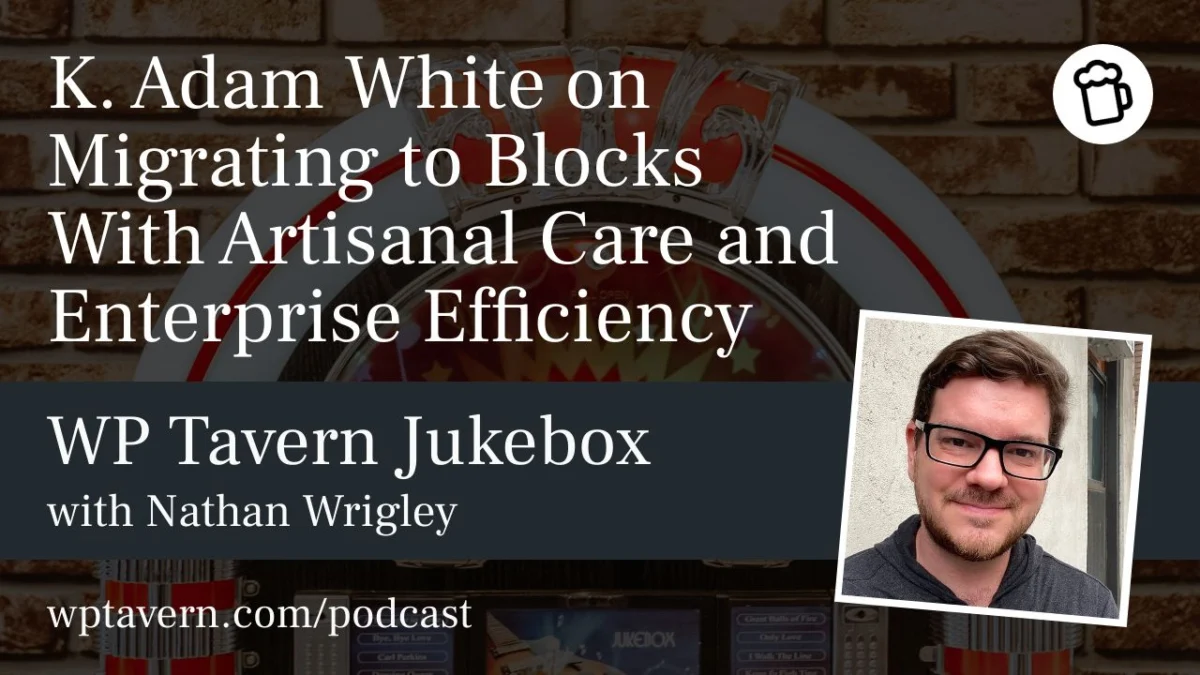
Recently on the WP Tavern Jukebox Podcast, host Nathan Wrigley sat down with K. Adam White, Principal Engineer at Human Made, to discuss the intricacies of modernizing web infrastructure at an enterprise level. Recorded live in the corridors of WordCamp US, their conversation delved into the realities of migrating hundreds of thousands of posts into the WordPress block editor, the rise of pattern-driven development, and the integration of artificial intelligence into traditional migration workflows.
Main Facts
- The Subject: K. Adam White, Principal Engineer at Human Made, an enterprise WordPress consultancy with nearly two decades of experience in the WordPress ecosystem.
- The Core Focus: Migrating complex enterprise sites—specifically from legacy systems like Sitecore and third-party page builders—into the native WordPress block editor (Gutenberg).
- The Philosophy: Combining "artisanal care" (attention to brand guidelines, layout, and visual fidelity) with "industrial scale" (automation, programmatic auditing, and mass content transformation).
- Key Technological Innovations: Utilizing AI-driven agents (such as Claude), SQLite for local development audits, and Human Made’s custom open-source migration plugin, rehydrator.
Chronology: From Legacy CMS to the Block Editor
The evolution of enterprise content management has seen a steady shift away from rigid, proprietary database structures toward modular, flexible interfaces. White’s journey in the WordPress space mirrors this trajectory.
- 2007–2011 (Early Adoption & Contribution): White began using WordPress personally in 2007 and attended his first WordCamp in Boston in 2011. By the early 2010s, he transitioned from a user to a core contributor.
- 2015–2017 (The Gutenberg Era): Human Made positioned itself as an early adopter of the Gutenberg project during its initial plugin days, testing experimental block-based builds and reshaping theme development processes long before the Full Site Editing (FSE) paradigm was officially merged.
- 2024–2026 (AI-Assisted Migrations): The migration methodology underwent a massive transformation. The integration of modern AI agents drastically accelerated the auditing and mapping phases of large-scale enterprise transitions, reducing manual overhead and allowing engineering teams to process tens of thousands of legacy records with unprecedented accuracy.
Supporting Data and Technical Insights
Migrating massive archives—ranging from tens of thousands to hundreds of thousands of individual posts—presents significant structural challenges. Simply clicking a generic "convert to blocks" button falls short in high-stakes enterprise environments where visual fidelity and brand consistency are paramount.
1. The Challenge of Legacy Data Structures
White highlighted the complexity of migrating from traditional enterprise CMS platforms like Sitecore, which often decouples content trees from layout databases. A single page rendered on such platforms relies on dynamic assemblies of data nodes that do not cleanly map to standard WordPress paragraphs and headings.
2. Pattern-Driven Development
Rather than relying on ad-hoc block generation, Human Made utilizes a "pattern-first" approach. By leveraging theme patterns stored as discrete PHP files within the WordPress theme directory, developers establish a robust architectural foundation. Core blocks are utilized wherever possible, augmented by block variations or third-party solutions only when specialized components (such as carousels or modals) are required.
3. Automated Auditing and the Rehydrator Tool
To handle edge cases across vast content libraries, the Human Made team implemented a sophisticated auditing workflow:
- Export files from legacy CMS platforms are parsed via custom Node.js scripts.
- Developers build local SQLite databases to query and identify anomalies (e.g., locating every instance of an accordion FAQ or unique image treatments).
- The team utilizes rehydrator, an open-source GitHub-hosted plugin designed to inject source data directly into pre-existing theme pattern HTML structures, ensuring posts load correctly in the editor without validation errors.
Official Responses and Industry Perspectives
During the podcast discussion, White offered candid reflections on the current state of the WordPress ecosystem, noting both its profound strengths and notable enterprise gaps.
- On the Power of the Block Editor: "The block editor is built in. We feel that it’s the most robust and future-proof platform that you can choose… Gutenberg does that leaps and bounds better than any of our other page builders that don’t have that native integration."
- On Enterprise Control vs. Flexibility: Addressing why WordPress has historically lagged behind traditional enterprise CMS platforms in certain corporate sectors, White pointed to granular permissions. While systems like Sitecore allow permissions to be dialed down to individual text strings or content tree nodes, WordPress traditionally operates on a binary post-level capability model (
can edit post). - On Workflow and Governance: White noted that enterprise clients are generally willing to exchange draconian, locked-down permissions for increased editorial flexibility, provided they can implement robust review steps, publication checklists, and workflow moderation plugins.
Implications for the Enterprise and Developer Ecosystem
The insights shared by K. Adam White point toward several critical implications for agencies, developers, and enterprise stakeholders considering a move to WordPress:
- AI as a Force Multiplier in Migrations: The heavy lifting of content auditing, pattern markup generation, and edge-case discovery is increasingly offloaded to AI agents and LLMs. This drastically lowers the barrier to entry for analyzing complex legacy data structures.
- The Shift Toward Partially Synced Patterns: As WordPress continues to mature, features like Partially Synced Patterns allow non-technical editors to modify copy, CTAs, and image assets without having access to global stylistic controls that could compromise brand integrity.
- The Need for Core Workflow Enhancements: White emphasized that while WordPress excels in flexibility, the ecosystem would benefit greatly from more opinionated, native publishing workflows—specifically regarding multi-step editorial reviews and staged content updates—to better compete in high-governance corporate environments.
As enterprise organizations continue to modernize their digital footprints, the intersection of artisanal design care and industrial-scale automation will remain the defining hallmark of successful WordPress migrations.