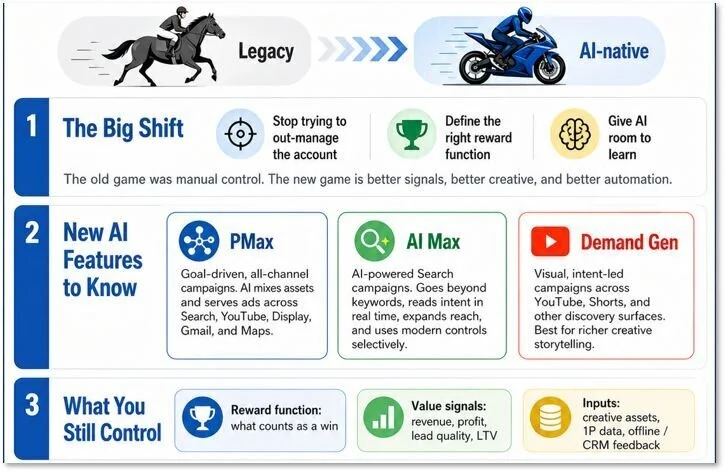
In an era defined by rapid technological evolution, the divide between those who embrace artificial intelligence and those who cling to legacy methodologies has never been more pronounced. Imagine, for a moment, an individual insisting on traversing the country on horseback when high-performance, fuel-efficient motorcycles are readily available. This is the reality for a significant portion of the search marketing industry today.
Despite the sophisticated AI-driven capabilities inherent in the modern Google Ads platform, a surprising number of practitioners continue to operate as if they are working within the constraints of the early 2000s. To bridge this gap, industry experts are now introducing rigorous maturity models designed to force an honest assessment of whether a company’s marketing strategy is truly "AI-ready" or merely a relic of a bygone era.
The Paradigm Shift: From Manual Micromanagement to Machine Intelligence
For years, the gold standard of search marketing was defined by the marketer’s ability to manually "sculpt" accounts. Professionals took pride in their granular control over match types, bid adjustments based on time-of-day or geography, and the obsessive curation of negative keywords. Agencies justified their fees by proving they could log into accounts and make dozens of micro-adjustments daily.
However, this "control-first" mindset has become a liability. The modern Google Ads ecosystem, characterized by tools like Performance Max (PMax), AI Max, and Demand Gen, has fundamentally shifted the value proposition. These platforms do not require the human to be the engine; they require the human to be the architect of the "reward function."
Chronology of a Transformation
The transition toward an AI-native advertising environment did not happen overnight, but it has certainly reached a point of no return:
- The AdWords Era (2000–2015): The era of "human-as-operator." Success was measured by how tightly one could control bids, keywords, and audience segments.
- The Rise of Smart Bidding (2016–2020): Google began integrating machine learning to automate bidding, though marketers remained skeptical, often running "test-and-learn" scenarios that still favored manual oversight.
- The AI-First Maturity (2021–Present): The introduction of PMax and AI Max effectively retired the need for manual segmentation. The platform now analyzes intent across a wider array of signals—YouTube, Gmail, Maps, and Search—than any human could process in real-time.
The core challenge for today’s marketer is no longer "how do I optimize this keyword?" but rather "how do I feed the machine better data so it can find my most valuable customers?"
Supporting Data: Assessing Your "AI-Ready" Status
To assist companies in navigating this transition, a new framework has emerged, built on two critical dimensions: Capability (the sophistication of the technology being utilized) and Depth (how widespread that technology is deployed across the organization).
The Maturity Scoring Model
The model evaluates an organization on a scale of 0 to 4 across six distinct dimensions. A score of 0 indicates a legacy operation, while a score of 4 denotes an AI-native organization.
- Measurement & Value Architecture: The most critical dimension. If a company optimizes for vanity metrics like "pageviews" or "all conversions," the AI will inevitably fail. Modern maturity requires passing actual business outcomes—profit, closed-won deals, and predicted Lifetime Value (LTV)—back to the platform.
- Search Operating Model: Moving away from SKAGs (Single Keyword Ad Groups) and manual bid modifiers toward Smart Bidding and broad-match logic.
- First-Party Data & Audience Intelligence: How effectively does the firm bridge the gap between their own CRM and the platform’s intelligence?
- Surface Breadth & Campaign Mix: Utilizing the full range of Google’s real estate (YouTube, Shorts, Display) based on user intent rather than channel silos.
- Creative & Landing Page Adaptability: Providing the AI with diverse, high-quality assets to match the specific intent of the user.
- Operating Cadence & Governance: Shifting from daily manual intervention to "intelligent guardrails" and strategic oversight.
By multiplying Capability by Depth, a company can derive a score that exposes the gap between its current reality and the potential of modern AI performance. The goal for any high-performing enterprise is a score of 85 or higher.
The "Horse Rider" vs. "Motorcycle Rider" Mentality
In meetings, the distinction between these two archetypes is often stark. The "Horse Rider" (the legacy marketer) will argue that manual control is necessary to "protect the brand" or "prevent waste," even when the data shows that human intervention is actually hindering the machine’s learning.
Conversely, the "Motorcycle Rider" (the AI-native marketer) views the system as a powerful engine that requires only a destination and a set of guardrails. They understand that while AI might make occasional mistakes, it learns at a velocity that humans cannot replicate. In the long run, the trade-off—losing on a few isolated auctions to win on dozens of highly profitable ones—is the only path to sustainable growth.
Implications for the Modern Professional
For marketing professionals, the implications are both daunting and liberating. The "soul-sucking" work of manual account management is being automated out of existence. This is not a threat to the profession; it is an evolution.
1. The Death of the "AdWords Operator"
The role of the search specialist is changing. The future belongs to those who understand data architecture, creative strategy, and business outcomes. If your daily routine consists of adjusting bids by 5% based on yesterday’s performance, your role is increasingly at risk of being marginalized by the very tools you are trying to manage.
2. The Rise of the "Marketing Architect"
Modern marketers must focus on the "reward function." The machine is only as good as the data it is fed. If an agency or internal team is not prioritizing the integration of offline conversion data, CRM feedback loops, and profit-based bidding, they are effectively starving the AI of the information it needs to drive growth.
3. Cultural Resistance and the "Truth Problem"
One of the greatest barriers to AI adoption is not technological, but cultural. Organizations often fear giving up control. However, the choice to remain in the past is no longer viable in a competitive landscape where rivals are leveraging AI to out-learn and out-grow them.
Strategic Recommendations for Implementation
To avoid the common trap of "self-deception"—where teams overestimate their maturity to satisfy management—it is essential to:
- Audit the Top 80%: Focus your assessment on the largest share of your ad spend. Do not let minor, experimental campaigns distract from the core reality of your primary business drivers.
- Prioritize Depth Over Capability: It is better to have a moderate level of maturity applied across 100% of your business than to have a high-tech "pilot" that only covers 5% of your traffic.
- Shift Governance Models: Replace the manual "daily check-in" with "business-outcome governance." Review the machine’s performance based on revenue and profit, not just CTR or CPC.
Conclusion: The Path Forward
The transition to an AI-native strategy is not merely an optimization tactic; it is a business imperative. Organizations that successfully transition from the "AdWords Era" of manual management to the "AI Era" of automated, value-based performance are seeing significant multipliers in revenue and profit.
As the adage goes, "The choice to stay in the past is not available." For those willing to embrace the discomfort of change, the reward is not just better performance metrics—it is a transformation of the marketing role into something far more strategic, impactful, and ultimately, enjoyable. The machine is ready to do the heavy lifting; the only question that remains is whether you are prepared to lead the way.