By PPC Hero Insights
Published in B2B Marketing Strategy
Main Facts: The Anatomy of Modern B2B Indecision
For years, the foundational playbook of B2B marketing has revolved around a singular, idealized persona: the decision-maker. Marketers have long crafted targeted campaigns, optimized lead magnets, and deployed direct response advertising designed to capture the attention of a single executive—whether that is the Chief Marketing Officer, the Chief Technology Officer, or a Head of Procurement—and shepherd them swiftly down the conversion funnel.
However, fresh insights emerging from industry gatherings, such as LinkedIn’s recent Indie Summit, suggest that this foundational premise is fundamentally broken.
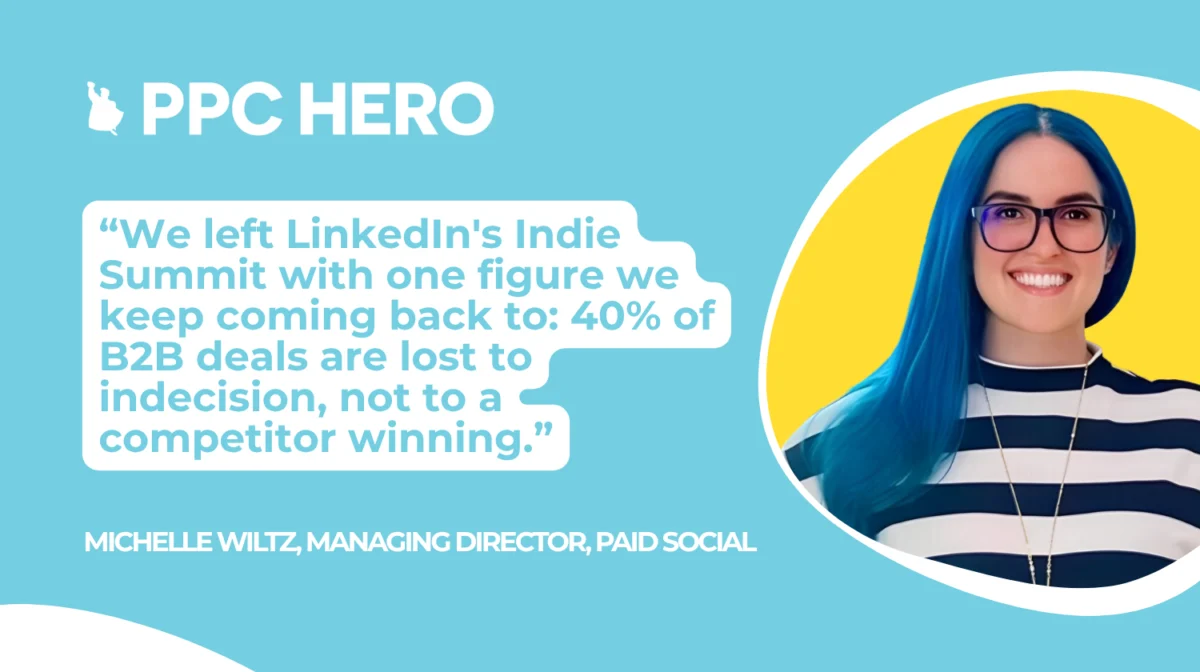
The headline-grabbing statistic dominating modern marketing discourse is stark: 40% of B2B deals are lost not to a competitive rival winning the account, but to sheer indecision.
When a deal stalls out, the traditional reflex of corporate leadership is to diagnose it as a product failure or a pricing mismatch. Yet, deeper operational analyses reveal that it is usually neither. The contemporary B2B buying landscape has evolved into a complex collective. The average B2B buying group now consists of roughly ten distinct stakeholders—including department heads, financial gatekeepers, security leads, and technical implementers.
Each member of this collective brings their own bespoke set of priorities, risk tolerances, and individualized questions that must be satisfied before they will officially sign off on a vendor. When none of these stakeholders are actively opposed to a solution, but none are entirely convinced either, the transaction does not pivot to a competitor; it simply evaporates into organizational gridlock.
Most modern marketing campaigns are entirely ill-equipped to handle this dynamic. They are optimized to win over a lone champion, differentiate a brand from its competitors, and force an immediate conversion. While that approach remains logical in a landscape where a single person holds absolute budgetary power, it falls woefully short when ten distinct individuals need to independently arrive at a shared level of confidence—often without ever engaging directly with a sales representative.
Chronology: The Evolution of the Modern Buying Group
To understand how B2B marketing arrived at this juncture, it is necessary to examine how enterprise purchasing behavior has shifted over the past decade.
Phase 1: The Era of the Gatekeeper and the Sales-Led Journey (Early 2010s)
In the earlier days of digital B2B marketing, sales funnels were linear. Marketing teams generated top-of-funnel leads via whitepapers and gated ebooks, handed those contacts over to sales development representatives (SDRs), and relied on human touchpoints to educate the buying committee. In this environment, convincing a primary budget-holder was often enough to secure a signature.
Phase 2: The Rise of Digital Content and Self-Education (Mid-to-Late 2010s)
As information became ubiquitous online, buyers began preferring self-education over early sales calls. Marketing shifted toward inbound methodologies, SEO, and comparison landing pages. Brands competed fiercely to position themselves at the top of organic search results, assuming that if they could win the digital comparison game, the deal would follow.
Phase 3: The Decentralization of the Committee (2020–2023)
The shift toward remote and hybrid work structurally altered enterprise decision-making. Procurement processes became more heavily scrutinized. Cybersecurity, compliance, and financial departments were pulled into software and service purchases much earlier in the evaluation cycle. Buying groups ballooned from an average of three or four stakeholders to upwards of ten, drastically increasing internal friction and the rate of stalled deals.
Phase 4: The AI-Driven Discovery Era (Present Day)
Today, enterprise buyers no longer rely solely on human-to-human networking or basic web searches to formulate their shortlists. Recent data reveals that 94% of B2B buyers now utilize Large Language Models (LLMs) and AI-driven research tools somewhere in their evaluation process. By the time a vendor’s campaign reaches a prospective organization, the members of that ten-person buying committee have already independently queried AI engines, compared category standards, and formulated deep-seated skepticism. They arrive at the vendor’s doorstep already well-researched, making traditional, top-of-funnel comparative advertising largely redundant.
Supporting Data: The Metrics Reshaping B2B Media Mixes
As marketing leaders grapple with committee-driven indecision, data from platforms like LinkedIn and associated agency studies are forcing a dramatic re-evaluation of media channels, content formats, and creative strategies.
1. The Prevalence of AI-Powered Research
- 94% of B2B buyers integrate LLMs into their buying journey.
- This means prospective buyers are evaluating category claims and vendor differentiators through algorithmic summaries before speaking with a brand, rendering conventional "us vs. them" feature comparisons less effective.
2. The Power of Video in Collective Alignment
Marketers seeking to influence a ten-person committee—many of whom will never interact with a salesperson—require assets that can travel organically across an organization. Video has emerged as the definitive medium for this challenge:
- 1.6x: Members who view video ads are 1.6 times more likely to complete a lead generation form from the same brand compared to static ad viewers.
- 95%: Video retains an exceptionally high retention rate among professional audiences.
- 60% Faster Growth: Video consumption on professional networks is outpacing all other content formats by 60%.
- Agency Performance: Agencies that have aggressively pivoted toward video-first strategies are reporting 20% year-on-year growth while static-reliant portfolios remain flat.
3. The Mechanics of the Scroll-Stopping Hook
Given that 86% of professional network users access platforms via mobile devices, capturing attention within a hyper-competitive feed requires precision engineering in the opening seconds of a campaign:

- 36% Lift: LinkedIn studies indicate a direct 36% increase in click-through rates (CTR) when a video asset or ad copy opens with a specific, hard-hitting number or statistic.
- Contrarianism and Urgency: Questions addressing genuine operational pain points and contrarian industry views consistently outperform generic, polished corporate messaging.
4. Advanced High-Impact Formats
- BrandLink: Standard in-feed video formats are increasingly being augmented by specialized units like BrandLink, which has demonstrated a 130% higher video completion rate than standard deployments.
- Connected TV (CTV): Enterprise-focused CTV deployments now reach 94% of members, driving a 2.6 times stronger awareness lift compared to traditional linear television.
Official Responses and Industry Perspectives
Industry leaders, agency executives, and platform strategists are increasingly vocal about the structural adjustments required to combat pipeline stagnation.
"When a deal fails to close, the immediate assumption inside the C-suite is that our pricing is uncompetitive or our product lacks feature parity," notes a senior B2B marketing strategist who attended the recent Indie Summit. "In reality, our data shows that the product is rarely the bottleneck. The bottleneck is internal consensus. You have ten intelligent people who are terrified of making a bad career-defining choice, and none of them have enough shared context to say ‘yes’ with total confidence."
According to platform analysts, the traditional marketing brief—which historically asked, "How do we prove we are better than Competitor X?"—is fundamentally obsolete.
"The modern brief has to shift," explains an enterprise media director. "It needs to ask: ‘How do we make it safe for a risk-averse committee to move forward?’ That means your creative strategy has to stop showcasing how shiny your product is, and start addressing the specific operational, financial, or security anxieties that the CFO and the security lead are whispering about in private Slack channels."
On the topic of production values, industry sentiment has undergone a quiet revolution. While polished, high-budget studio commercials once dominated B2B advertising, modern performance data points in a different direction.
"Lo-fi clips, behind-the-scenes founder videos, and authentic workplace culture content are consistently outperforming high-production corporate spots," a leading B2B creative director points out. "Why? Because a cautious buying group isn’t just auditing your software code; they are auditing your reliability as a partner. Authenticity signals trust much faster than a massive production budget ever could."
Implications: What This Means for Future B2B Campaigns
The shift from single-buyer conversion optimization to multi-stakeholder consensus-building carries profound implications for how organizations structure their budgets, design their creative briefs, and measure marketing ROI.
1. Redefining Content Strategy: From Features to Risk Mitigation
Because modern buyers arrive at the table armed with AI-synthesized research, traditional competitive comparison content (e.g., feature matrix tables and generic "why choose us" landing pages) yields diminishing returns.
Future-proof campaigns must pivot toward risk-normalization content. Marketers must proactively identify the existential worries haunting committee members—such as migration downtime, data security vulnerabilities, or internal change management fatigue—and address them head-on. The objective is no longer to prove superiority over a rival, but to dismantle the internal objections causing organizational paralysis.
2. The Multi-Touch, Multi-Viewer Distribution Model
If a buying group consists of ten people, treating an account as a single lead is a strategic error. Marketing and sales alignment must embrace account-based marketing (ABM) frameworks powered by formats that naturally circulate within an enterprise.
Because video assets can be seamlessly embedded into internal Slack channels, played during departmental huddles, and independently reviewed by both the CFO and the technical lead, it serves as an organizational bridge. It establishes a shared baseline of context that written whitepapers and static banner ads simply cannot replicate.
3. A Shift in Metrics: Defending Pipeline to Finance
For years, marketers have struggled to defend pipeline metrics to corporate finance departments. When pipelines stall due to committee indecision, superficial lead generation metrics (like raw form fills or click counts) obscure the true health of the funnel.
Marketers must transition toward measuring collective engagement velocity—tracking how deeply and widely content penetrates an account across multiple decision-makers. By aligning campaign metrics with the reality of group-based consensus, marketing leaders can provide finance departments with a more resilient, defensible pipeline number.
The Ultimate Question for Marketers
As organizations prepare their next fiscal year strategies and draft upcoming creative briefs, the fundamental metric of success is no longer about maximizing individual conversions. The definitive question every marketing team must ask before launching their next campaign is deceptively simple:
Are you building a campaign designed to convince one person, or are you building one robust enough to get ten people comfortable enough to move?