In an era of fragmented media consumption and dwindling linear television audiences, sports remains the last great campfire of the digital age. Last year, nearly all of the top 50 most-watched telecasts in the United States were sports-related. Aside from the 97th Oscars, the SNL 50th anniversary special, a high-profile 60 Minutes interview, a singular episode of The Floor, and the 67th Grammys, the list was dominated entirely by live athletic competition. Even events like “NFL Weather Delay” drew millions, proving a fundamental truth of modern media: audiences will watch almost anything if it carries the weight of a sporting title.
This reality has triggered a massive, high-stakes land grab. Streaming giants are aggressively acquiring broadcasting rights, and corporate brands are flooding the arena with billions in capital. From stadium naming rights and jersey patches to the ubiquitous presence of logos on balls, bats, and interview backdrops, the landscape of sports marketing has never been more crowded. Yet, as marketing budgets swell, a growing number of senior executives are beginning to ask a sobering question: “I’ve enjoyed the hospitality suites and the access to elite athletes, but for $38 million in spend, is this actually doing anything for the business?”
The Paradox of Sports Visibility
To understand the efficacy of sports marketing, one must first accept that the same rigorous laws of marketing apply here as they do in any other channel. There is a persistent myth that the sheer scale of a sporting event guarantees brand success. However, if a brand’s creative and storytelling fail to capture attention within the fleeting 1.2-second window typical of a TikTok feed, that same brand will surely fail when plastered on a race car or a stadium sideline. In fact, during a live game, the stakes are higher; the audience is there for the sport, meaning the tolerance for intrusive or uninspired branding is at an all-time low.
The "Spike and Sustain" Mandate
In standard marketing, the "spike and silence" approach—short, loud bursts of activity—is widely considered the kiss of death. In sports, this is exponentially worse. Because the sport itself acts as a massive distraction, the brand halo effect requires a consistent "spike and sustain" strategy to penetrate the consumer consciousness.
Furthermore, the "frequency" fallacy continues to plague the industry. Many marketers believe that the massive reach of a sports broadcast compensates for low frequency. They are mistaken. To persuade a consumer, a brand still requires a frequency of at least three exposures per user per week. Achieving this through sports marketing alone is nearly impossible without supplemental paid media—often featuring the very athletes or teams the brand is sponsoring—to bridge the gap between organic exposure and genuine message absorption.
The Hierarchy of Measurement: From Vanity to Value
For years, the industry has relied on "vanity metrics" to justify astronomical sports marketing spends. However, a shift toward data-driven accountability is emerging. To move beyond the hospitality suite and into the realm of true business impact, marketers must adopt a more sophisticated framework for measuring their ROI.
Level 5: The Opening Gambit (Vanity Metrics)
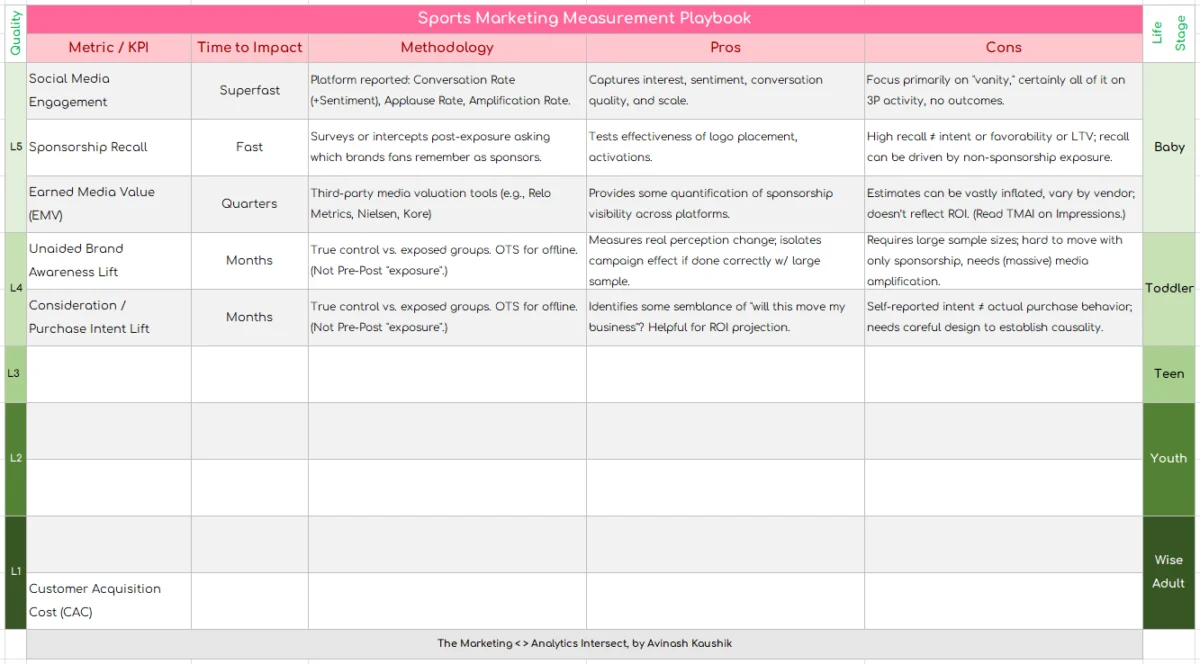
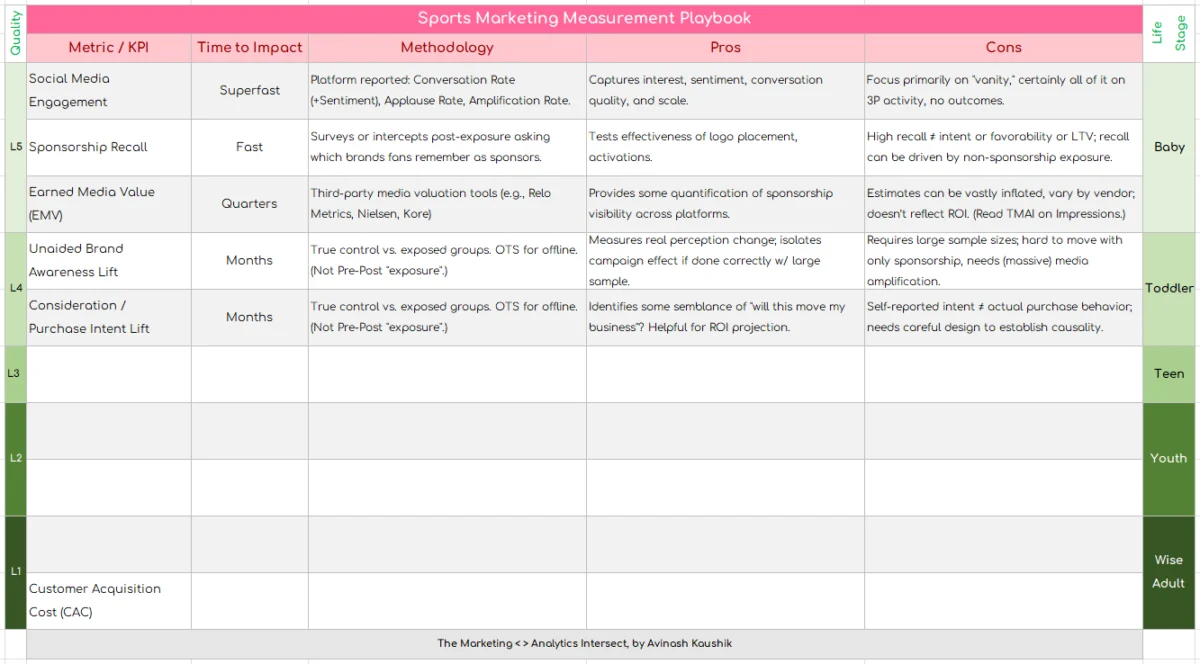
Most brands begin their journey at Level 5, the land of "Big Numbers." This level is characterized by metrics like social media impressions, engagement rates, and the widely discredited "Earned Media Value" (EMV).
EMV, or Ad Value Equivalency, is the favorite tool of agencies looking to justify high-priced packages. It works by calculating how much it would cost to purchase the time or space where a logo appeared. The flaw, however, is glaring: it assumes all exposure is high-quality and ignores the audience’s frame of mind. It measures noise, not outcome. While L5 metrics are useful for establishing baselines and measuring short-term decay rates, they provide zero insight into financial causality.
Level 4: The Quest for Brand Impact
Moving to Level 4 requires a pivot from measuring activity to measuring human impact. At this stage, companies utilize true test-versus-control methodologies to assess how sponsorship influences consumer perception. The primary metrics here are:
- Unaided Brand Awareness (UBA): A long-term driver of revenue that remains one of the most difficult, yet most essential, KPIs to move.
- Consideration and Purchase Intent: This is where the CFO begins to pay attention. By measuring whether exposure to a brand’s sports sponsorship increases a consumer’s likelihood to purchase, marketers move closer to proving business value.
The methodology here relies on rigorous survey instruments. By using propensity score matching, marketers can compare "exposed" groups (those who watched the broadcast or engaged with the content) against "control" groups (those who were not). This provides a clearer, albeit still incomplete, picture of how sports marketing drives the middle of the sales funnel.
The Strategic "Dirty Little Secret"
Despite the challenges of measurement, sports marketing holds a distinct advantage that many brands underutilize: the ability to outsource creative excellence. Because creative accounts for 60% to 70% of all brand marketing success, it can be highly profitable for a brand to "inherit" the values and storytelling power of a beloved sport or athlete.
If a brand struggles to craft a compelling narrative, aligning itself with the high-octane drama of professional sports allows that brand to borrow the emotional resonance of the game. However, this is a decision that must be made with eyes wide open. It is not enough to simply pay for the association; the brand must ensure that the storytelling is integrated and that the budget supports enough paid media to amplify that creative across the entire customer journey.
Implications for Future Investment
As the industry matures, the divide between those who sponsor in the dark and those who illuminate their results will only grow. The transition from Level 5 to Level 4—and eventually to the more advanced Levels 3, 2, and 1—represents the professionalization of the sports marketing sector.
Implications for CMOs and CFOs:
- The Long-Game Necessity: Short-term sports marketing deals are almost always a waste of capital. Because the shift in brand perception takes time, sports marketing should be viewed as a medium-to-long-term investment, ideally spanning at least five years.
- The Incrementality Proof: Using Marketing Mix Modeling (MMM), brands can begin to isolate the incremental profitability of their sports spend. When a brand moves beyond vanity metrics, they can prove that their presence at the stadium or on the broadcast is directly contributing to bottom-line growth.
- The "Human" Element: Hospitality suites and clubhouse access are valuable for relationship building, particularly in B2B sectors with long sales cycles. However, these benefits should be accounted for as distinct from mass-market advertising ROI.
Conclusion: Turning the Lights On
Sports marketing is not inherently flawed, but its execution is often clouded by a lack of analytical rigor. The "consequences" of the $38 million marketing spend are only visible if the organization is willing to measure the right things.
By shifting the focus from "How many people saw our logo?" to "How did this sponsorship shift our brand equity and purchase intent?", companies can transform their sports partnerships from expensive line items into powerful engines for business growth. The era of blind faith in sports sponsorship is ending. For the serious marketing professional, the challenge now is to apply the same level of scientific scrutiny to the playing field as the athletes apply to their craft.
The data is there, the tools exist, and the mandate is clear: stop sponsoring in the dark. It is time to turn the lights on.