For the past two decades, the digital marketing lexicon has been anchored by a single, powerful acronym: SEO. Search Engine Optimization became the bedrock of the modern web, dictating how brands were discovered, how they built authority, and how they generated revenue. But as the underlying technology of the internet shifts from index-based search to generative AI-based reasoning, the old playbook is showing its age.
It is time for a new acronym to enter the marketing lexicon: OAO (Organic Answers Optimization).
While many practitioners have attempted to bridge the gap using terms like AEO (Answer Engine Optimization) or GEO (Generative Engine Optimization), these labels often feel like temporary fixes for a much larger, structural evolution. The reality is that the artificial wall between "traditional" search and the "answer-based" paradigm is crumbling. For the modern business leader, there is no longer a dichotomy between the two—there is only the singular quest to influence machines to recommend a brand and convert that influence into tangible, bottom-line results.
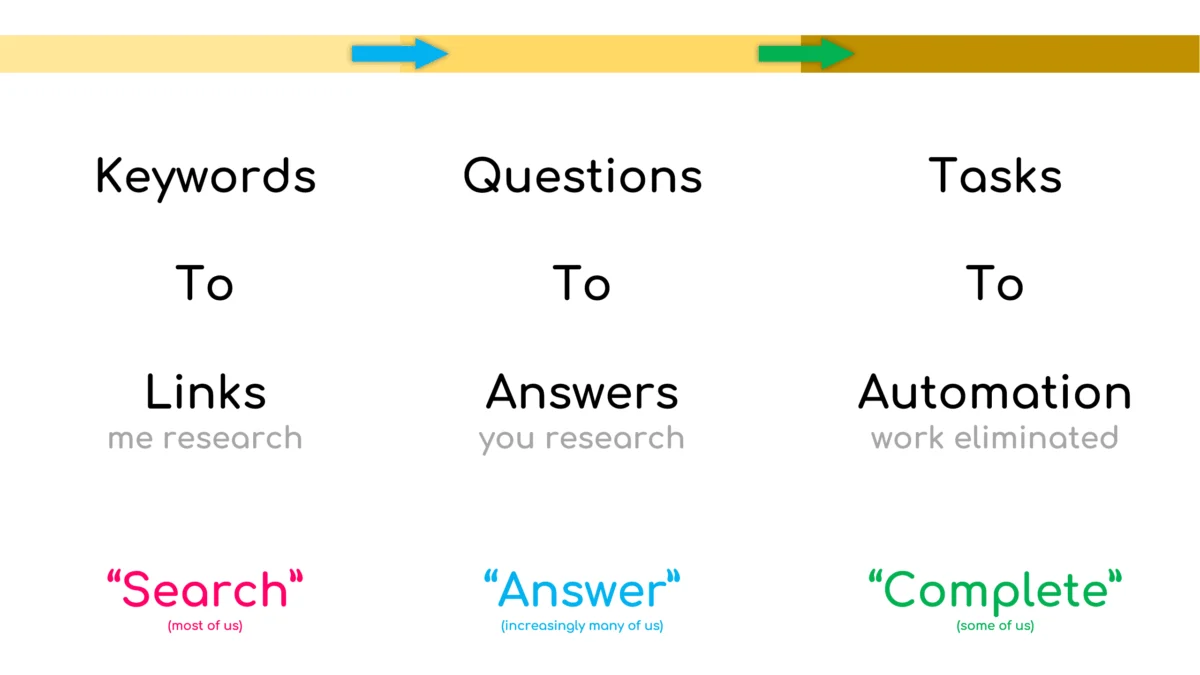
The Evolution of Consumer Behavior: From Search to Completion
To understand why OAO is necessary, one must look at the trajectory of human-machine interaction. This shift is not merely a change in user interface; it is a fundamental transformation in how consumers navigate the acquisition of goods and information.
1. The Search Era (The Status Quo)
For over a billion users, the standard operating procedure remains "Big Google." A user searches for a query, such as "lightweight carry-on luggage," is presented with a list of paid and organic links, and embarks on a manual research mission. This is the world of traditional SEO, where success is measured by keyword density, backlink profiles, and domain authority.
2. The Answer Era (The Gen Z Shift)
Approximately 50% of Gen Z users have already pivoted away from traditional search. Instead of querying for links, they query for outcomes. A prompt like, "I need a light carry-on for a ten-day trip for under $250 that fits small European airline requirements," bypasses the need for the user to visit a third-party site entirely. The Large Language Model (LLM) synthesizes information, compares options, and provides a direct recommendation.
3. The Completion Era (The Frontier)
We are now entering the phase of "Agentic Commerce." The user no longer asks for information; they ask for a task to be completed. A consumer might prompt an AI to "buy the first recommendation, confirm it arrives by October 30th, and ensure it has a clear returns policy." In this model, the machine acts as the surrogate for the human, and the "visit" to a website becomes a secondary, if not invisible, step in the conversion funnel.
The Financial Reality of the OAO Shift
For CFOs and CMOs, the implications of this shift are already visible on the balance sheet. Data from Adobe and Shopify indicates that LLM-driven visits convert approximately 50% better than traditional organic search and deliver significantly higher revenue per visit.
However, the transition creates a "measurement paradox." Many businesses are seeing a 20% to 30% year-over-year decline in traditional SEO traffic, while their "Answer Engine" traffic—often lumped into "Direct" or "Unattributed" buckets—remains invisible or modest. Without a unified OAO scorecard, marketing departments are prone to fighting internal wars between their SEO teams (focused on clicks) and their AEO teams (focused on machine influence), effectively cannibalizing their own potential growth.
Why OAO is the Unified Solution
The "OAO" approach is designed to break these silos. It recognizes that SEO and AEO are not competing strategies; they are two sides of the same coin.
- SEO work drives AEO: A strong, well-structured, and authoritative website provides the foundational data that LLMs ingest to build their answers.
- AEO drives SEO: As a brand gains prominence in LLM recommendations, it builds brand equity, which in turn leads to more direct traffic and branded searches on traditional search engines.
By adopting an OAO framework, organizations move away from vanity metrics—such as "Keyword Ranking" or "Visibility Scores"—and toward metrics that directly impact the bottom line.
Methodologies Over Metrics: A Warning on "Snake Oil"
In the rush to track AI performance, many marketers are falling prey to "garbage in, landfill out" data practices. There is currently no "OpenAI Webmaster Tools," and any vendor claiming to have full access to the proprietary, individual prompts of LLM users is likely providing misinformation.
For a unified OAO strategy, we must rely on rigorous methodologies:
- Understand the Source: Distinguish between owned data (GA4, CRM, ERP), observed data (Search Console), and modeled data (competitive tools).
- Avoid Goodhart’s Law: Do not treat proprietary vendor "authority scores" or "visibility indexes" as objective truth. These are often estimates that, while useful for relative comparison, do not represent actual revenue.
- Recognize the "Long Tail" Void: Nearly half of all clicks occur on long-tail queries that are increasingly hidden or swallowed by AI summaries. Any tool that claims to perfectly model this should be viewed with healthy skepticism.
The OAO Scorecard: Three Essential KPIs
To successfully implement OAO, an organization should limit itself to three primary Key Performance Indicators (KPIs). These metrics bridge the gap between "machine influence" and "business impact."
KPI #1: Non-Brand Organic Search Profit
This measures the profit generated from users who found the brand without knowing its name. This is the purest indicator of your ability to capture "new" demand. By setting targets for this metric, teams can justify funding SEO initiatives aimed at slowing the decline of traditional search traffic.
KPI #2: Answer Engine Profit
This tracks revenue directly attributable to AI Assistant channels. While currently imperfect due to changing referral strings, it provides the necessary signal to justify investments in content types that machines prefer—specifically video, audio, and third-party validation.
KPI #3: AI Brand Score
This is perhaps the most forward-looking metric. By using probabilistic testing (e.g., repeating a standard set of prompts to see how often a brand is recommended), marketers can calculate their "Share of LLM Shelf." A score of 100 means your brand is the default answer. This score serves as a modern baseline for "Unaided Brand Awareness," providing a concrete KPI that even the most skeptical CFO can appreciate.
Implications for Future Strategy
The shift to OAO requires a fundamental change in organizational culture. As consumers delegate more of their decision-making to AI, the traditional "visit" to a website becomes a less complete record of a brand’s influence.
The strategy for the next decade is simple but demanding: More content, in more places, more often.
Brands must stop viewing their website as the "destination" and start viewing it as the "source of truth" for a vast network of AI agents. If your content is not accessible, optimized, and authoritative enough for an LLM to cite it as the primary answer, your brand will effectively cease to exist in the new digital economy.
Conclusion: Preparing for the Shock
The decline in traditional organic traffic is not a temporary dip; it is the natural consequence of an evolving ecosystem. For many businesses, the "Search" era provided a comfortable, predictable stream of revenue. The "Answer" era, however, requires a leap of faith backed by rigorous data.
OAO is not just a new acronym; it is a survival strategy. By unifying the teams, the metrics, and the goals, businesses can ensure that they are not just "found" on the web, but "recommended" by the machines that define the modern consumer experience. The transition will be difficult, but those who wait for the dust to settle before adapting will find that the landscape has changed entirely—leaving them with no ground to stand on.
Carpe diem. The era of the answer is here.