In the high-stakes world of digital advertising, where billions of dollars are allocated annually based on data-driven projections, the interpretation of "statistical certainty" has become the defining battleground between platforms and advertisers. At the center of this controversy is Google’s official guidance regarding its Brand, Search, and Conversion Lift studies.
For years, advertisers have relied on these metrics to justify massive media budgets. However, a closer inspection of Google’s own methodology reveals a troubling reality: the definitions of "success" promoted by the search giant may be designed to encourage continuous spending rather than to provide the rigorous evidence required for sound financial stewardship.
The Illusion of "Directional Results"
The primary point of contention is a phrase that has become a staple in marketing boardrooms: "directional results." It is a term that sounds sophisticated, nuanced, and safe—a way to characterize data that doesn’t quite hit the gold standard of scientific certainty but still suggests a positive trend.
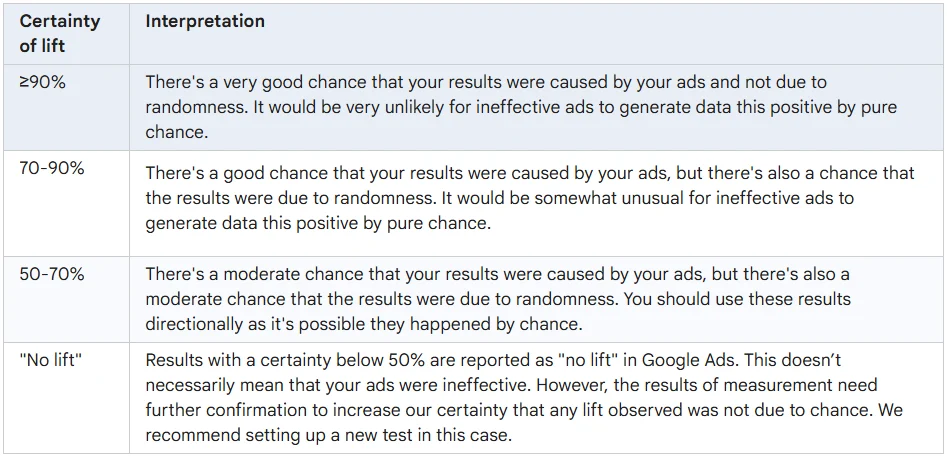
But in the cold, hard light of data science, "directional" is often a euphemism for "statistically inconclusive." According to official Google Ads guidance, studies yielding a 50% to 70% certainty level are deemed to provide "valuable, directional insights." In the context of Google’s own reporting, they categorize a 70%–90% certainty as a "good chance" of success.
For the average marketing executive, these labels act as a green light. But for those tasked with managing corporate capital, the language masks a fundamental misalignment of incentives. When Google labels a 70% certainty result as a "good chance," they are essentially telling the advertiser: Your ads probably did something useful; spend more money, and we’ll see what happens.
The Asymmetry of Risk: A Tale of Two Parties
To understand why this terminology is so dangerous, one must distinguish between the incentives of the two parties involved.
Party One: The Advertising Platform
Google’s primary objective is the sale of advertising inventory. If a lift study produces weak, suggestive evidence, Google has a powerful incentive to present it as a positive outcome. There is no financial downside for the platform if an advertiser follows "directional" advice and sees no return on their second $5 million investment. To the platform, even inconclusive data is "interesting" enough to warrant further exploration—which, by definition, requires more ad spend.
Party Two: The Advertiser
The advertiser, conversely, owns the budget and bears the consequences of poor decision-making. For a Senior Director of Brand Media or a Chief Financial Officer, the question is not "did this study find something interesting?" The question is "is the evidence strong enough to justify risking another $5 million of shareholder money on the assumption that the first $5 million was effective?"
The divergence here is stark. Google’s world view is built on the pursuit of suggestive insights, while a CFO’s world view is built on the mitigation of capital risk. When an advertiser adopts Google’s "directional" metrics as their standard for success, they are effectively outsourcing their risk tolerance to the very entity that benefits from their spending.
Chronology of the "Certainty" Problem
The evolution of these metrics has tracked alongside the growth of automated bidding and black-box attribution.
- The Early Era: Marketers relied on rudimentary A/B testing and direct response metrics. Statistical significance was treated with rigorous, academic-level scrutiny.
- The "Lift" Era: As platforms moved toward "Lift" studies, the complexity of the math increased. Platforms moved away from simple attribution toward complex, proprietary methodologies, often keeping the underlying "p-values" and confidence intervals opaque.
- The Current Normalization: By labeling 50%–70% certainty as "valuable," Google has effectively lowered the bar for what constitutes actionable data. By normalizing lower thresholds of statistical confidence, the industry has shifted from a culture of "proof" to a culture of "possibility."
The Math Behind the Replication Risk
To expose the flaw in the "good chance" narrative, we must look at what happens when a campaign is repeated under identical conditions. This is known as "Replication Risk."
If YouTube reports a +3-point lift in Consideration at 70% certainty, a CMO asks: "If I spend another $5 million, will I see the same result?" If we apply a Bayesian replication model—a standard tool used by biostatisticians to determine the reproducibility of findings—the results are sobering.
Using a simple model to project the outcome of a second, identical $5 million spend, the "good chance" label starts to crumble:
- Positive Lift Probability: There is only a 65% chance that a repeat campaign will produce any positive lift, even if that lift is statistically negligible.
- High Certainty Probability: There is only a 30% chance that a repeat campaign will hit a 90% certainty threshold—the minimum standard most prudent financial managers should require.
- Replication Risk: There is a 70% chance that the repeat campaign will fail to produce the level of evidence required to confirm that the initial investment was a success.
In short, Google’s "good chance" is mathematically closer to a coin flip, yet it is framed as a strategic recommendation to continue investing.
Official Responses and Industry Caveats
Google does include "drive-by" disclaimers in its documentation, noting that advertisers should "interpret results based on your business needs and risk tolerance." However, burying these caveats in the fine print while prominently labeling 50%+ results as "valuable" creates a cognitive bias. It places the burden of statistical literacy entirely on the advertiser, even as the platform provides tools and reporting that nudge the user toward an optimistic interpretation.
When challenged, platforms often cite the inherent difficulty of measuring brand impact. They argue that "directional" data is better than no data at all. While this may be true in an academic vacuum, it is a dangerous philosophy in a corporate budget environment. Suggestive data is not evidence of success; it is evidence of a need for more rigorous testing.
The Implications for Modern Marketing
The implications of relying on low-certainty data are twofold:
- Type S (Sign) and Type M (Magnitude) Errors: As noted by experts in statistics, weak evidence can mislead twice. First, the effect may not even exist (Type S error), and second, the reported impact may be significantly overstated (Type M error). An advertiser might think they achieved a +3-point lift, but in reality, the impact could be +0.5 or even negative.
- Erosion of Trust: When marketing leaders repeatedly approve large budgets based on "directional" data that fails to materialize in actual business growth, the entire function of marketing analytics loses credibility with the C-suite.
Establishing a New Standard
For organizations that are serious about capital efficiency, the "directional" trap must be avoided. A professional, data-driven marketing organization should establish a "certainty floor."
For most high-consequence business decisions, 90% certainty should be the minimum standard. This isn’t because 90% is a magic number, but because it represents a necessary, if still imperfect, barrier against random noise and platform-biased reporting.
When the results fall below this threshold, the strategy should not be to "spend more to see what happens." The strategy should be to:
- Redesign the test to increase sample size.
- Change the creative or the audience to test a more robust hypothesis.
- Acknowledge the failure of the test and reallocate funds to channels with proven, replicable performance.
Conclusion: Take Back Your Budget
The takeaway is clear: Google and other major advertising platforms are operating with a different set of incentives than your company. When you look at their dashboards, remember that you are looking at data optimized for their business model, not yours.
Don’t let an advertising platform’s definition of "useful information" become your company’s definition of "sufficient evidence." Whether you are running campaigns on Google, Meta, TikTok, or any other major platform, the math remains the same. Before you authorize that next $5 million, ask yourself: Am I spending this because the data proved it worked, or because I’m hoping the platform’s "directional" guess turns out to be right?
Stop outsourcing your risk tolerance. It is your money, your reputation, and your company’s future on the line. Ensure that your standards for "success" are built on rigorous, replicable evidence—not just a platform’s suggestion to keep the lights on.