By Financial Markets Desk
Published: October 2026
Main Facts
The global investment landscape is experiencing a historic divergence. While the venture capital (VC) asset class is riding a massive wave of high-velocity fundraising—fueled largely by the insatiable global appetite for artificial intelligence—private equity (PE) is mired in a severe, multi-year contraction.
According to data compiled by PitchBook and highlighted by industry analysts, U.S. private equity fundraising is tracking downward for the fourth consecutive year. Through the first three quarters of 2026, U.S. PE firms raised roughly $222 billion. When annualized, 2026 is projected to close at approximately $296 billion—a stark drop from the $330 billion raised in 2025 and a staggering 27% decline from the market’s peak of $405 billion in 2023.
In sharp contrast, the venture capital ecosystem has remained remarkably resilient. While VC fundraising faced minor corrections in previous quarters, it has largely stabilized, buoyed by monumental AI rounds closing at speeds and valuations not seen since the tech boom of 2021. For B2B founders, middle-market business owners, and institutional limited partners (LPs), this widening gap between VC buoyancy and PE drought is reshaping the rules of corporate liquidity, valuations, and M&A exits.
Chronology of a Slowdown: How the PE Slump Unfolded
To understand how private equity reached its current inflection point, it is necessary to examine the trajectory of the market since the post-pandemic economic peak:
- 2021 (The Apex): Fueled by ultra-low interest rates and aggressive fiscal stimuli, global M&A and private markets hit historic highs. PE dry powder expanded rapidly, and valuations reached unprecedented multiples, particularly for software and B2B tech firms.
- 2023 (The Turning Point): U.S. PE fundraising reached its zenith at roughly $405 billion before macroeconomic tightening, rising interest rates, and a frozen IPO market brought cheap leverage to an abrupt halt.
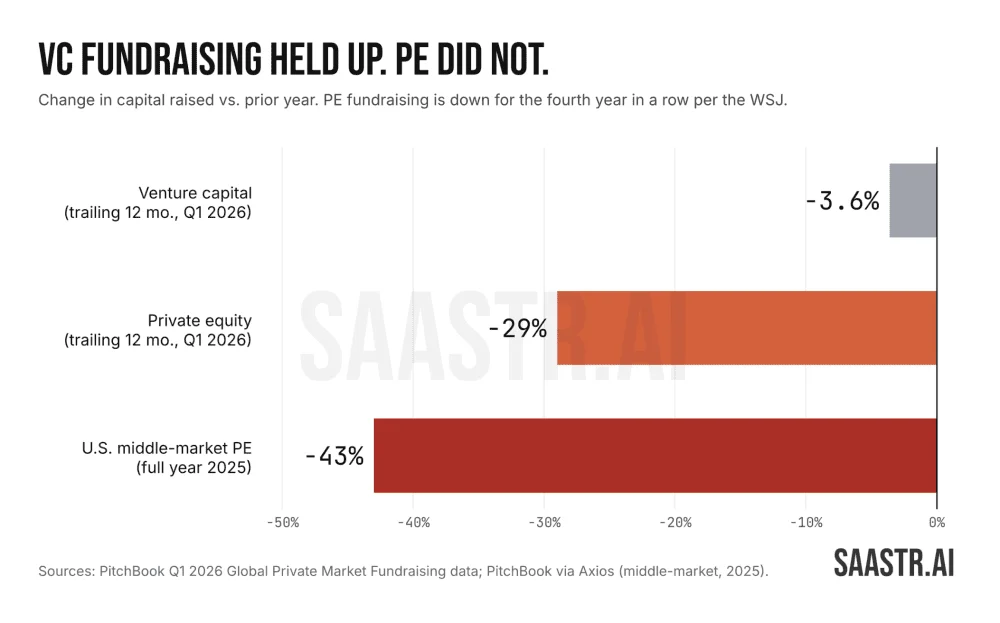
- 2025 (The Middle-Market Crunch): The contraction deepened dramatically, particularly in the middle market. U.S. middle-market PE fundraising plummeted by more than 43% to $94.8 billion—marking the worst year for that vital segment since 2018.
- 2026 (The Ongoing Correction): PitchBook’s Q1 and Q3 data confirm that the downturn has settled into a structural trend. U.S. PE fundraising is down 29% over trailing 12-month periods, while the total number of newly closed funds dropped by 45.1% to 2,613.
Supporting Data: Breaking Down the Numbers
The disparity between venture capital and private equity is not merely a matter of sentiment; it is written clearly in the financial metrics.
VC vs. PE: The Fundraising Gap
In PitchBook’s comprehensive Q1 market reports, private equity suffered the steepest contraction among all major alternative asset classes, with trailing 12-month raises tumbling by nearly 29% to $385 billion. Meanwhile, venture capital proved remarkably resilient, raising $189 billion—a minor retreat of just 3.6% year-over-year.
The Middle-Market Bottleneck
For the average B2B founder, the health of mega-cap private equity funds matters far less than the health of the middle market. Companies generating between $10 million and $75 million in Annual Recurring Revenue (ARR) rely almost exclusively on mid-market sponsors for buyouts. When middle-market fundraising craters by 43% in a single year (as it did in 2025), the pool of viable acquirers shrinks proportionally.
The Collapse in Fund Formations
Fewer total dollars entering the asset class has naturally translated to fewer active buyers. The total number of funds successfully reaching a final close fell by 45.1% down to 2,613. In the world of M&A, fewer funds mean fewer bidders at the negotiation table—directly undercutting the competitive tension required to drive up company valuations.
The Liquidity Paradox: $2 Trillion in Dry Powder
Paradoxically, private equity is not entirely broke. The asset class sits on an estimated $2 trillion in dry powder. Deal activity remains active—Q1 2026 recorded roughly 5,100 transactions valued at $481.6 billion, supported by lower borrowing costs. Furthermore, 2025 stands as the second-best exit year in history (behind only 2021), delivering nearly $730 billion across 1,600-plus exits.
However, this massive pool of dry powder comes with a major catch: much of it is locked inside aging older funds. General Partners (GPs) cannot easily raise Fund VI when Funds IV and V are still weighed down by underperforming assets purchased at 2021 peak valuations. Until these legacy companies are successfully exited and cash is returned to LPs, new capital deployment will remain constrained.
Official Perspectives and Market Commentary
Industry veterans and market analysts have been vocal about the implications of the ongoing PE drought.
Venture capitalist and SaaS expert Jason Lemkin underscored the severity of the trend on social media, noting that the data signals a multi-year cooling period for founders relying on private equity buyouts.
"Venture and venture fundraising are on fire, but Private Equity fundraising is down again so far this year—the fourth year in a row," Lemkin noted. "By the numbers at least, selling your company to PE gets harder and harder each year since 2023."
PitchBook analysts echo this sentiment, emphasizing that the bottleneck is ultimately driven by LP liquidity constraints. Institutional investors—pension funds, endowments, and sovereign wealth funds—allocating capital across alternatives face a zero-sum game. Because venture capital is capturing massive liquidity upside via high-speed AI rounds and technology innovations, LPs are heavily prioritizing VC allocations.
Conversely, PE firms are facing harsh pushback from LPs. A GP cannot successfully market a new flagship fund when previous vintages are trapped in portfolio limbo, unable to return cash due to a sluggish M&A market and valuation mismatches. PitchBook’s outlook suggests that private equity fundraising will not fully recover until public and private exit avenues remain consistently open long enough to restore normal LP liquidity cycles—a process market watchers estimate could take several more years.
Strategic Implications for Founders and Investors
The current market dynamic forces a fundamental reassessment of exit strategies for founders, particularly in the B2B software and technology sectors.
1. The Death of the Easy PE Exit
Historically, a private equity buyout was the most statistically probable exit route for a bootstrapped or venture-backed B2B company—far more common than an initial public offering (IPO) and frequently more reliable than a strategic trade sale. With middle-market PE fundraising down dramatically and the total count of active fund closings cut nearly in half, founders can no longer assume a deep bench of private equity suitors waiting in the wings.
2. The Return of Competitive Tension
In corporate finance, price discovery relies entirely on competition. When a founder takes a company to market, having multiple credible bidders forces buyers to stretch on price, structure, and terms.
As veteran founders note—such as EchoSign founder Jason Lemkin recounting his acquisition by Adobe—losing even two or three credible bidders fundamentally alters the dynamics of a negotiation. With fewer PE funds possessing fresh, uncommitted capital mandates, founders will experience less bidding tension, potentially leading to lower valuation multiples and more onerous deal terms.
3. Raising the Bar for Sponsor-Backed Outcomes
The B2B companies successfully navigating today’s tighter private equity market share common traits:
- Strong, defensible profitability: Gone are the days of paying high revenue multiples for cash-burning growth. PE buyers demand immediate or near-term free cash flow.
- AI-Resilient Metrics: Companies must demonstrate that their unit economics, customer acquisition costs (CAC), and net retention rates (NRR) can withstand rigorous diligence regarding the disruptive threat of artificial intelligence.
- Wide-Funnel Processes: Rather than relying on a sole-sourced relationship with a preferred PE sponsor, successful founders are running robust, competitive processes to maximize the few active buyers currently holding deployment mandates.
Conclusion
The dichotomy between venture capital’s AI-fueled boom and private equity’s four-year fundraising slump represents a historic pivot in private markets. While venture is sprinting ahead on the promise of technological transformation, private equity is caught in a holding pattern, hindered by legacy portfolio valuations and cautious LPs. For business owners and executives navigating the M&A landscape through the remainder of 2026 and beyond, success will require exceptional operating fundamentals, proactive liquidity planning, and a clear-eyed understanding of the new, highly selective private equity marketplace.