The traditional public relations playbook—a discipline long defined by the rhythmic pitching of stories to journalists and the cultivation of long-term editorial relationships—is undergoing a radical, existential transformation. For decades, success was measured in column inches, broadcast segments, and the prestige of a publication’s masthead. Today, however, that work is only half the battle. In an era where buyers increasingly turn to ChatGPT, Gemini, and Google’s AI Overviews for product recommendations and brand discovery, the old metrics of PR are being superseded by a new, machine-readable reality.
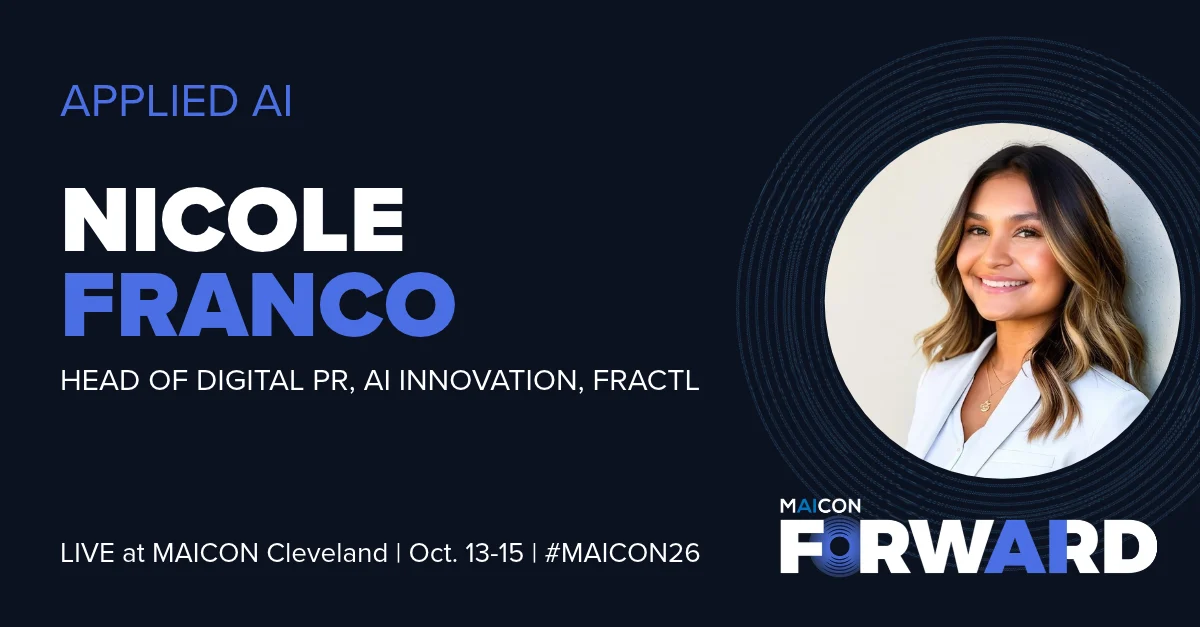
This paradigm shift is the focus of Nicole Franco, Head of Digital PR and AI Innovation at the data-driven agency Fractl. As the industry grapples with the transition from human-centric search to AI-synthesized answers, Franco is set to headline a critical session at MAICON 2026: "Entity-Led Digital PR Workflows: Using Commentary, AI Prompts, and Media Partnerships to Build SME Authority in Search." Her message to marketers is clear: if your brand isn’t being "read" by the algorithms, it effectively doesn’t exist in the modern digital marketplace.
Rethinking PR: The Brand as an "Entity Engine"
To understand the future of PR, one must first abandon the notion that public relations is merely a service for generating headlines. Instead, Franco argues that PR must be re-engineered as an "Entity Engine."
In the language of search engines and Large Language Models (LLMs), an "entity" is a distinct, recognizable unit—a subject matter expert (SME), a specific product, or the brand itself. These entities serve as the nodes of authority in a digital ecosystem. When a consumer queries an AI model, the model retrieves information based on the strength and interconnectedness of these entities.
"The best way to think about this is to identify a cohesive metric across your entities and see how you can create and repurpose content across all media," says Franco.
Under this framework, the traditional silos of marketing—digital PR, LinkedIn thought leadership, media bylines, and expert commentary—are demolished. They are replaced by a singular, unified engine. A successful campaign is no longer a collection of disparate tactics; it is a synchronized orchestration of assets that reinforce a brand’s authority simultaneously across social media, traditional search, and generative AI interfaces. By treating every expert opinion and every media mention as a data point in a broader authority network, brands can ensure that when an AI model processes a query, it finds a consistent, high-authority narrative.
Chronology of a Disruption: From Relationship-Based to Data-Led
The transition from "pitching to people" to "feeding the models" did not happen overnight. The chronology of this shift can be traced back to the early integration of AI into search engines.
- The Traditional Era (Pre-2020): PR was defined by human gatekeepers. The goal was to reach the journalist who would then reach the reader. Domain authority was largely dictated by backlinks and site traffic.
- The SEO Integration (2020–2023): As digital PR matured, the focus shifted toward "link building." Agencies prioritized high-authority placements to boost organic search rankings. PR became an extension of the SEO department.
- The AI Overviews Era (2024–Present): With the rise of RAG (Retrieval-Augmented Generation) and AI search engines, the "link" is becoming secondary to the "citation." Models now synthesize information from multiple sources to provide a direct answer. The goal is no longer just to get a link, but to be the source material that the AI deems "authoritative" enough to cite in its response.
This evolution has fundamentally changed what it means to be a "high-authority" publication.
Challenging the "Big Media" Myth
Perhaps the most disruptive insight from Fractl’s proprietary research is the refutation of the long-standing industry obsession with "big" media. For years, PR agencies have charged premium fees to place clients in top-tier business publications, assuming that a mention in a national newspaper is the pinnacle of PR success.
However, in the context of AI visibility, this assumption is often flawed.
"High-authority media is great, but in the context of your brand," Franco explains.
Her team has developed data models that track which publishers actually influence AI outputs for specific industries. The findings suggest that authority is highly contextual. A food brand, for instance, gains more "AI-authority" by securing a placement in a specialized platform like All Recipes than by appearing in a general-interest business publication.
This is because LLMs are trained on vast datasets, and they prioritize sources that demonstrate topical expertise within a specific vertical. If a brand wants to be the "answer" for a query about career growth, it must appear in the niche, high-trust publications that HR professionals and career coaches actually frequent. By chasing the wrong "big logos," brands are effectively burning their PR budgets on impressions that the AI model views as irrelevant to the user’s specific intent.
Turning Commentary Into a Structured Data Asset
One of the most practical takeaways from Franco’s upcoming MAICON session is the transformation of the "expert quote." Too often, PR teams treat quotes as "fluff"—filler text intended to make a press release look professional.
Franco proposes a radical rethink: "Think of quotes like data points, sound bites, or clips a journalist will use in their story," she notes.
In an era of AI-generated "slop," journalists and AI models alike are starving for high-quality, unique, and emotionally resonant content. The new PR workflow must treat expert commentary as a structured data asset. This involves:
- Candid, Uncut Insight: Moving away from sanitized, PR-speak quotes. Instead, providing raw, surprising, and contrarian perspectives that add genuine substance to a story.
- Modular Content: Creating quotes that are easily excerpted and synthesized by journalists and AI summarization tools.
- Consistency: Ensuring that the messaging of these quotes aligns with the brand’s core entity identity, creating a pattern that models can recognize and trust over time.
This approach shifts the PR team’s responsibility from "pitching" to "content engineering." The goal is to produce such high-value, high-substance commentary that it becomes the "source of truth" for the media. When a story breaks, the brands that have already established their SMEs as definitive sources are the ones that get cited—not just by the journalist, but by the AI models scraping the journalist’s work.
The Implications: A New Competency for PR Leaders
The implications for marketing and communications leaders are profound. Modernizing PR is no longer a "nice to have"; it is a competitive necessity. As AI continues to mediate more of the consumer journey, the brands that fail to adapt their PR workflows will find themselves increasingly invisible, buried under the weight of competitors who have successfully optimized their entities for the machine age.
At MAICON 2026, Franco will provide the roadmap for this transformation. Her session is designed to move beyond theory, offering attendees a tactical playbook that includes:
- Audit Frameworks: How to identify which entities in your brand (products, SMEs, or corporate values) carry the most weight in AI-generated search results.
- Media Mapping: How to identify the specific publications that influence the AI models relevant to your industry.
- Workflow Optimization: A repeatable, scalable system for producing high-substance expert commentary that earns citations from both human journalists and AI algorithms.
A Call to Action for the Future of Authority
As we look toward 2026, the marketing landscape is clearly bifurcating. On one side are the legacy players, clinging to the vanity metrics of traditional PR and failing to see that the gatekeepers have changed. On the other side are the forward-thinking organizations that treat their brands as data-rich entities, building authority that is as legible to a machine as it is compelling to a human.
Nicole Franco’s work represents the cutting edge of this transition. By joining her and 50+ other industry leaders at MAICON 2026, marketing professionals can gain the tools and strategies necessary to lead their brands into this new era.
Authority in the age of AI is not a static achievement; it is an active, ongoing, and data-driven process. The question for every PR leader today is not "Did we get the press coverage?" but rather, "When the AI answers for our industry, does it cite us as the authority?"
To learn more about the evolving intersection of PR and artificial intelligence, join the conversation at MAICON 2026. Register today to secure your place at the forefront of the AI-led marketing revolution.