For over two decades, the WordPress ecosystem has been driven by a shared, open-source ethos. Yet while much of the community’s oxygen is consumed by arguments over block editors, PHP versions, and enterprise-level architecture, a quiet revolution has been unfolding in the background. Driven by a core group of passionate community leaders and supported by the WordPress Foundation, the project’s educational initiatives have expanded from localized experiments into a robust, international movement.
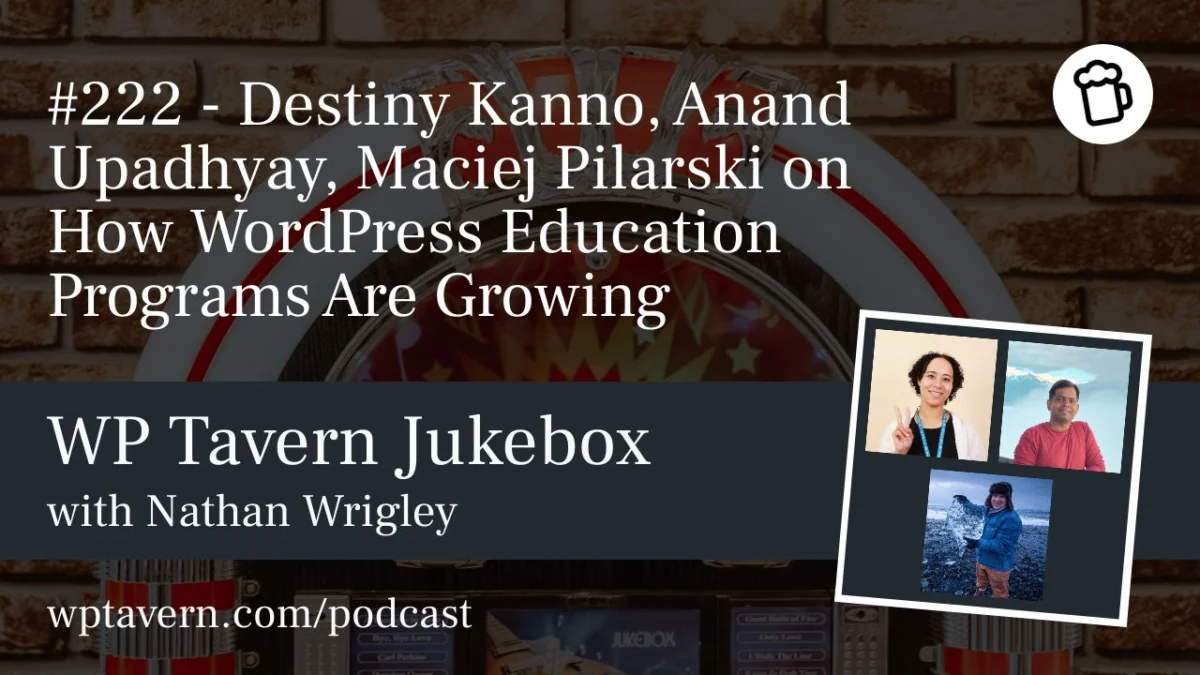
Recently, Nathan Wrigley of the WP Tavern Jukebox Podcast sat down with three key figures at the heart of this movement—Destiny Kanno, Education Program Manager sponsored by Automattic; Anand Upadhyay, plugin developer and community organizer; and Maciej Pilarski, Happiness Engineer and WordPress Credits Program administrator.
Together, they detailed how a web of interconnected programs—spanning university credits, ad-hoc campus events, and student-led clubs—is introducing thousands of learners to WordPress, the open-source philosophy, and digital literacy.
Main Facts: The Three Pillars of WordPress Education
The modern landscape of WordPress education is built upon three distinct yet mutually reinforcing initiatives. Rather than competing, these programs serve different age groups, institutional frameworks, and levels of commitment:
- The WordPress Credits Program: Directed primarily at higher-education students, this initiative bridges academic study with real-world open-source contribution. Students can complete a 50-hour or 150-hour course over an academic semester, earning university credit while contributing to Make WordPress teams under the guidance of vetted community mentors.
- WordPress Campus Connect: Geared toward students of virtually any age—from elementary schoolers to vocational and university students—Campus Connect events are flexible, community-driven workshops. Whether hosted in a university lecture hall or a public library in Uganda, these single- or multi-day sessions introduce students to web building and career opportunities across design, marketing, and development.
- Student Clubs: Modeled after local WordPress meetups but entirely peer-led within educational institutions, these clubs maintain momentum between larger campus events. They provide a flat, low-hierarchy space where students can study together, teach their peers, practice public speaking, and experiment with code and site-building tools.
Chronology: From Organic Experiments to a Turbocharged Global Ecosystem
The formalization of these educational efforts is relatively recent, though the seeds were sown years prior.
- 2014–2016: Early community engagement initiatives, such as volunteering at WordCamps, opened doors for many current contributors. However, formal educational structures remained sparse.
- The Launch of Learn WordPress: Education program manager Destiny Kanno notes that efforts initially focused on rebuilding and relaunching Learn WordPress, laying the groundwork for digital training materials.
- September 2024 (WP Tavern Jukebox Episode 183): Wrigley hosted an initial panel featuring Kanno and Upadhyay to untangle the overlapping education initiatives that had begun springing up globally. At the close of that recording, the participants agreed that the space was moving so quickly that a six-month check-in would be necessary.
- Late 2024–Early 2025: The WordPress Credits Program launched its first experiment at the University of Pisa, onboarding humanities students. Concurrently, WordPress Campus Connect was officially codified as an official WordPress event series in May 2025.
- The Past Eight Months (2025–2026): The educational movement has been dramatically "turbocharged." Institutions onboarded into the Credits Program surged from 6 to 21 globally—including its first African institution in Uganda, secured following connections made at WordCamp Asia. Meanwhile, Campus Connect events have expanded rapidly, recording dozens of completed events across multiple continents.
Supporting Data: Quantifying the Impact
While the organizers emphasize that the true impact of education is long-term and difficult to measure solely through cold metrics, the raw numbers paint a picture of extraordinary growth:
- WordPress Campus Connect: Since becoming an official event series in May 2025, the initiative has hosted 42 completed events across 71 participating institutions, reaching over 5,500 students.
- Website Creation: The vast majority of Campus Connect attendees successfully build a live website during their sessions, effectively injecting thousands of new WordPress sites into the live web within a single year.
- WordPress Credits Program: Currently boasts 450 students globally enrolled, with 75 graduates having successfully completed the rigorous program requirements.
- Ticket Sales & Community Demographics: In regional hubs like Ajmer, India, targeted campus outreach directly influenced local events, resulting in a 50% student demographic for a Women’s Day event that sold out its tickets within a single day.
Official Responses and Perspectives
The leaders driving these initiatives emphasize that the programs are designed to remove friction, build sustainable ecosystems, and offer personal validation to learners.
"We’re trying to make it as barrier-free for students wherever their campus is… It’s more wide-ranging in terms of who can participate as a student, and the fact that it could be a one-off event or a multi-day event," explained Destiny Kanno regarding the flexibility of Campus Connect.
Maciej Pilarski highlighted the mutual reinforcement between university partnerships and open-source contributions:
"The Credits Program is not limited to technical universities. The first university we started with was the University of Pisa, and it was humanities studies… It builds this bridge between the previous generation of WordPress contributors to the new one."
Anand Upadhyay underscored the importance of student clubs in fostering long-term community health and leadership:
"With the Student Club, it’s like an in-campus meetup program… It is helping to keep the momentum going on so that students keep learning about WordPress, and it is also generating leadership qualities in them as they take the stage."
Furthermore, leadership at the highest levels of the project—including Executive Director Mary Hubbard—has thrown significant support behind education, integrating educational tracks and contributor tables into flagship events like WordCamp Europe and WordCamp Asia.
Implications: Securing the Future of Open Source
The rapid expansion of WordPress education carries profound implications for the future of the platform. Open-source projects face a perpetual existential risk: aging demographics. Without a deliberate pipeline to introduce younger generations to the mechanics, ethics, and community of open source, projects risk stagnation.
By embedding WordPress into high schools, libraries, and universities, these initiatives do more than teach CMS mechanics—they cultivate digital citizenship. Students learn about open-source ethics, remote collaboration across time zones, and alternative career paths outside proprietary tech ecosystems.
As Kanno, Upadhyay, and Pilarski continue to roll out resources like the upcoming Meetup Activity Library—complete with facilitation guides and presentation decks designed to lower the barrier for new organizers—the WordPress educational movement is proving that the most valuable thing an open-source community can do is invest in its future participants.
For readers looking to get involved, the blueprint is already written. Whether by mentoring a university student through the Credits Program, organizing a local Campus Connect workshop, or simply starting a peer-led student club, the path from curious learner to active open-source contributor is open today.