In the modern digital landscape, the disparity between "activity" and "actual business impact" has never been wider. For marketing departments at global enterprises, the struggle to justify budgets to the C-suite is often hampered by a reliance on vanity metrics that masquerade as performance indicators. At the center of this controversy is a metric that has recently gained traction in mid-level marketing circles: Cost Per Session (CPS).
Strategic consultants, particularly those with deep expertise in analytics, are raising alarms. For the modern CMO, the focus on bringing traffic to a website at the lowest possible cost—regardless of whether that traffic converts—is not merely an ineffective strategy; it is a direct path to fiscal insolvency in an era dominated by AI-driven search and platform automation.
The Genesis of the "Cost Per Session" Myth
A few years ago, during a high-level strategic consulting engagement for a global corporation operating in 75 countries, an alarming trend emerged. The marketing sub-team tasked with defining the next generation of success metrics pointed to "Cost Per Session" as their primary North Star.
For industry veterans, this was a startling revelation. Despite decades of experience working with the world’s largest companies, authoring best-selling books on analytics, and helping invent the very tools used to measure digital performance, the term "Cost Per Session" was virtually unknown. Traditionally, the only "CPS" that mattered in business was Cost Per Sale.
The implications of this shift are profound. When a marketing department defines success by "Cost Per Session," they are essentially tasked with "shoveling traffic" as cheaply as possible. It is a metric that ignores the fundamental objective of marketing: generating profitable outcomes.
Chronology of a Metric’s Failure
To understand why this metric is so dangerous, we must look at the hierarchy of digital measurement:
- The Activity Layer: This is where metrics like Impressions, Views, and Sessions reside. These are "things," not metrics. They track noise, not intent.
- The Outcome Layer: This is where the marketing effort meets the business goal. Here, we track Revenue, Conversion Rates, and Micro-Conversions. This is the minimum acceptable threshold for any serious marketing organization.
- The Accountability Layer: This is the domain of the CFO. It accounts for inputs—Campaign Cost and Cost of Goods Sold (COGS)—against the outputs to determine actual profitability.
The shift from Activity to Accountability is not merely a technical adjustment; it is a cultural transformation. When companies rely on activity metrics, they often fall into the trap of "optimizing" for the wrong thing—purchasing cheap, low-intent traffic that creates a false sense of growth while draining the company’s bottom line.
Supporting Data: The Case for Accountability
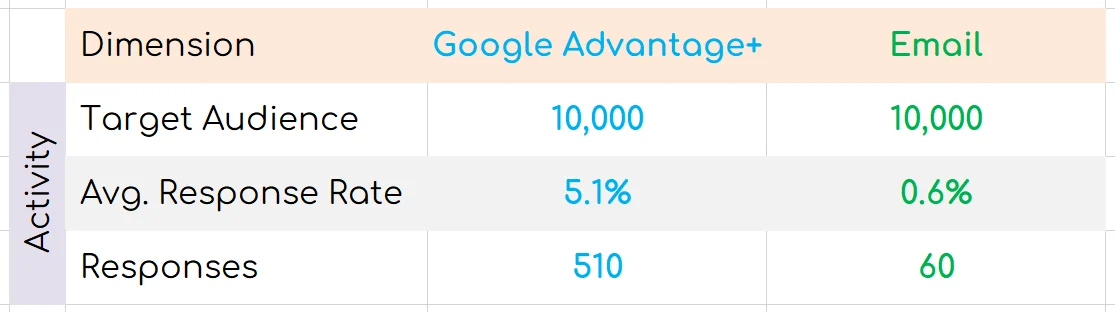
Consider a hypothetical campaign using Google’s Advantage+ (or similar automated ad products). A standard activity report might look like a resounding success: high traffic volume, high engagement, and lower costs per user. However, when an engaged CFO pulls the curtain back, they demand to see the outcomes.
The Full Business Impact View
| Metric | Google Advantage+ | Email Marketing |
|---|---|---|
| Campaign Spend | $7,200 | $500 |
| Revenue | $17,000 | $17,000 |
| COGS | $4,800 | $4,800 |
| Profit | $5,000 | $11,700 |
| ROAS | 2.4 | 9.6 |
| POI (Profit on Investment) | 0.70 | 5.7 |
As the data illustrates, while Google Advantage+ might drive higher volume, the Profit on Investment (POI) reveals a harrowing truth: for every $1 spent on Google, the company is receiving only $0.70 in profit. In contrast, email marketing, while perhaps less "scalable" in terms of raw traffic, is a profit-generating engine.
This data suggests that many companies are effectively acting as "subsidiaries" of large ad platforms, spending their own capital solely to provide employment to the platforms’ advertising sales teams.
The AI Shift: A New Era of Search
The push to abandon vanity metrics like Cost Per Session is no longer just a strategic recommendation—it is a survival necessity in the age of AI. Google’s recent guidance regarding SEO in the "AI Search" era (where results are generated by AI Overviews) explicitly warns against the obsession with click-through traffic.
Google’s guidance is clear: "Consider looking at various indicators of conversion on your site, be it sales, signups, a more engaged audience, or information lookups about your business." The platforms themselves are signaling that the future belongs to high-quality, intent-driven traffic. If a marketer continues to optimize for "cheap sessions," they will find their content ignored by the very AI models that now dictate discovery.
Implications for the Modern CMO
The conflict between the CMO and the CFO is as old as the modern corporation. However, the path to reconciliation is through radical transparency and accountability.
1. The Death of Cost Per Session
If a marketing team is forced to use CPS due to internal culture or lack of data maturity, they should immediately pivot to Cost Per Non-Bounced Session. By filtering out users who "puke and leave"—the bounce traffic—marketers force themselves to acknowledge the true, inflated cost of their low-quality acquisition strategies. A $14 Cost Per Session that jumps to $27 when accounting for bounce rates is a powerful wake-up call that current tactics are not working.
2. Prioritizing Profit Over Revenue
Marketing leaders must transition from reporting on "Revenue" (which is a gross figure) to reporting on "Profit on Investment" (POI). This requires a closer relationship with the finance department to understand COGS and net margins. When a CMO approaches a CFO with a report that highlights how marketing spend is driving net profit, the budget conversation changes from "How can we cut costs?" to "How can we scale this success?"
3. The "Zero-Spend" Strategy
For campaigns that show negative POI, the most effective action is often a temporary halt. By cutting off spend to platforms that are not delivering profitable outcomes, a company sends a clear message: the marketing organization is a profit center, not a cost center. This "pause" creates the necessary vacuum to re-evaluate the strategy:
- Intent Analysis: What are customers actually looking for?
- Tactical Alignment: How does the creative and messaging match that intent?
- AI Integration: How can automation be used to improve the efficiency of these targeted efforts rather than just scaling mass traffic?
Conclusion: An AI-Proof Career
The transition from "Activity" to "Accountability" is undoubtedly difficult. It requires complex data modeling, a willingness to have uncomfortable conversations with agencies and platform partners, and a rigorous commitment to bottom-line results.
However, for those who make the shift, the rewards are twofold. First, they secure the respect and funding of the CFO, ensuring that marketing is viewed as a critical driver of business success. Second, they build an AI-disruption-proof career. As AI continues to commoditize the execution of marketing, the ability to think strategically, define value, and hold marketing accountable for real-world profit will become the most valuable skill set in the global marketplace.
The metrics we choose define the work we do. By abandoning the siren song of Cost Per Session and embracing the discipline of Profit on Investment, marketing professionals can move beyond being mere conduits for advertising spend and become true stewards of corporate value. Carpe diem.