In an era defined by rapid technological acceleration, the digital advertising landscape has undergone a seismic shift. Yet, a startling number of marketing professionals continue to operate with the tactical mindset of a bygone era. They cling to manual bidding, granular match-type segmentation, and obsessive daily account adjustments—tools that were once the hallmarks of "expert" search engine marketing (SEM).
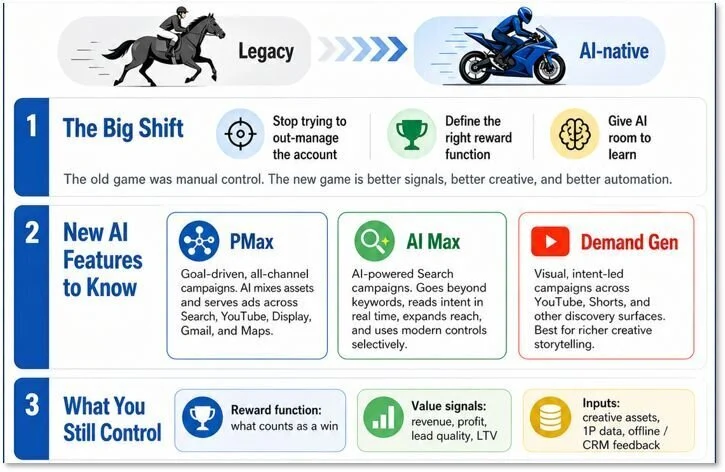
In a world equipped with fuel-efficient, high-performance motorcycles—the modern AI-powered advertising ecosystem—insisting on traveling by horse is not just inefficient; it is a direct threat to corporate profitability. The transition from legacy management to AI-native strategy is no longer a competitive advantage; it is the baseline requirement for survival in a digital economy that moves faster than any human operator.
The Evolution of the "Search Marketer"
For years, the definition of a skilled search marketer was someone who could master the intricacies of the Google Ads interface. This involved "monkeying" with match types, adjusting hourly bids, micromanaging geographic targets, and obsessively refining negative keyword lists. Agencies built their reputations on proving their worth through the frequency of their manual interventions.
However, Google—and by extension, platforms like Meta—have been systematically "AIfying" their ecosystems. The platform is no longer a collection of levers and pulleys to be manipulated by a human; it is a sophisticated machine-learning engine designed to optimize for business outcomes.
The resistance to this shift often stems from a fundamental misunderstanding of the current landscape. When marketers frame search strategy solely around "brand versus non-brand" silos, they are ignoring the reality of intent-based signals. The modern goal is not to "out-manage" the auction; it is to feed the machine superior data, higher-quality creative assets, and clear business-value signals.
The Case for Embracing AI: A Pragmatic Perspective
The transition toward full AI integration is supported by two core philosophical tenets: trust and utility.
First, consider the pedigree of the platform. Google’s transition to AI-driven performance marketing is a calculated, engineering-led evolution. While human error exists, the vast majority of platform shifts are driven by data-backed decisions aimed at efficiency.
Second, the "embrace and extend" strategy is the only viable path forward. AI models, such as those powering Performance Max (PMax), AI Max, and Demand Gen, function on narrow-AI principles that are already superior to human capacity. While these systems are not infallible, they operate on a scale of intent analysis that is impossible for humans to replicate. The goal is to maximize long-term wins, accepting that an AI may miss a minor detail in the pursuit of 30 or 40 significant conversions.
As the adage goes, the choice to remain in the past is simply not available. To continue with manual, legacy tactics is to actively put your employer’s capital—and your own career—in reverse gear.
The Google Ads Maturity Model: Assessing Your Readiness
To help organizations move from "horse-and-buggy" tactics to high-performance AI integration, a new framework is necessary. A maturity model must evaluate both Capability (how sophisticated your approach is) and Depth (how widely that sophistication is deployed).
The Scoring Dimensions
To avoid self-deception, companies should score themselves across six critical dimensions. Each dimension is measured on a scale of 0 to 4:
- 0 (Legacy): Manual, siloed, and disconnected.
- 1 (Mostly Legacy): Minimal automation, but still clinging to old structures.
- 2 (Hybrid): Partial adoption of smart features, but still heavily reliant on human intervention.
- 3 (Modern): Core strategy is AI-driven, with smart bidding and broader matching logic.
- 4 (AI-Native): The system is the default; humans act as governors rather than operators.
Depth vs. Capability
Crucially, the depth of implementation must be calculated as a percentage of total spend or conversion volume. A company that tests AI on 5% of its budget is not an "AI-native" organization; it is a pilot project. True maturity is found when 75% to 100% of an account’s execution defaults to AI-led strategies.
Pillar 1: Measurement and Value Architecture
The foundation of any successful AI strategy is the "reward function." If an organization does not know where it is going, any road will lead it to a place of professional misery.
Google’s AI is only as intelligent as the signals it receives. If you are optimizing for "pageviews" or "sessions," you are telling the machine that traffic is the goal, not profit.
Key Maturity Indicators:
- Legacy (0): Optimizing for proxies like clicks or basic lead counts.
- Modern (3): Utilizing offline conversion imports and data-driven attribution (DDA).
- AI-Native (4): Bidding is tied directly to real business value, such as profit margins, closed-won lead values, or predictive Lifetime Value (LTV).
If your measurement architecture is built on sand, every campaign above it—regardless of how sophisticated the creative is—will fail to yield the desired business results.
Pillar 2: The Search Operating Model
The second pillar involves abandoning the obsession with manual keyword sculpting. The modern search operating model is defined by Smart Bidding, broad match, and Responsive Search Ads (RSA).
The "Horse Rider" Trap:
The legacy operator believes performance comes from "sculpting" the account—segmenting campaigns by device, match type, and minute-by-minute bid adjustments.
The "Motorcycle Rider" Shift:
The modern operator simplifies the structure, providing the machine with enough room to learn. They use controls sparingly—not to micromanage, but to protect the brand and ensure governance. By moving toward AI Max, firms can leverage intent signals that extend far beyond the specific keywords a user types, allowing for massive, profitable scale.
The Remaining Dimensions: A Roadmap for Growth
Beyond measurement and search structure, four additional dimensions round out the maturity model:
- First-Party Data & Audience Intelligence: How effectively is your proprietary customer data feeding into Google’s intelligence engine?
- Surface Breadth & Campaign Mix: Are you utilizing the full range of Google’s surfaces—YouTube, Discovery, Gmail, Maps—based on customer intent rather than legacy channel silos?
- Creative & Landing Page Adaptability: Are you feeding the machine diverse, high-quality assets to enable effective real-time testing?
- Operating Cadence & Governance: Has your team successfully transitioned from "manual laborers" to "business-outcome governors"?
Avoiding the Pitfalls of Self-Deception
The greatest enemy of digital transformation is the ego of the marketer. Many professionals feel the need to justify their roles by creating complexity. To avoid this:
- Score Depth First: Assessing how much of your budget is actually being handled by AI forces an honest look at the reality of your operations.
- Audit the Top 80%: Do not let the 20% of "special projects" or edge cases distract from the reality of your main account performance.
Implications: The Future of Marketing Careers
The old game was centered on the question: "Can the human out-manage the auction?" The new game is: "Can the company feed the machine better truth, better creative, and more precise value signals?"
The cultural shift required to embrace this new reality is significant, but the rewards are profound. Organizations that successfully transition to a high-maturity state often see exponential growth in revenue and profit. For the marketing professional, this shift is equally liberating. By abandoning the soul-sucking manual tasks of the AdWords era, marketers are free to focus on what truly matters: strategy, business outcomes, and the creative vision that AI cannot yet provide.
The journey toward maturity is not merely an IT upgrade; it is a fundamental transformation of how businesses compete in the digital age. As the saying goes, Carpe diem—the future of performance marketing is here, and it is time to leave the horse in the stable.