SAN FRANCISCO — In the rapidly expanding ecosystem of B2B sales automation, a quiet consensus has begun to form: standard AI prospecting tools are suffering from a severe case of homogeneity. Because the vast majority of sales development representatives (SDRs) rely on the exact same third-party data vendors, the marketplace is flooded with a monotonous hum of lookalike emails. Prospects are inundated daily with messages featuring identical bolded text, clumsy emojis, and hyper-generic pitches.
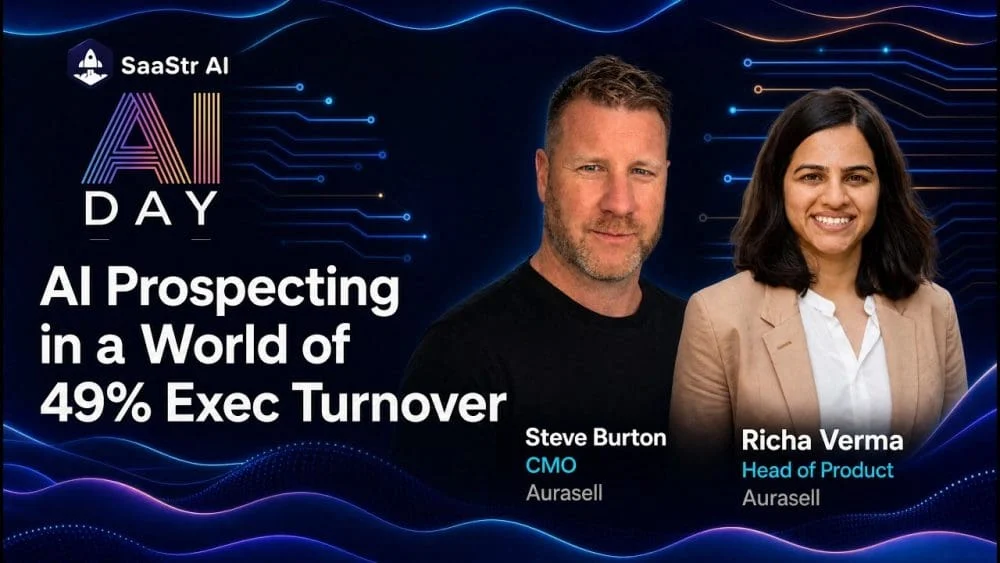
At the latest SaaStr AI Day, this core industry vulnerability took center stage. In a joint presentation, Aurasell CMO Steve and Head of Product Richa laid out a radical departure from the status quo. Joined by SaaStr’s leadership, the panel dissected why traditional AI outbound has devolved into an echo chamber of self-perpetuating, non-responsive email threads—and demonstrated how tapping into proprietary, first-party data is changing the game.
Main Facts: The Shift from Generic Noise to Contextual Precision
The central thesis presented by the Aurasell team is straightforward: AI sales agents fail when they operate in a vacuum of generic, rented data. To break through the noise, AI outbound must transition from relying solely on external data vendors to digesting and utilizing internal, first-party assets—such as deep CRM history, historical meeting transcripts, and internal communication archives.
Traditional AI sales development representatives (SDRs) have earned a poor reputation among buyers. During the SaaStr session, Steve highlighted an absurd example: when asked by an engineer prior to the conference who would win an NFL matchup between the Washington Commanders and the San Francisco 49ers, a standard AI SDR readily answered. The model abandoned its sales persona entirely because it was programmed with a singular, flawed directive: keep the prospect talking at all costs, regardless of relevance.
Aurasell rejected this archetype. After months of researching why AI outbound yields such abysmal results, the company engineered a system designed around context, relevance, and restraint.
The cornerstone of this new approach is first-party data utilization. In one notable early test of Aurasell’s platform, an agent successfully booked a meeting with a prospective client named Chris. The email subject line inquired whether Chris’s home fish tank was still thriving, and the opening line of the body copy wished the "fish tank crew" well before pivoting smoothly into a concise business pitch.
The human SDRs on the team were baffled; no one had mentioned a fish tank during recent outreach. An internal investigation across product, engineering, and sales teams eventually traced the anomaly back to the company’s CRM. Chris had engaged in a discovery call with Aurasell more than a year prior—a deal that ultimately didn’t close at the time. The AI agent had ingested the historical meeting transcript, extracted a casual introductory remark about Chris’s large home aquarium, and deployed it as a hyper-personalized hook a year later.
No third-party data vendor possesses that level of granular, human detail. The only place it existed was within Aurasell’s proprietary CRM vault.
Chronology: From Concept to Autonomous Execution
To understand how modern AI agents are evolving, it is helpful to trace the chronological development of automated outbound strategies and the milestones shared during the SaaStr AI Day presentation.
- Phase 1: The Era of Mass Automation and Third-Party Dependency. For over a decade, sales teams relied on static sequence tools and purchased lead lists. Email was treated as a zero-cost medium, leading to extreme over-saturation and plummeting response rates.
- Phase 2: The First Wave of GenAI SDRs. Generative AI entered the sales stack, enabling automated email generation at scale. However, because these tools relied on identical public data sources, they produced generic "personalized" icebreakers (e.g., "I saw you went to [University]") that savvy buyers quickly learned to ignore. Furthermore, these agents often lacked conversational guardrails, resulting in endless, unmonitored loops.
- Phase 3: The Integration of First-Party CRM Data. Recognizing the diminishing returns of public data, innovators like Aurasell spent months researching agentic memory architectures. They began feeding AI agents unstructured historical data—past meeting recordings, support tickets, and old CRM notes—transforming legacy dead-ends into active prospecting signals.
- Phase 4: Dynamic, Non-Linear Sequencing. Moving away from rigid, multi-touch email sequences, modern agents began utilizing event-driven architectures. Richa demonstrated live how an agent dynamically replans a contact’s journey in real-time based on immediate behavioral signals.
- Phase 5: Autonomous Multi-Channel Execution. Today, agents are breaking out of the email-only silo. Richa shared a case study where an AI recruiting agent autonomously sourced, vetted, and booked 20 product management candidates across international time zones while she was completely offline on vacation.
Supporting Data and Technical Architecture
Scaling an AI-driven outbound operation requires sophisticated engineering behind the scenes to maintain deliverability, handle complex temporal logistics, and optimize conversion channels.
Dynamic, Non-Linear Contact Sequencing
Unlike legacy sales engagement platforms that force every prospect down a rigid, linear path (e.g., Email Day 1, LinkedIn Day 3, Call Day 5), Aurasell’s agent builds a customized blueprint for each individual contact. This plan is continuously replanned after every new signal.
During the live product demonstration, Richa walked through a dynamic scenario:
- An initial email is sent containing a tailored, first-party data hook.
- If the prospect opens the email multiple times and clicks embedded resource links without replying, the agent instantly adjusts its strategy.
- Recognizing high digital engagement combined with a lack of direct reply, the agent automatically bypasses the next scheduled email touchpoint and triggers a high-priority phone task for a human SDR or pivots to a targeted LinkedIn message.
Solving the Global Time Zone Dilemma
One of the historical hurdles for autonomous agents has been chronological awareness. Amelia, co-hosting the session, noted that even a year ago, instructing an agent to execute an action at 6 a.m. frequently resulted in failure because models defaulted to Coordinated Universal Time (UTC) rather than local time zones. Aurasell’s architecture incorporates localized time-zone intelligence, ensuring that communications are dispatched during appropriate business hours whether the target is in San Francisco, London, or Mumbai.
Deliverability Infrastructure and Mailbox Warming
Email deliverability remains a make-or-break metric for outbound success. Aurasell addresses this by sourcing email addresses from multiple redundant verification vendors before any campaign launches. Users connect a primary Gmail or Outlook corporate mailbox and can seamlessly integrate secondary mailboxes. A built-in SendGrid integration automatically warms new domains and distributes sending volume across multiple mailboxes to prevent throttling or flagging by spam filters.
The Power-Channel Mix: Phone and LinkedIn Over Email
Despite the allure of fully automated email campaigns, the human leadership at Aurasell relies heavily on a multi-channel blend to drive results. CEO Jason (sales) and CMO Steve (marketing and SDR management) reported that their internal SDR team consistently books 14 to 16 qualified meetings per week using a specific channel distribution:
- 60% of meetings originate from cold calling executed via a power dialer by human reps.
- 40% stem from targeted LinkedIn engagement.
- Near 0% come from cold email, particularly when targeting senior sales leaders who are perpetually inundated with automated outreach.
Official Responses and Industry Insights
The discussions at SaaStr AI Day brought together prominent voices in the software and AI space to evaluate the real-world utility of autonomous agents.
Steve emphasized that a personal hook on its own is entirely insufficient to secure a meeting. "Hey Steve, I saw you like golf" prompts little more than a shrug from a busy executive. The hook must transition seamlessly into a genuine business problem—one that the prospect may not have fully articulated yet, but desperately needs to solve. Furthermore, recency matters: signals older than a few weeks rapidly degrade in value compared to fresh indicators from the past seven days.
Addressing the broader talent landscape, Steve shared his philosophy on hiring human SDRs in an automated world. Aurasell deliberately tests candidates on skills that AI cannot replicate. Prospective SDRs are asked to visit the Aurasell website without the aid of artificial intelligence and manually write a prospecting email from scratch. This exercise measures how quickly a human can synthesize product value and tests their innate creative writing abilities—a human touch that often separates winning teams from competitors using identical automated toolsets.
This sentiment was echoed by enterprise leaders. Amelia referenced a recent interview with the Chief Revenue Officer of Databricks for her upcoming series, The Agents. Even at a cutting-edge data and AI behemoth, the CRO still rigorously screens SDRs on cold calling and physical office drop-ins. While AI handles heavy lifting like account research, automated writing, and multi-timezone scheduling, it cannot pick up the phone and navigate a live objection. Because many incoming sales professionals grew up entirely surrounded by software automation, these foundational human-to-human skills are becoming increasingly rare and valuable.
Richa’s real-world experiment further demonstrated the versatility of autonomous agents beyond standard sales outbound. By deploying an AI recruiting agent to source Product Managers in India while she was on a multi-day fall foliage vacation, the system autonomously messaged candidates on LinkedIn, answered technical inquiries within minutes while respecting local time zones, and populated her calendar with 20 confirmed introductory meetings by the time she returned to her desk three days later.
Implications: The Future of GTM Strategies
The evolution highlighted by Aurasell points to a profound maturation in how go-to-market (GTM) teams will operate over the next several years.
- The Death of the Generic Blast: As buyers become increasingly numb to templated AI-generated emails, companies relying strictly on third-party list-buying will see their conversion metrics approach zero. First-party data integration will cease to be a "nice-to-have" differentiator and become an essential baseline for enterprise outbound.
- Redefining the SDR Role: Rather than replacing human sales professionals entirely, AI agents are compressing the administrative burdens of prospecting—such as data enrichment, CRM logging, and initial sequence mapping. This elevates the role of the human SDR closer to an account executive, placing a higher premium on live conversational intelligence, pitch delivery, and verbal call control.
- The Strategic Value of CRM Archives: Organizations are beginning to view their historical CRM data not merely as a passive archival database of lost deals, but as an active, highly lucrative goldmine of conversational context. Past meeting transcripts and support tickets are the new oil for generative sales agents.
- Channel Diversification: The heavy reliance on email as the sole vector for outbound is giving way to sophisticated orchestration layers where email, LinkedIn, and human-led voice calling operate in dynamic harmony, triggered instantly by real-time behavioral telemetry.
As businesses navigate this new frontier, tools that prioritize contextual depth, strict deliverability protocols, and human-agent collaboration will ultimately dominate the sales landscape. For organizations looking to move past the third-party echo chamber and evaluate these next-generation workflows firsthand, live demonstrations and exploratory sessions remain available directly through platforms like Aurasell’s official website.