In the high-stakes world of global enterprise marketing, the difference between a thriving, scalable budget and a career-ending fiscal disaster often boils down to a single, critical decision: what you choose to measure.
During a recent strategic consulting engagement for a multinational corporation operating across 75 countries, the author encountered a startling reality. While tasked with developing a marketing strategy for the next generation of success, the internal team revealed that their primary North Star metric was "Cost Per Session" (CPS).
For a veteran consultant with decades of experience, multiple bestselling books on analytics, and a history of inventing industry-standard tools, the revelation was jarring. In the professional lexicon, CPS has historically stood for "Cost Per Sale." Seeing it repurposed to track traffic—a metric of mere volume—was not just surprising; it was a red flag indicating a fundamental disconnect between marketing activity and business value.
The Mirage of Activity: Why "Cost Per Session" Fails
In the modern digital landscape, there is a plague of "vanity metrics." Impressions, views, and clicks are frequently touted as signs of success. However, as the industry evolves, these metrics are increasingly viewed as value-deficient. They represent "things" rather than actual business outcomes.
When a marketing organization focuses on Cost Per Session, they are effectively incentivizing the "shoveling" of traffic. The underlying philosophy—get as many people to the site as possible, as cheaply as possible—is a recipe for shallow engagement. It ignores the quality of the visitor, the intent of the traffic, and, most importantly, the financial contribution of those users to the bottom line.
If your primary success KPI is driving traffic at the lowest cost, you are likely filling your sales funnel with low-intent, high-bounce traffic that provides no incremental value. In an era where AI-driven search engines are changing the rules of discovery, this reliance on quantity over quality is not just inefficient—it is an existential risk to your company’s profitability.
Chronology of a Marketing Audit: From Activity to Accountability
To illustrate the danger of focusing on activity, one must look at how marketing reports typically evolve within a large organization.
The Activity View (The Trap)
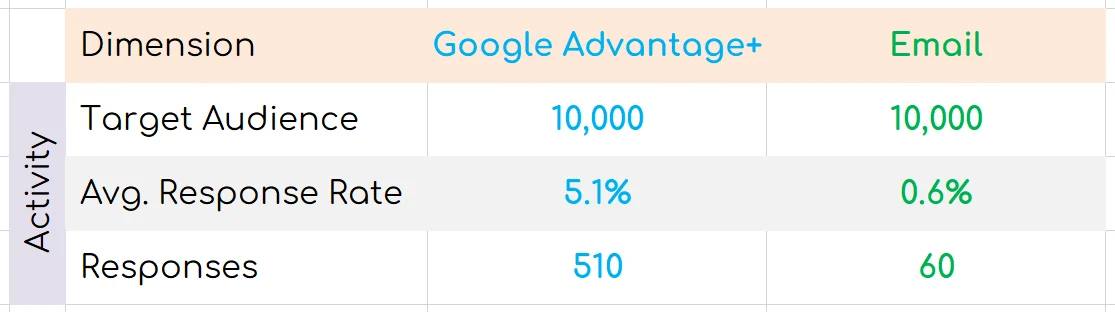
Most companies begin with a basic "Activity View." They look at platforms like Google Advantage+ and celebrate high response rates. They see traffic spikes, they see engagement, and they report these to leadership as wins. The immediate, reflexive response is to "ship more budget" to the channel that generates the most traffic.
The Outcomes View (The Necessary Pivot)
A sophisticated CFO or a forward-thinking CMO will inevitably push back: "What was the outcome?" This is where the transition begins. Instead of just looking at sessions, the team must incorporate metrics like Revenue and Conversion Rate. This shift forces the organization to acknowledge that traffic is only as valuable as the actions it triggers.
Even in B2B or complex B2C environments—where the sales cycle is long or the conversion happens offline—this transition is possible. By using micro-conversions (e.g., lead forms, whitepaper downloads) and multiplying them by average lead-to-sale conversion rates and average order values, companies can derive a proxy for true business impact.
The Accountability View (The Gold Standard)
The final and most critical stage is "Accountability." Marketing is not free. When you factor in the Campaign Cost (ad spend) and the Cost of Goods Sold (COGS), the picture changes dramatically.
When analyzing a campaign’s profitability, the metrics must shift from mere Return on Ad Spend (ROAS) to more rigorous standards like Return on Investment (ROI) and, ultimately, Profit on Investment (POI). ROAS, while popular, is misleading because it fails to account for the cost of the products sold, thereby inflating marketing’s perceived impact.
Supporting Data: The Profitability Gap
To understand the necessity of this shift, consider a comparative analysis of two common marketing channels: Google Advantage+ and Email Marketing.
- Google Advantage+: While this channel may generate 173 orders—a high-volume "win" by activity standards—the high campaign cost often cannibalizes the profit margin.
- Email Marketing: This channel might only generate 14 orders, but with significantly lower acquisition costs and higher intent, it often yields a much higher net profit.
When you calculate the Profit on Investment (POI), the results are often stark. In many scenarios, while Google drives 12 times the revenue of email, it might actually be losing money on a per-dollar-invested basis. If the POI is negative, the company is effectively paying to provide employment for the advertising platform’s sales team rather than growing its own business.
The AI Shift: A Warning from Google
The urgency to abandon "Cost Per Session" is no longer just a matter of good business practice; it is a technical necessity in the age of AI. Google’s recent guidance on SEO for AI-powered search experiences explicitly warns against focusing on traffic volume.
Google notes that visitors arriving via AI-generated summaries are higher quality, spending more time on the site because the AI has provided better context. If companies continue to optimize for "clicks" or "sessions," they will fail to capture the value of this new, more engaged audience. Google is explicitly telling marketers: Do not incentivize one-night stands.
Strategic Implications: How to "Suck Less"
If your organization is trapped in a culture that demands Cost Per Session, there are immediate, actionable steps to mitigate the damage.
- Shift to Cost Per Non-Bounced Session: If you cannot immediately drop the session-based metric, at least filter out the "I came, I puked, I left" traffic. By measuring only non-bounced sessions, you increase the cost-per-metric significantly, which often triggers the necessary internal realization that the current strategy is unsustainable.
- Audit the Channel Spend: Immediately pause campaigns that show a negative POI. The inevitable panic about "dropping traffic" should be met with the cold, hard fact that you are trading profit for vanity.
- Implement a Three-Part Strategy:
- Identify Intent: What is the consumer actually looking for?
- Match Tactics: Align creative and offers specifically to that intent.
- Leverage AI: Use AI-powered tools to optimize for engagement, not just for reach.
- Prioritize Accountability: Every CMO and CFO should demand a dashboard that tracks Profit on Investment. If your current reporting tools don’t support this, it is time to upgrade your analytics stack, not your marketing spend.
Conclusion: Outcomes Over Activity
The ultimate goal of any marketing organization should be to protect the CMO from the CFO by ensuring that every dollar spent is defensible, incremental, and profitable. While the transition from measuring activity to measuring accountability is difficult—demanding uncomfortable conversations, organizational discipline, and a shift in culture—the payoff is immense.
By moving away from superficial metrics like Cost Per Session and embracing a framework of true business accountability, marketers can stop being perceived as a cost center and start being recognized as the primary engine of sustainable corporate growth. In the rapidly evolving landscape of AI-driven marketing, those who adapt to this new standard of accountability will build careers that are not only successful but fundamentally "AI-proof."
Carpe diem. The path to profitability is clear; it simply requires the courage to stop measuring what is easy and start measuring what matters.