In an era of fragmented media consumption, sports stand as the final, untouchable monolith of linear television. Last year, nearly every one of the top 50 most-watched telecasts in the United States was tethered to a sporting event. With the exception of the 97th Oscars, the 50th anniversary of Saturday Night Live, a high-profile 60 Minutes interview, an episode of The Floor, and the 67th Grammys, the list was a sea of athletic competition.
Even the obscure—such as the #27 ranked broadcast, titled "NFL Weather Delay"—commanded massive audiences. It is a testament to a simple, underlying truth: audiences will watch almost anything if it carries the weight of a sporting title. This reality has forced streaming giants to pivot, aggressively acquiring expensive broadcast rights to secure the one thing that still guarantees a simultaneous, massive, live audience.
However, this rush into the arena has created a precarious situation for marketers. As budgets flow into stadium naming rights, jersey patches, and pitch-side billboards, a difficult question is finally being asked by C-suite executives: "Beyond the hospitality suite and the photo-op with a star quarterback, is this $38 million investment actually driving the business?"
The Chronology of an Investment Obsession
The evolution of sports marketing has moved from a branding "nice-to-have" to a multi-billion dollar cornerstone of corporate strategy. Decades ago, sponsorship was primarily about visibility—the simple act of placing a logo where eyes were guaranteed to land.
As the digital age arrived, brands grew more sophisticated, moving from static signs to experiential activations. Companies began hosting high-end events at the Kentucky Derby or luxury suites at MLB stadiums to court clients. While these efforts effectively delighted stakeholders and high-net-worth clients, they often lacked the scalability required for a true return on investment (ROI).
Today, we are in the era of "performance-led" sports integration. Marketers are no longer satisfied with just being present; they are demanding data-driven justification for their presence. This shift, while overdue, is creating friction between the traditional, "feel-good" world of sports sponsorship and the cold, hard metrics of modern marketing analytics.
Supporting Data: The Measurement Gap
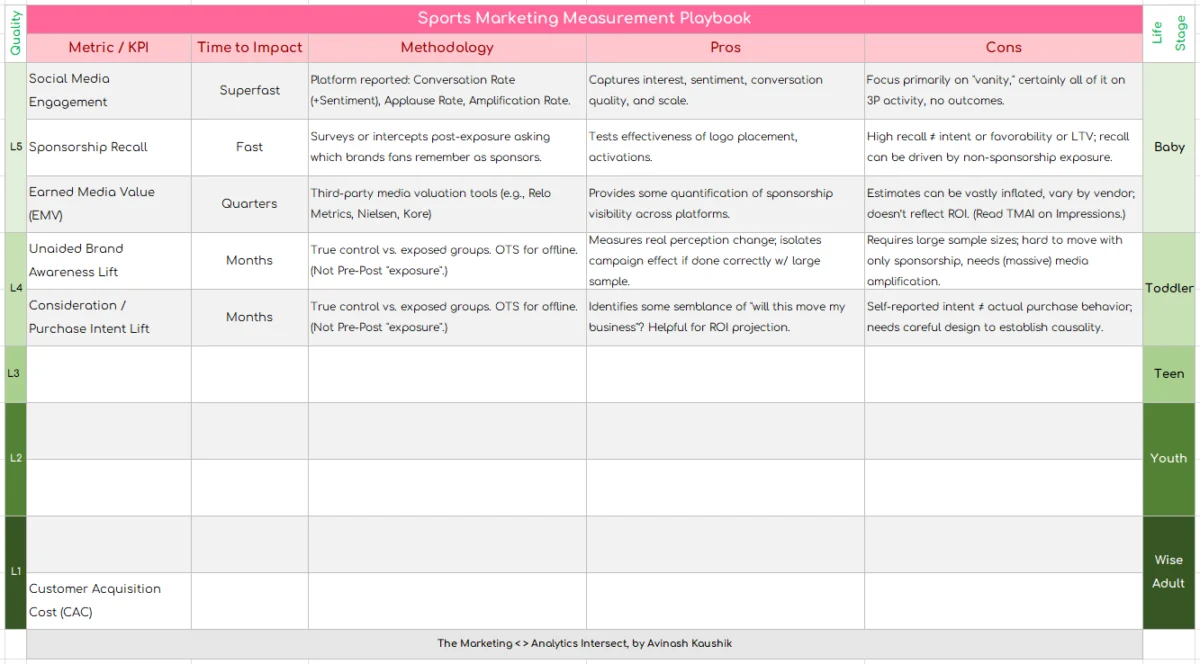
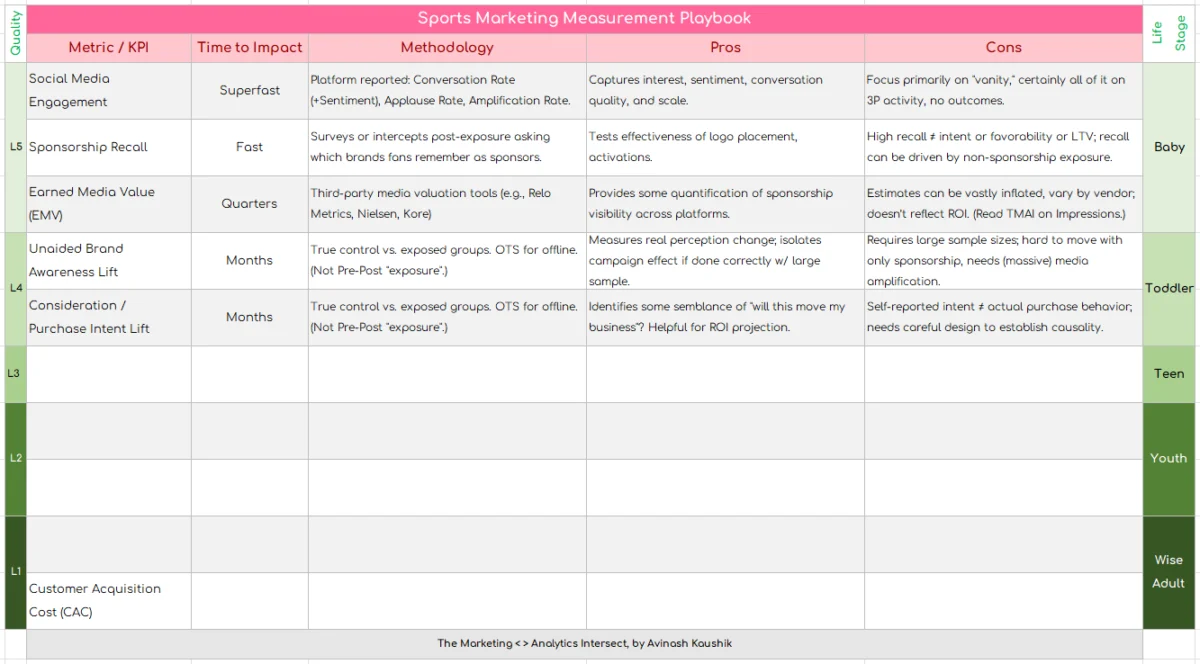
The problem with many sports marketing campaigns is that they are built on a foundation of "Vanity Metrics." According to industry experts, most brands operate at what is termed "Level 5" of the measurement hierarchy—the land of Big Numbers.
The Illusion of Impressions
At Level 5, companies report on "Impressions" in the hundreds of millions. These figures are seductive, appearing impressive in board decks, yet they often measure activity rather than outcomes. They track how many times a logo appeared on a screen, but they fail to account for whether that logo was ever processed by a human brain.
The Fallacy of Ad Value Equivalency (AVE)
A persistent "con" in the industry is Earned Media Value (EMV), or Ad Value Equivalency. Agencies often calculate the value of a sponsorship by counting every second a logo appears on screen and multiplying it by the cost of a traditional 30-second commercial. This metric is widely discredited because it assumes all exposure is positive, ignores the clutter of the environment, and assumes that a brief logo flash carries the same weight as a dedicated marketing message.
Professional Analysis: The Laws of Marketing Apply
The most critical realization for any CMO is that sports marketing is not an exemption from the fundamental laws of marketing. If a brand’s creative and "story" are insufficient to capture attention in the fleeting 1.2 seconds of a TikTok scroll, they will fare no better on a jersey patch or a stadium banner.
In fact, the sports environment is arguably more challenging. Because the audience is fundamentally there for the game, any intrusive branding is treated as noise. The "halo effect"—the idea that the prestige of an athlete or a team automatically transfers to the brand—is not an automatic occurrence. It requires a "spike and sustain" approach. If a brand only shows up occasionally, it gets ignored. To break through, a brand must achieve a high frequency of contact—the "3/User/Week" rule—which is rarely achieved through passive sponsorship alone. It requires an aggressive overlay of paid media that forces the brand into the narrative.
The Five Levels of Impact Intelligence
To move beyond the "dirty little secret" of sports marketing—which is that many brands struggle to define what they are actually achieving—companies must adopt a more rigorous, tiered measurement framework.
Level 5: The Opening Gambit (Vanity)
At this stage, companies measure social media engagement and simple ad recall. While useful for establishing a baseline, it provides no insight into financial impact. It is, essentially, measuring the volume of noise rather than the quality of the signal.
Level 4: The Quest for Brand Impact
This is the first true step toward understanding human impact. By employing test vs. control methodologies—not the unreliable pre-post surveys—brands can determine if their sponsorship is shifting "Unaided Brand Awareness" (UBA) or purchase intent. This is the stage that begins to capture the interest of the CFO, as it correlates with medium-term revenue impact.
However, even at Level 4, brands must guard against the long-term trap. Sports marketing is rarely a "quick fix"; it is a marathon. Short-term, sporadic deals are often a waste of capital. A sustained five-year commitment is usually the minimum threshold for seeing meaningful, measurable shifts in market perception.
Levels 3, 2, and 1: The Path to Profitability
Beyond Level 4 lie the more advanced stages of maturity:
- Level 3 (Heart & Mind Influence): Identifying how the sponsorship compounds brand advantage over time.
- Level 2 (The First Digital Trace): Connecting sports exposure to specific digital behavioral outcomes.
- Level 1 (Show Me the Money): The gold standard of incrementality, where analytics prove that the sponsorship is the direct cause of increased profitability.
Implications for Future Strategy
The implication for marketing leaders is clear: stop sponsoring in the dark.
The traditional model of "hospitality suite" marketing is rapidly losing favor. While shaking hands with icons like Tom Brady or hosting clients at exclusive venues is undeniably beneficial for relationship management, it cannot be disguised as a high-ROI performance marketing strategy.
For sports marketing to be a legitimate pillar of a business, the creative strategy must be subservient to the brand’s core goals. If a brand is unable to create a compelling story on its own, it can be profitable to "rent" the brand equity of a sport or athlete—but this must be a conscious, calculated decision.
Once the decision is made, the final requirement is the allocation of sufficient capital for paid media. The sponsorship is merely the canvas; the paid media is the paint. Without the latter, the sponsorship remains a static, ignored background element.
A Final Note on Accountability
The transition to higher-order measurement is not merely an academic exercise; it is an existential one. As marketing budgets face increased scrutiny, the "black box" of sports spending will be the first to be opened. Those who can prove incrementality—those who can move from reporting on "impressions" to reporting on "business outcomes"—will secure their budgets and their influence within the organization.
The sport itself may be the last bastion of live, shared human experience, but the marketing of that sport must evolve. It is time to turn the lights on, discard the vanity metrics, and treat sports sponsorships with the same level of analytical rigor as any other performance-driven channel. Failure to do so isn’t just a missed opportunity—it’s a multi-million dollar gamble that, in the modern economy, is increasingly difficult to justify.