
In the modern digital economy, user experience (UX) design is no longer just a peripheral creative department; it is a primary driver of enterprise growth and product innovation. As UX practices continue to expand rapidly across global industries, foundational sub-disciplines such as content strategy, operations, and user research are scaling to meet the demands of iterative product development.
Yet, as organizations lean harder into agile delivery frameworks—often operating on strict two-week sprint cycles—traditional UX research models are increasingly falling behind. Long-form discovery phases, deeply intensive interview studies, and slow administrative loops can leave product teams guessing rather than validating. To bridge this operational gap, industry leaders are turning to a transformative solution: Rapid Research programs.
By standardizing and templatizing standard research operations, Rapid Research provides product teams with actionable, end-user insights at an unprecedented operational speed. Below is a comprehensive roadmap detailing the core facts, historical evolution, structural mechanics, and enterprise implications of establishing a Rapid Research program from the ground up.

Main Facts: What Is Rapid Research?
Rapid Research is an agile operational framework where conventional user research practices are standardized, modularized, and templatized to deliver a consistent, highly predictable cadence of insights. Unlike ad-hoc feedback loops or deep generative studies, a true Rapid Research program is built to supply quick answers to targeted problems within compressed timeframes—often functioning on a strict weekly or bi-weekly cycle.
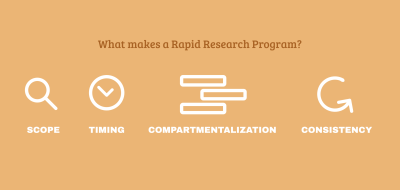
The framework rests on four core pillars:
- Scope: Narrowing methodologies, sample sizes, and session durations to fit administrative and technical constraints.
- Timing: Compressing project timelines so that end-to-end insights are delivered significantly faster than traditional studies.
- Compartmentalization: Breaking the research workflow into independent, modularized pieces (e.g., separating intake from kickoff, or discussion guides from participant recruitment).
- Consistency: Establishing a predictable, reliable cadence that stakeholders can depend upon sprint after sprint.
By shifting evaluative testing into this high-speed lane, organizations protect expert researchers from burnout, free up bandwidth for complex generative discovery, and keep pace with the relentless velocity of agile engineering.
Chronology: The Evolution from Bottlenecks to Agility
The trajectory of UX research maturation within enterprise environments typically follows a predictable timeline:
- The Infancy Stage (Small Teams): An organization employs a small cohort of UX generalists or researchers. Human insight is utilized selectively, often tied to major product overhauls or annual releases.
- The Scaling Crisis (Exponential Demand): As the product organization grows, demand for user feedback skyrockets. Researchers are brought into the product development lifecycle too late—often merely to validate pre-existing ideas. Teams feel constantly rushed, restricted exclusively to reactive, evaluative work. Senior researchers grow frustrated by the lack of deep, strategic, generative discovery.
- The Structural Intervention (Diversifying the Portfolio): Recognizing the unsustainability of traditional models, leadership introduces multi-pronged portfolio strategies. These typically include research democratization programs, structured quarterly planning, and the launch of a dedicated Rapid Research initiative.
- Operationalization and Maturation: Teams audit historical timelines, identify primary customer profiles, establish vendor partnerships or specialized internal junior staffing, and pilot the rapid cadence. Over time, feedback loops refine the process, doubling research throughput and seamlessly integrating insights into agile sprints.
Supporting Data & Structural Mechanics: How to Build a Program
Establishing a Rapid Research program requires a methodical, four-phase implementation strategy. Organizations cannot simply demand speed; they must engineer the underlying infrastructure to support it safely.
Phase 1: Determine the Need and Limitations
Before investing capital or headcount, organizations must audit current research request volumes, evaluate team capabilities, and define what Rapid Research cannot do. Rapid Research is poorly suited for complex, longitudinal diary studies or foundational, exploratory research that requires profound analytical depth. It is built strictly for targeted, evaluative inquiries.
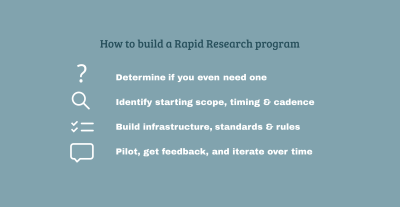
Phase 2: Identify Starting Scope, Timing, and Cadence
- Participant Profiles: Strike a balance between profiles specific enough to yield useful data and broad enough to recruit easily. Test panel incidence rates beforehand to prevent recruitment bottlenecks from stalling velocity.
- Research Methods: Focus on lightweight evaluative methods—such as rapid usability testing or short concept checks—that can be executed reliably within a 1-to-2-week window.
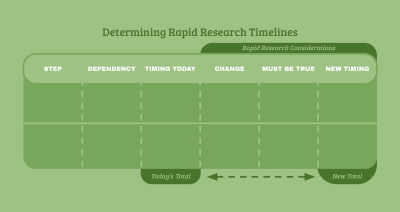
- Process Mapping: Document every step of the current research workflow, identify dependencies (such as legal and compliance reviews), and establish what structural changes "must be true" to slash total project timelines by at least 50%.
Phase 3: Build Infrastructure, Standards, and Rules
- Buy-In First: Secure stakeholder alignment and budget before drafting lengthy operational playbooks. Ensure product and legal partners agree to compressed SLAs (Service Level Agreements), such as 24-hour turnaround times for compliance reviews.
- Templatization: Standardize screening surveys, moderation guides, synthesis decks, and reporting formats.
- Staffing Models: Deploy creative resourcing strategies, such as partnering with trusted long-term research vendors, hiring junior researchers as a talent development pipeline, or establishing dedicated rapid-response ops coordinators.
Phase 4: Pilot, Gather Feedback, and Iterate
Treat the first three to six months as a pilot phase. Expect friction. Partner with sympathetic product teams to run trial projects, and establish transparent feedback mechanisms at every project milestone to identify and eliminate operational friction points.
Official Industry Perspectives and Expert Responses
Industry leaders and professional UX bodies have weighed heavily on the structural challenges that Rapid Research aims to solve.
UserZoom, in examining common hurdles faced by experience teams, notes the perennial challenge of participant sourcing: "Why is sourcing participants such a challenge? Well, you could probably find as many users as you like by spreading the net as wide as possible and offering generous incentives, but you won’t necessarily find the ‘right’ participants." Rapid Research solves this paradox by pre-defining broad yet accurate customer profiles that align with recurring product use cases.
Furthermore, management insights highlight the immense risk-mitigation value of operational pilots. As noted by business strategists regarding the iterative deployment of new corporate programs: "Piloting offers a realistic preview experience for users at the earliest stages of development. It allows the organization and design team to gather real-time insights that can be used to shape and refine the product and prepare it for commercialization."
Implications: Strategic Value and Enterprise Impact
The implementation of a mature Rapid Research program yields profound, measurable implications for an enterprise across financial, structural, and cultural dimensions:
- Financial ROI via Early Issue Detection: Catching usability flaws upstream during rapid evaluative cycles prevents expensive post-launch failures. According to industry quality benchmarks, identifying and fixing a design flaw early in development can save exponential downstream costs compared to post-release engineering overhauls.
- Amplified Generative Innovation: By offloading repetitive, tactical evaluative work into a streamlined rapid pipeline, expert UX researchers are liberated to focus on deep, strategic, generative discovery. This unlocks true innovation and long-term product roadmapping capabilities.
- Double Throughput: Organizations utilizing dedicated rapid vendors or specialized internal pods frequently witness a 100% increase in project throughput. Teams can deliver actionable insights twice as often without burning out staff.
- Cultural Alignment with Engineering: By matching the cadence of agile software development (two-week sprints), UX research ceases to be viewed as a sluggish bottleneck. Instead, it becomes an active, synchronized partner in digital product delivery.
Summary of Pros and Cons
| Pros | Cons |
|---|---|
| Aligns seamlessly with agile sprint cycles | Not suitable for long-form, complex discovery |
| Doubles research throughput | Requires strict discipline to avoid scope creep |
| Lowers overall cost per insight | High initial operational setup requirement (3–12 months) |
| Frees senior researchers for strategic work | Vulnerable to compliance and legal review delays if unoptimized |
Conclusion
Building a Rapid Research program requires intention, structural discipline, and a willingness to rethink traditional research workflows. By carefully defining scope, timing, compartmentalization, and consistency, organizations can transform user research from a reactive hurdle into an agile engine of continuous innovation. For enterprises looking to scale their UX maturity and uncover untapped return on investment, investing in Rapid Research is no longer just an operational option—it is a strategic necessity.