In the modern digital landscape, the speed of product development is no longer just an advantage; it is a baseline requirement. As User Experience (UX) practices continue to balloon, organizations are finding that their traditional research methods—often deep, complex, and time-consuming—cannot keep pace with the iterative nature of agile development. To bridge this gap, forward-thinking organizations are turning to Rapid Research, a standardized, templatized, and high-cadence approach to gathering human insights.
This article provides a comprehensive roadmap for building a Rapid Research program from the ground up, detailing how to turn the "need for speed" into a strategic asset that delivers tangible ROI.
The Core Concept: What is Rapid Research?
Rapid Research is defined as a framework where typical research operations are standardized to deliver consistent, repeatable insights on a compressed timeline. Unlike traditional discovery, which may take weeks to scope and months to synthesize, Rapid Research is designed to fit directly into the cadence of bi-weekly product sprints.
The goal is not to replace deep-dive generative research, but to complement it. By offloading evaluative, tactical questions—such as usability testing or quick preference checks—to a Rapid Research track, senior researchers are freed to focus on long-term, complex discovery initiatives that drive product innovation.

The Four Pillars of the Program
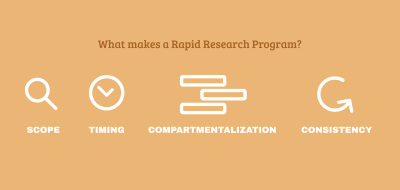
To build a successful program, leaders must master four distinct pillars:
- Scope: Defining which methods (e.g., usability testing, A/B testing) fit the "rapid" criteria.
- Timing: Establishing a strict, predictable cadence that outpaces traditional study timelines.
- Compartmentalization: Breaking down the research process into independent, modular steps to remove bottlenecks.
- Consistency: Ensuring that stakeholders know exactly what to expect from every study, every time.
Chronology of Development: From Concept to Execution
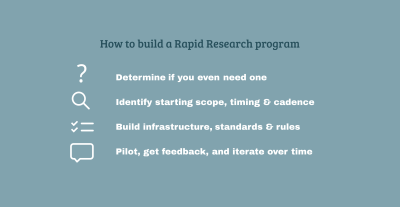
Building a program of this magnitude requires a phased approach. Based on industry best practices, the following chronology outlines how to move from an idea to a fully operational system.
Phase 1: Diagnostic Assessment (Months 1–2)
Before writing a single template, you must determine if your organization is ready. Conduct an audit of the last 12 months of research requests. Ask:
- What percentage of requests were tactical/evaluative versus generative?
- Where are the current bottlenecks in our pipeline?
- Are we constantly receiving requests that we have to decline due to lack of bandwidth?
Phase 2: Design and Infrastructure (Months 3–5)
Once the need is validated, focus on the "plumbing." This includes:
- Creating Templates: Develop standardized discussion guides, recruitment screeners, and reporting templates.
- Defining Rules of Engagement: Establish strict SLAs (Service Level Agreements) for stakeholders. For example, a 48-hour window for feedback or a "no changes to the scope once recruitment begins" policy.
- Securing Resources: Whether you are hiring junior researchers or partnering with a research vendor, ensure the talent is in place to execute the rapid cadence.
Phase 3: The Pilot Program (Months 6–8)
Never roll out a new program to the entire organization at once. Select a friendly product team to be your pilot partner. During this phase, you are testing your assumptions about timing and recruitment. Collect feedback after every study, track the "time-to-insight," and iterate on your templates based on real-world friction points.
Supporting Data: Why Speed Matters
The impact of Rapid Research is best measured through throughput and efficiency. Data from organizations that have successfully integrated these programs shows several key metrics of success:
- Throughput Doubling: By standardizing the recruitment and reporting process, teams often double the number of studies they can support per quarter.
- Upstream Mitigation: According to industry studies, catching usability issues during the design phase—rather than after development—can save organizations over 100x in overhead costs associated with rework and "bug squashing."
- Agile Alignment: The primary objective is to match the 2-week sprint cycle. When researchers can deliver insights by the end of the first week of a sprint, the impact on product design is immediate and measurable.
The Trade-off Matrix
It is essential to be transparent about what this program cannot do. Rapid Research is not for:
- Long-form longitudinal studies: Diary studies lose quality when compressed.
- Strategic discovery: Uncovering the "unknown unknowns" of user behavior requires depth, not speed.
- Highly complex segments: If your target user is a "niche medical specialist," you cannot recruit them in 48 hours.
Official Perspectives: Navigating Stakeholder Buy-in
A common point of failure for new research programs is a lack of organizational alignment. "Rapid" does not mean "lazy," and it is the responsibility of the research lead to communicate this distinction clearly to stakeholders.
Managing Expectations
Leadership often views "Rapid Research" as a magic button. You must educate your partners on the "Scope-Speed-Rigor" triangle. If they want high-speed, they must accept a narrower scope. If they want high-rigor, they must accept a slower timeline.
Legal and Compliance
In highly regulated industries like fintech or healthcare, internal bureaucracy is often the primary blocker. When building your program, engage Legal and Compliance early. Standardize the consent forms and legal headers so that they are "pre-approved," effectively removing the need for a legal review for every individual study.
Implications and Long-term Evolution
The introduction of a Rapid Research program transforms the research department from a service provider into a strategic partner.
The "Junior Talent" Pipeline
One of the most profound, yet often overlooked, implications of a Rapid Research program is its value as a training ground. Because the methods are standardized and the guardrails are clearly defined, it serves as the perfect environment for junior researchers to cut their teeth. They learn the fundamentals of participant management, moderation, and synthesis in a controlled, high-frequency setting, eventually graduating to more complex, generative research roles.
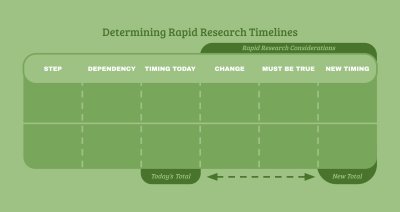
Sustaining the Program
To ensure longevity, the program must evolve. What works in year one may need adjustment by year three.
- Automate where possible: Leverage AI-driven transcription and automated scheduling tools to reduce manual labor.
- Track the ROI: Always link your research insights to product outcomes. Did your rapid test lead to a change in the button placement that resulted in a 5% increase in conversion? Document it.
- Iterate on the Process: Every six months, perform a "process audit." Remove any steps that have become redundant and refine your templates to be even more concise.
Final Considerations
Ultimately, a Rapid Research program is about culture as much as it is about process. It requires a mindset shift from "perfection" to "progress." By providing actionable insights at a pace that matches the modern development cycle, you not only increase the value of your research team but also significantly reduce the risk of building products that miss the mark.
As you embark on this journey, remember that the goal is not to run as fast as possible, but to run at the right pace to enable meaningful, sustainable innovation. Start small, prove your value through pilot programs, and scale your impact with intention. The ROI of bringing the voice of the customer into every sprint is, quite simply, immeasurable.