The intersection of marketing and technical reality has long been a battleground in the tech sector, but nowhere is this tension more palpable than in the WordPress ecosystem. With millions of websites relying on the platform to power everything from small personal blogs to massive enterprise e-commerce hubs, security is the ultimate selling point. Go to the landing page of almost any major managed WordPress host, and you will inevitably find prominent badges, bold guarantees, and comforting assurances of "secure hosting."
However, a sweeping new study conducted by Patchstack—a dedicated security firm within the WordPress ecosystem—suggests a sobering truth: when pushed to the real-world test, the marketing hype surrounding secure hosting often outpaces actual protection.
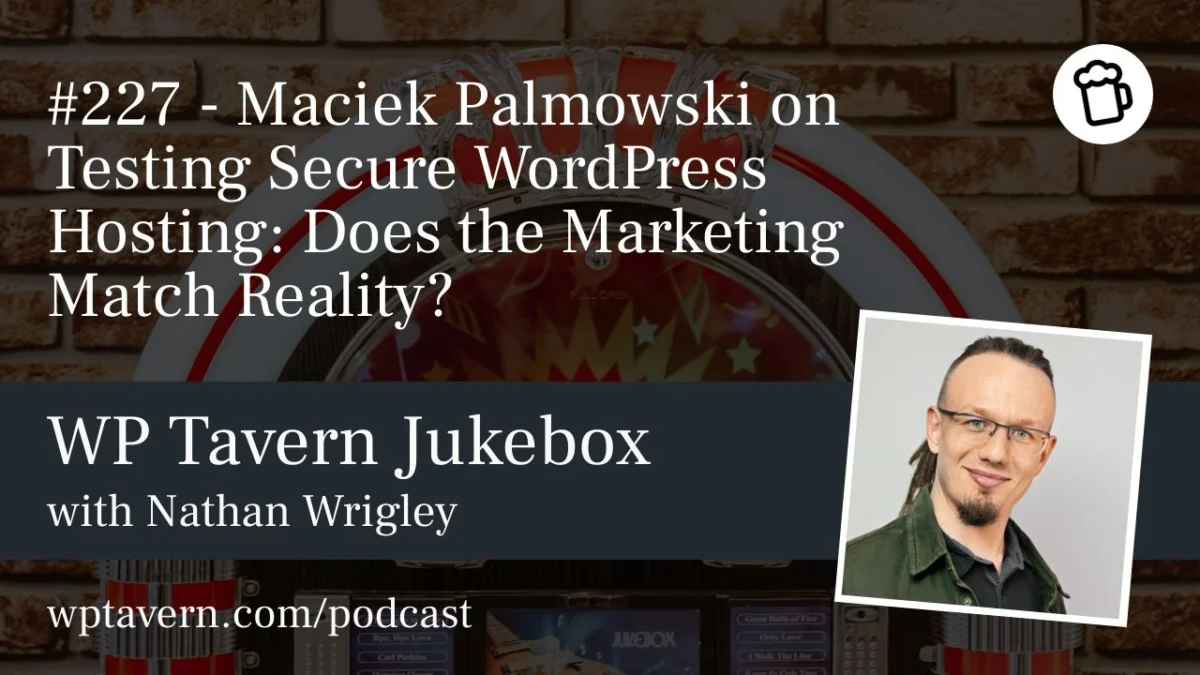
In a recent conversation on the Jukebox Podcast from WP Tavern, host Nathan Wrigley sat down with Maciek Palmowski, Growth Team Engineer at Patchstack, to dissect a provocative presentation titled "Testing the Promise: Does Secure Hosting Deliver?" The findings lift the lid on a critical gap in the industry, revealing that standard security configurations are routinely bypassed by everyday WordPress vulnerabilities.
Main Facts: The Methodology and the Shocking Results
The impetus for Patchstack’s research did not emerge in a vacuum. It was sparked by a public inquiry from WordPress co-creator Matt Mullenweg, who questioned whether hosting companies were already handling core security measures on behalf of users. While security professionals suspected the answer was a qualified "no," concrete, cross-platform data was lacking.
To find out, Patchstack engineered a rigorous, standardized penetration test.
- The Scope: The team selected over 30 known, well-documented WordPress plugins featuring public proof-of-concept exploits. These included popular components, such as WooCommerce integrations, spanning various vulnerability types.
- The Methodology: The same collection of vulnerable plugins was deployed across multiple distinct hosting environments. Researchers attempted to execute real-world attacks while enabling every available native security feature offered by the respective hosts. The results were then independently validated.
- The Core Finding: Approximately 80% of the WordPress-specific attacks successfully breached the perimeter.
While hosting providers generally excelled at handling generic PHP-level attacks—such as basic file uploads or path traversal—they failed miserably against WordPress-specific vectors. Even more alarming, hosts utilizing identical security stacks often produced drastically different outcomes, proving that effective protection depends not just on the tools deployed, but on how aggressively and intelligently they are configured.
Chronology: From a Twitter Trigger to Global Presentation
The evolution of Patchstack’s security auditing highlights a methodical approach to uncovering industry shortcomings:
- The Initial Observation: Following the publication of a routine state-of-security report, social media discussions prompted questions regarding the efficacy of host-level protections.
- The Beta Run: Patchstack ran an initial, smaller-scale test across a handful of hosting providers and a limited number of plugins. Upon seeing an 80% success rate for incoming attacks, researchers initially suspected methodological error, believing the real-world impact couldn’t possibly be that high.
- The Expanded Research: Driven by these surprising baseline numbers, the team scaled up the experiment. They incorporated a wider array of hosts and an expanded battery of 30+ plugins, ultimately cementing the data presented at the Checkout Summit in Palermo and subsequently at WordCamp Europe in Kraków.
- Post-Test Disclosures: Following the experiments, Patchstack privately contacted the participating hosting companies to share detailed breakdowns of what was blocked and what slipped through. While some providers took immediate corrective action, others ignored the reports entirely, exposing a dangerous variance in corporate accountability.
Supporting Data: The 5-Hour Window and the Patch Gap
The illusion of secure hosting is further undermined by broader ecosystem metrics regarding software updates and zero-day exploitation speeds. For years, the conventional wisdom doled out to non-technical site owners has been simple: just update your software weekly, and you will be safe.
Patchstack’s data reveals this advice to be dangerously obsolete.
- The 5-Hour Rule: According to Patchstack’s telemetry, active exploitation of published vulnerabilities begins, on average, just five hours after a bug goes public.
- The Vendor Responsiveness Deficit: When bugs are discovered via bug bounty programs, vendors are typically given a standard 30-day window to patch the code before public disclosure. Shockingly, Patchstack’s data reveals that 50% of vulnerable plugins remain unpatched at the moment of public disclosure because vendors fail to respond or issue fixes.
- The Illusion of Scale: While WordPress is frequently lambasted in broader tech circles as "insecure," experts argue this is a statistical illusion. Core WordPress code is remarkably secure, featuring very few minor vulnerabilities annually. The perceived risk stems from the vast ocean of third-party plugins—an ecosystem where thousands of components intersect, creating an immense attack surface.
Official Responses and Industry Accountability
The research raises uncomfortable questions about corporate messaging. Managed WordPress hosts routinely market their services on the premise of absolute peace of mind: focus on your business, write your content, sell your products, and leave the technical heavy lifting to us.
When hosting providers claim users do not need to install third-party security tools because "we have your back," they are often selling an illusion. Palmowski notes that while it is economically understandable why companies lean into absolute statements—algorithms and consumer attention spans favor black-and-white marketing over nuanced gray zones—the messaging fundamentally misleads consumers.
Furthermore, the study highlighted a deep divide in corporate responsibility. When handed empirical proof that their security configurations failed standard penetration tests, some hosting companies aggressively optimized their firewalls and patched the logic gaps. Others simply shrugged, treating the data as a non-issue. This variance demonstrates that an explicit "secure hosting" badge or certification is currently unfeasible, as human factors (such as weak administrator passwords or lax maintenance) can instantly compromise even the most fortified server infrastructure.
Implications: The Swiss Cheese Model and the AI Threat Horizon
As the industry looks toward the challenges of 2026 and beyond, security professionals are urging a fundamental shift in how webmasters view risk.
The Swiss Cheese Layer Model
Security is not a single button, a plugin, or a marketing tagline; it is a process built on layers. Every security layer—whether it is a server-level firewall, a WordPress-specific security plugin, or regular backups—will inevitably have holes, much like slices of Swiss cheese. By stacking multiple overlapping defenses, organizations ensure that if a threat slips through the holes of one layer, it is caught by the next.
The AI Imperative
The introduction of artificial intelligence into the threat landscape has accelerated the arms race exponentially. Automated AI agents are now capable of discovering attack surfaces, identifying vulnerabilities, and executing exploits in mere fractions of a second. This velocity makes traditional, manual update cycles entirely inadequate.
Practical Advice for Site Owners
For those navigating this complex landscape, Palmowski advises abandoning generic security inquiries. When evaluating a hosting provider, site owners should bypass superficial questions about web application firewalls (WAFs) and instead ask targeted, technical questions:
- Does your security stack feature solutions that are explicitly WordPress-aware?
- How do you mitigate WordPress-specific application-layer attacks rather than just generic PHP exploits?
Ultimately, the takeaway from Patchstack’s research is not that hosting companies are malicious, but that absolute security is a myth. By piercing the veil of marketing hype, web professionals can build resilient, multi-layered defenses that acknowledge reality rather than relying on empty promises.