In the high-stakes world of digital marketing, the obsession with traffic has long been the industry’s greatest blind spot. For years, businesses have funneled millions into top-of-funnel acquisition, chasing clicks and impressions with the assumption that volume alone equates to success. However, as customer acquisition costs (CAC) continue to skyrocket, the narrative is shifting. The new gold standard for digital growth is no longer just "more visitors"—it is the strategic art of conversion marketing.
Conversion marketing is the systematic practice of optimizing every touchpoint of a user’s journey to ensure they take a desired action—whether that is a newsletter sign-up, a demo request, or a final purchase. By pivoting from a focus on quantity to a focus on quality, companies are discovering that they can double their revenue without spending an extra cent on advertising.
The Financial Case for Conversion Over Acquisition
The economic logic behind conversion marketing is straightforward, yet frequently overlooked. Consider a standard e-commerce site attracting 50,000 monthly visitors with a 1% conversion rate. This yields 500 sales. If the marketing team manages to optimize the landing page experience, streamline the checkout process, and sharpen the value proposition, they might bump that conversion rate to 2%. Suddenly, they have 1,000 sales—doubling the revenue from the exact same pool of traffic.
In an era where marketing budgets are under intense scrutiny from CFOs, conversion rate optimization (CRO) offers a rare, high-margin alternative to the relentless treadmill of paid media. While SEO and brand-building are essential long-term plays, CRO provides the immediate, data-backed wins that keep growth metrics trending upward.
Chronology of the Conversion Shift
The evolution of conversion marketing mirrors the maturation of the internet itself:
- The Early Web (1995–2005): The "Field of Dreams" era. Simply having a website was enough to generate interest. Conversion was rarely tracked, and user experience (UX) was a secondary concern.
- The Analytical Dawn (2005–2012): With the proliferation of Google Analytics, marketers began tracking bounce rates and goal completions. The industry shifted from "gut-feeling" design to data-informed decision-making.
- The Optimization Era (2012–2020): The rise of specialized tools like Unbounce, Optimizely, and Hotjar enabled non-technical marketers to run A/B tests, design landing pages, and analyze user behavior in real-time.
- The Modern AI-Driven Paradigm (2020–Present): Today, conversion marketing is powered by AI and machine learning. "Smart Traffic" algorithms now automatically route visitors to the specific page variants they are most likely to interact with, removing the guesswork from experimentation.
Core Pillars: What Actually Drives Conversion?
Conversion is not a mystical occurrence; it is the result of psychological triggers meeting technical efficiency. To optimize, marketers must address four critical pillars.
1. The Value Proposition
At the heart of every conversion is a promise. Does your visitor know, within three seconds of landing on your page, what you offer and why it matters? A high-performing value proposition is not just descriptive—it is transformative. It speaks to the "end state" the customer desires, such as time saved, stress reduced, or status gained. If a visitor has to work to understand your value, they have already begun to bounce.
2. Frictionless UX and Design
Design is not just for aesthetics; it is the structural integrity of your sales funnel. Every form field that is not strictly necessary, every slow-loading image, and every confusing navigation menu acts as a barrier. Data consistently shows that reducing form length can lead to significant increases in completion rates. In the mobile-first era, if your interface is not optimized for touch, you are essentially closing the door on a massive segment of your potential audience.
3. Trust Signals and Social Proof
Human beings are wired to seek validation from their peers. This is why testimonials, case studies, security badges, and client logos are not just "nice to have"—they are critical psychological bridges. However, specificity is the key. Vague praise like "Great product!" carries little weight compared to data-backed feedback, such as "This software saved our team 15 hours per week."
4. Urgency and Intentional Incentives
Scarcity is a powerful motivator. By utilizing limited-time offers or clearly defined incentives, marketers can nudge a visitor from consideration to action. However, there is a caveat: the urgency must be genuine. Perpetual "last chance" sales eventually train customers to ignore your deadlines, eroding trust.
Analytical Deep Dive: The Data of Success
A successful conversion marketing strategy is built on the foundation of granular data. Relying on vanity metrics like "page views" is insufficient. Instead, high-growth organizations focus on:
- Macro Conversions: The primary goal of the site (e.g., a purchase or demo booking).
- Micro Conversions: Smaller actions that lead to the macro goal (e.g., watching a video, downloading a whitepaper, or clicking a pricing link).
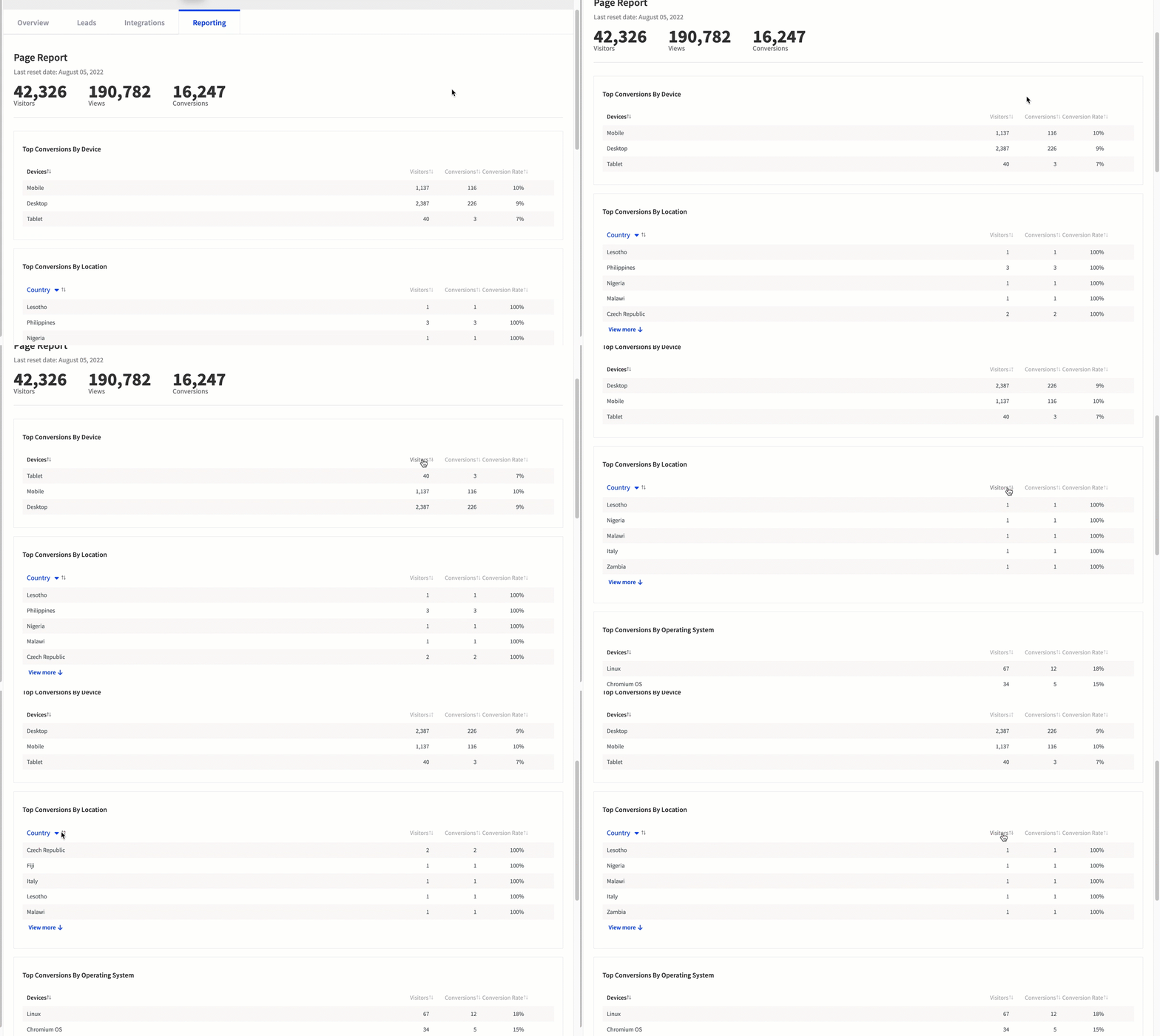
Tools such as heatmaps and session recordings allow marketers to move beyond the "what" and understand the "why." If your data shows a high drop-off rate on a specific checkout page, a heatmap might reveal that users are clicking on a non-clickable image, or that a form field is hidden behind a chat widget on mobile devices.
The Role of Experimentation
The mantra of the modern conversion marketer is: Test everything, assume nothing. A/B testing allows teams to challenge their own biases. By showing two versions of a page to different segments of traffic, the data—not the loudest person in the meeting—determines the winner.
The most successful experiments are iterative. By testing one variable at a time—a headline, a button color, or a hero image—marketers can isolate what drives change. Once a "winner" is identified, it becomes the new baseline, and the next cycle of optimization begins.

Implications for the Future of Marketing
The implications for this data-driven approach are significant. As privacy regulations tighten and third-party cookies fade away, the importance of "first-party" data—information gathered directly from your own site—becomes paramount. Conversion marketing is the engine that collects this data, turning anonymous traffic into known prospects.
Furthermore, as AI continues to integrate into marketing platforms, the barrier to entry for effective optimization is dropping. Features like AI-powered traffic routing mean that even small businesses can achieve levels of personalization that were once reserved for enterprise-level organizations.
Conclusion: The Path Forward
Conversion marketing is not merely a tactic; it is a philosophy of respect for the visitor. It acknowledges that every click is a person with a specific need, and it seeks to minimize the distance between that need and the solution.
By prioritizing the visitor experience, implementing a culture of continuous A/B testing, and utilizing the right technological stack, companies can transform their digital presence from a passive brochure into an active revenue driver. In a digital landscape defined by noise and distraction, the companies that succeed will be those that provide the clearest, fastest, and most trustworthy path to value.
The question is no longer how many people are visiting your site—it’s what they are doing while they are there. It is time to start counting the results that actually matter.