In an era where high-performance, AI-driven engines have redefined the limits of speed and efficiency, the marketing industry faces a fundamental choice: cling to the manual, labor-intensive practices of the past, or embrace the automated intelligence that now defines the digital landscape.
The Google Ads platform, the primary engine of global digital discovery, has evolved beyond the manual levers of its infancy. Today, the platform is no longer just a database of keywords; it is an AI-powered ecosystem designed to prioritize outcomes over inputs. Yet, many organizations remain anchored in the "AdWords era," treating search marketing as a game of granular manual adjustments. To bridge this divide, industry experts—including veteran Google alumni—are introducing rigorous "Maturity Models" to help businesses determine if they are truly AI-ready, or simply riding horses in a world designed for motorcycles.
The Paradigm Shift: From Manual Control to AI Orchestration
For over a decade, search marketing was defined by human intervention. Professionals spent their days "monkeying" with match types, adjusting bids for specific hours or geographies, and meticulously curating negative keyword lists. This was the era of the human operator, where success was measured by the speed at which an agency could make manual changes.
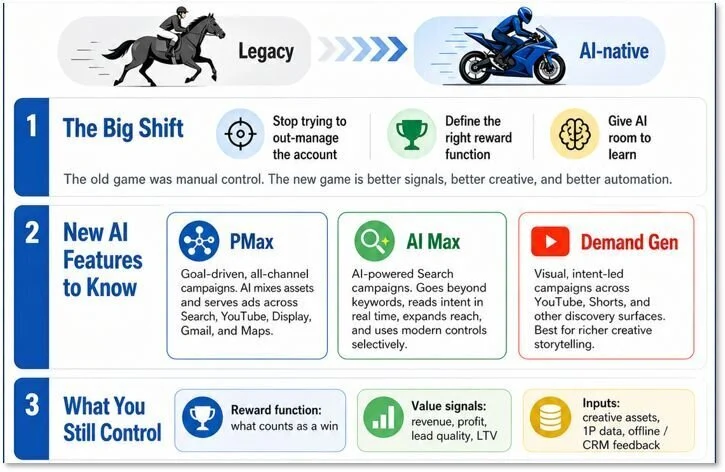
However, Google’s aggressive transition to AI-integrated products like Performance Max (PMax), AI Max, and Demand Gen has rendered these manual tactics not only inefficient but counterproductive. These tools operate on a "reward function" basis: marketers define what winning looks like, and the AI evaluates intent across millions of signals—far beyond the scope of any human analyst—to deliver that outcome.
Chronology of the Transformation
- The AdWords Era (2000–2015): The industry was built on manual control, keyword-focused architecture, and human-led bid management.
- The Machine Learning Transition (2016–2021): Google began integrating smart bidding and automated creative assets, slowly shifting the burden of optimization from human to machine.
- The AI-Native Present (2022–Present): With the introduction of PMax and AI Max, the platform has pivoted to an "embrace and extend" model. The system now prioritizes real-time intent analysis over static keyword matching.
The current reality is stark: the choice to stay in the past is no longer a viable business strategy. By continuing to manually manage accounts, companies are essentially opting for higher operational costs and lower profit margins, effectively "pulverizing" their own ROI in favor of outdated control.
The Maturity Assessment: Scoring Your AI Readiness
To help businesses navigate this transition, a new framework has emerged: the Google Ads Maturity Model. This model evaluates companies on two critical dimensions—Capability and Depth—to determine whether they are effectively leveraging modern technology or merely paying lip service to innovation.
1. Capability Scoring: The Sophistication Metric
Capability is measured on a scale of 0 to 4:
- 0 (Legacy): Manual CPC, heavy reliance on device/hour modifiers, and SKAG (Single Keyword Ad Group) architectures.
- 1 (Basic Automation): Some smart bidding, but still siloed by match type or manual campaign structures.
- 2 (Hybrid): Responsive search ads and partial smart bidding, yet held back by a "control-first" mindset.
- 3 (Modern): Core campaigns use smart bidding with broad matching logic; creative is driven by AI-optimized responsive ads.
- 4 (AI-Native): Full adoption of AI Max and PMax, with human input reserved for high-level governance rather than micromanagement.
2. Depth Scoring: The Breadth Metric
Depth prevents "self-deception" by measuring how widespread these capabilities are across the organization’s actual spend. A company might have one "modern" campaign, but if 90% of their budget remains in legacy structures, their overall maturity remains low. A score of 4 in depth signifies that 75% to 100% of the company’s spend is governed by AI-native logic.
The Six Pillars of Modern Marketing
To achieve a "unicorn" status—a score of 85 or higher—organizations must master six distinct dimensions of the Google Ads ecosystem. Each dimension serves as a building block for sustainable, automated growth.
Pillar 1: Measurement and Value Architecture (Weight: 30 Points)
If a business does not know where it is going, any road will do. AI optimization is only as good as the "reward function" it is given. Companies that optimize for "pageviews" or "basic leads" will consistently underperform against those that feed the AI high-fidelity data like revenue, profit margins, or long-term customer lifetime value (LTV).
Pillar 2: Search Operating Model (Weight: 20 Points)
The modern operating model requires letting go of the need to segment by match type. By moving to broad match and Smart Bidding, companies give the AI the "room to learn." The objective here is to replace manual bid modifiers with intelligent guardrails that protect the brand while maximizing reach.
Pillar 3: 1P Data and Audience Intelligence
How effectively are businesses connecting their first-party customer data to Google’s engine? Modern success requires a seamless feedback loop where offline sales data and CRM insights inform the AI about the quality of the leads it is generating.
Pillar 4: Surface Breadth and Campaign Mix
Legacy marketers often stick to their "channel habits." Modern marketers, however, follow the customer. By leveraging the full breadth of Google’s surfaces—YouTube, Shorts, Gmail, Maps, and Display—based on real-time intent, companies can reach audiences that were previously inaccessible via simple text search.
Pillar 5: Creative and Landing Page Adaptability
AI needs high-quality raw materials. The job of the modern marketer is no longer to write the perfect ad copy, but to provide a diverse array of creative assets—images, videos, and headlines—that the AI can mix and match to find the optimal combination for each unique user.
Pillar 6: Operating Cadence and Governance
The final shift is cultural. Teams must transition from "constant manual intervention" to "intelligent guardrails." This involves setting clear business rules and letting the AI execute, only stepping in to adjust strategy when business outcomes (not auction metrics) dictate a change.
Implications for the Modern Enterprise
The transition to AI-first marketing is not merely a technical upgrade; it is a fundamental shift in business culture. The "old game" was defined by the human’s ability to out-manage the auction. The "new game" is defined by the company’s ability to feed the machine with better truths, better creative assets, and more robust value signals.
The implications for professional marketers are profound. Those who persist in the "soul-sucking" manual labor of the AdWords era are not only risking their employer’s capital but are also devaluing their own professional relevance. Conversely, those who embrace the shift find that their roles become more strategic and more meaningful. By offloading the operational drudgery to AI, marketers gain the time to focus on the truly human elements of the business: brand strategy, creative innovation, and the alignment of marketing output with bottom-line profitability.
Addressing the Skeptics
Some professionals express hesitation, citing concerns over AI "mistakes" or the loss of control. However, the pragmatic perspective is clear: AI is not perfect, but it is demonstrably better than human-only intervention. In the world of performance marketing, the goal is not to be perfect; it is to win significantly more often than you lose. Losing three times while winning thirty times represents a net gain that manual management simply cannot match.
Conclusion: The Path Forward
The goal of the maturity model is to ensure that businesses stop "fooling" themselves. Auditing the top 80% of spend is the only way to get a true picture of one’s position. For those who score in the lower tiers (0–29), the path forward is an immediate transition toward modern value-based bidding and simplified account structures. For those reaching toward the 85+ threshold, the focus becomes optimization and governance.
As the industry continues to evolve, the distinction between those who use AI as a tool and those who allow AI to drive the strategy will become the primary determinant of competitive advantage. The era of the legacy AdWords operator is coming to an end. For those ready to leave the horse-and-buggy days behind, the rewards—in terms of scale, efficiency, and professional satisfaction—are substantial.
Carpe diem. The machine is waiting for better instructions.